

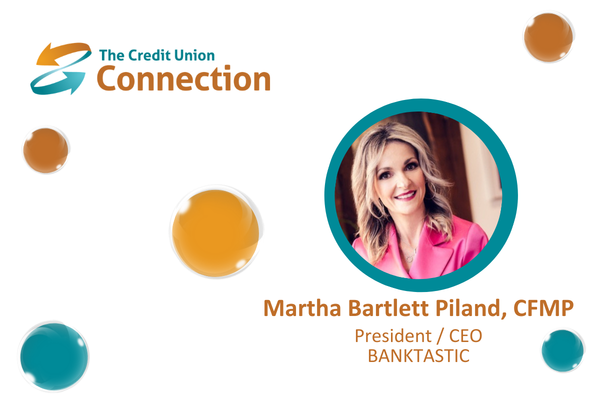
Martha Bartlett Piland, President/CEO, BANKTASTIC
Credit union marketers are getting pitched nonstop: new tech, new “must-have” apps, new AI tools and new ways to automate everything. It’s tempting. Prices are coming down, making what was previously out of reach for many smaller institutions more viable.
But before you sign another contract or roll out another “game changer,” get your foundation right. If you skip the fundamentals, you’ll just spend money faster and confuse more people at scale.
These five things make every new effort more effective because they focus on strategy, tighten the message and keep you from paying to learn the same lesson twice.
1) Get clear on your brand and who it’s for
If your brand positioning is fuzzy, new technology won’t fix it. It will only help you communicate the wrong thing more efficiently.
- Write one sentence that explains why someone should choose your institution over everyone else.
- If you can’t say it simply, your members won’t repeat it, and your team won’t deliver it.
- Define your primary audiences in plain language.
- Identify what you want to be known for and what you should stop trying to be.
- Align leadership on the few differentiators you can actually prove.
PQ: If your copy could have any bank’s name dropped into it, you don’t have brand messaging. You have filler.
2) Build a brand system people will actually use
Most credit unions have brand guidelines. Fewer have a brand system.
A system is practical. It helps people make good decisions quickly, even when Marketing isn’t in the room.
Solidify:
- A simple message hierarchy: your main promise, your reasons to believe and your key phrases.
- A short list of what you will not say because it’s generic, overused or not true.
- Templates that make it easy to be consistent: ads, social posts, email headers and one-pagers.
- A streamlined approval process so you can move without going off the rails. (Remember to include Compliance!)
PQ: Consistency is not a creative limitation. It’s how you build an enduring brand.
3) Tighten your content and channel focus
If everything is a priority, nothing is. And when you try to show up everywhere, your message gets watered down and your team gets stretched thin.
Before you add a new channel or a new tool, make sure you’re showing up powerfully in channels that reach your audiences.
- Audit what you’re publishing and eliminate or fix anything generic or off-strategy.
- Pick a set of channels you can win in, not just participate in (especially valid in sponsorships and advertising channels where competitors can outspend you).
- Match content to the customer journey: awareness, consideration, conversion and retention.
- Build a repeatable process your team can sustain without burning out.
Then, when a vendor pitches a new platform, you can evaluate it with one simple question: “Does it strengthen what’s already working or distract us from it?”
4) Use real evidence, not internal opinions
Before you chase the next tech, research and gather proof about your brand. Find out:
- The actual words members use when they describe why they chose you—and stay with you.
- Where you’re excelling and where you’re falling short in their eyes.
- The moments that create loyalty: speed, clarity, kindness, expertise or problem-solving.
Gather testimonials and short stories that build credibility. Go deeper than “great service,” and “they know my name.” Listen, then turn that evidence into assets.
Your best AH-HAs! may already be sitting inside these member conversations.
5) Nail measurement and follow-through
New tools don’t solve a lack of accountability. If you can’t track what’s working, you can’t optimize and you can’t defend spend.
- Define what counts as a lead, what counts as a qualified lead and who owns the next step.
- Track the full path: source to action to follow-up to outcome.
- Establish a set of KPIs you can review monthly and quarterly.
- Consistently evaluate what’s working, what’s not and what you’re changing next.
If you can’t answer, ‘What did we get for that?’ don’t scale it.
The bottom line
You DON’T need to avoid new technology. You DO need to prepare for it.
Get these basics rock solid and you’ll make smarter bets, move faster and maximize budget. Then when you do add the next tool, platform or app, it won’t be a shiny distraction. It will be a multiplier.
About the author:
Martha Bartlett Piland, CFMP, is president and CEO of BANKTASTIC®, a marketing agency that helps financial organizations build love and loyalty and offers deep branding expertise. Martha can be reached at martha@banktastic.com.