

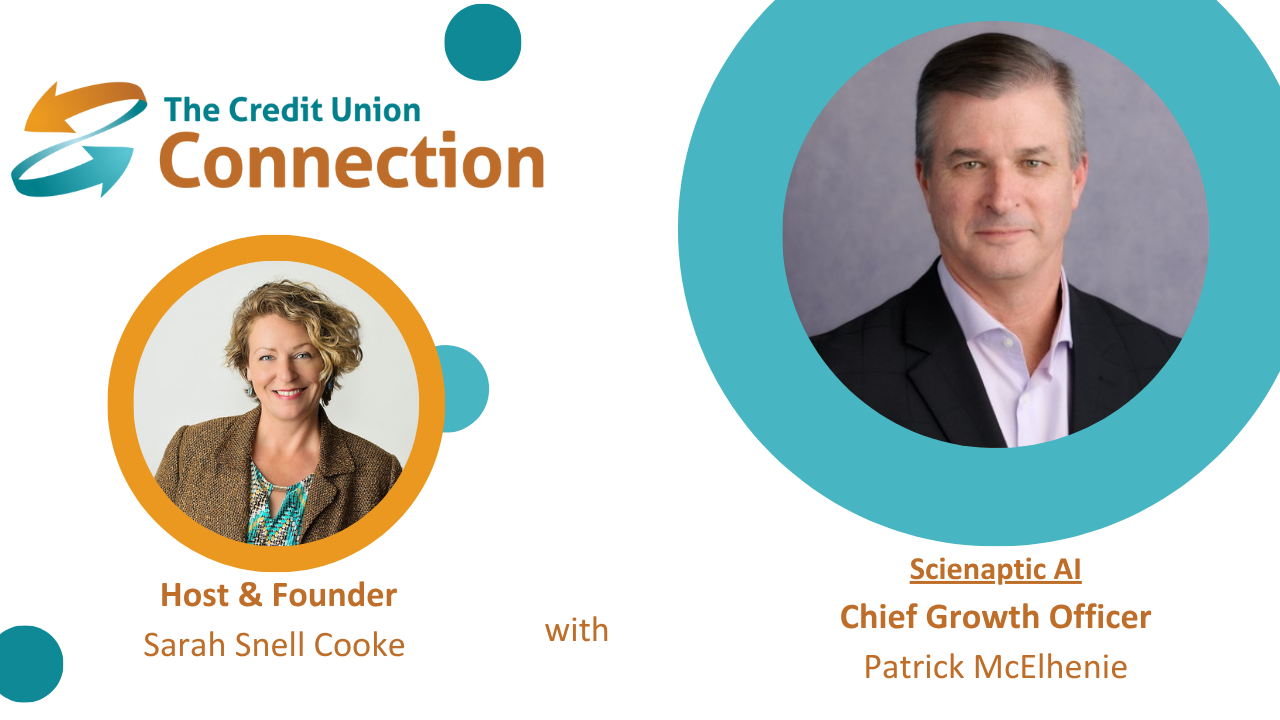
When most people hear “AI in finance,” they think automation, not empathy.
But Patrick McElhenie, Chief Growth Officer at Scienaptic AI, paints a different picture. In his conversation with Sarah Snell Cooke on The Credit Union Connection, he makes it clear: artificial intelligence isn’t replacing credit unions’ people-first values. It’s reinforcing them.
Find solutions related to this content on the Solution Playground. The Credit Union Connection is piloting a partnership with the Solution Playground to assess the benefit of combining content and solutions to quickly move from ideas to action. Learn more about this pilot and review sample solutions related to this content using the following link.
Patrick has spent 25 years in the credit union space and speaks with conviction about how AI can help institutions deliver faster decisions, reach underserved members, and reduce delinquencies. This isn’t theory, it’s happening. One credit union saw $9.5 million in new loan growth and an 87% drop in used auto loan delinquencies after adopting Scienaptic’s solution. These aren’t marginal gains. They’re transformative outcomes.
“AI is making credit unions more credit union,” Sarah observed. Her remark captures the essence of the interview. Patrick explains how AI enables a deeper, more inclusive form of lending, reaching gig workers, thin-file borrowers and younger members often missed by traditional credit scores. With real-time risk signals and alternative data, credit unions can approve more loans, faster, without sacrificing safety or fairness.
Speed and compliance, two long-time tensions in lending, finally find balance through AI. Patrick notes that credit unions can now render decisions in milliseconds using 4,000 data points, all while maintaining full regulatory alignment. Built-in bias monitoring, no-code transparency, and consistent scoring take the friction out of compliance and the guesswork out of underwriting.
What makes this conversation stick, though, is its humanity. Patrick isn’t pitching tech for tech’s sake. He’s genuinely invested in helping credit unions fulfill their mission. Sarah closes by sharing how her own credit union gave her a second chance years ago, an act that led her to serve on its board for over a decade. That’s the heart of it. AI is just helping credit unions do more of what they do best: serve people.
NOTE: The following transcript was created by our robot overlords. It could have a boo-boo here and there.
Sarah Cooke 00:00
Hello and welcome everybody. My name is Sarah Snell Cooke, and I’m your host here at The Credit Union Connection. I’m here today with Patrick McElhenie, Scienaptic AI’s chief growth officer. Welcome.
Patrick McElhenie 00:22
Great to be here. Sarah.
Sarah Cooke 00:24
Great to have you. So, why don’t you give us a little bit more background on Scienaptic AI’s and yourself.
Patrick McElhenie 00:31
So yeah, Sarah, I’ve been working in the credit union industry for, oh, wait 25 years now, so serving in various capacities, primarily with, you know, institutions that support credit unions. Firm believer in credit unions, and in my mind and always thought this way, they are the best financial institution option for any consumer across the country. True Blue, believer in credit unions and that cooperative spirit. I don’t believe there’s any other industry that operates quite like credit unions do, and it’s wonderful to be part of it, synaptic really. What you know, what we do is we provide AI solutions to help credit unions make better loan decisions in an inclusive and in a fair manner. Everyone’s talking about AI. We’ve been doing this for, you know, over 10 years, and our ability to help credit unions serve the underserved, reach those members using AI, using machine learning to basically make quicker decisions, go deeper into their membership, making sure they’re actually connecting with the members that really need their help. Our solution does that, and I can’t think of any other way to truly help a credit union live out their mission, and people helping people, then a solution that’s approving more loans in a safe and inclusive and a fair way. And that’s exactly what we do using AI technology,
Sarah Cooke 02:10
Alrighty. Well, you hit everything. Videos done. Talk to you. It’s all over done, yeah. So, as you said, it’s like AI is making credit unions more credit union. And, you know, it’s a real opportunity, because it’s changing the speed of everything, as you mentioned, this is all about, you know, now, credit unions have to, they have to beat fintech. They have to beat the neobanks to making that offer. It’s not you can wait a couple days, or even sometimes a couple hours, to make that kind of decision and make the offer and fund it. So are credit union leaders open to what it takes to implement AI in their shops as well as you know, what are you hearing, as far as pros and cons from the credit union leaders?
Patrick McElhenie 02:56
Yeah, the openness is absolutely growing, especially post pandemic, credit union leaders and credit unions everywhere just recognize that speed is no longer a luxury. It’s really an expectation and a necessity. I mean, think about you can actually order a product off of Amazon and get it the same day. I mean, so these expectations from a consumer, from a member perspective, absolutely are changing, and credit union leaders are absolutely adopting, yes, we have to be there. It’s an expectation. I mean, pros, right? Let’s talk about pros of AI and what this can do. I mean, it faster approvals. You know, we’re, we’re making decisions on a individual member on with 4000 different data elements in milliseconds. So the ability to render a decision instantaneously is key that really helps also provide less friction in the process. AI provides greater consistency in the process, by all means, and it’s a deeper reach into that membership base. Again, we opened up, helping people right? Reaching those members in an inclusive and fair way. That’s what AI does, and those are the pros that we’re seeing. And doing it with speed. What are the concerns we see? Well, let’s face it, what’s AI is change it’s about change management, right? When you lose manual control of a process that’s been around for 1015, years, that’s a big change. I’m an individual that’s been touching every loan application that comes through, and now it’s all of a sudden, ooh, 60 to 70% of these applications are now being approved. That’s a big change. So we hear a lot about that. A concern would be regulatory compliance, obviously, but we’ll, I’m sure we’ll talk about that later in this interview. And then the concern we hear about with AI that is complexity. Know, let’s face it, every credit union has probably had a frustrating time when they’ve implemented new technology, but through our solution, a no code AI solution, we we can actually explain, through any and overcome all of these concerns you know, that we hear as it relates to implementing AI.
Sarah Cooke 05:21
And is there a type of credit union that best benefits from the implementation of AI? Is it large? Is it small? Is it, you know, ones that are more into business lending or more complex, simpler? Who’s the ideal candidate for adding AI into their strategy.
Patrick McElhenie 05:42
I think every credit union, every credit union, because AI really enables that credit union to fulfill their mission. Yeah, a credit union mission always is going to be about their member and how they’re helping their members, how they’re making their members life better, and again, through an inclusive and fair way to extend more credit in a safe way for the credit union, everyone can benefit from that. So I don’t think there’s any credit that shouldn’t be using this type of the solution eventually. Now we have to be real. You know, there are some very small credit unions out there, but I do believe that this is a solution, and we’re going to see this solution continue to scale in the marketplace, and so you’ll see more and more credit unions having that so I wouldn’t say it’s for one particular type of, you know, segment of the credit unions. I think it’s for all credit unions.
Sarah Cooke 06:39
Yeah, I mean, and that makes total sense, especially like the larger ones need to be able to handle things and maybe not add so much head count. Or the smaller ones already don’t have the head count, so they need somebody to as well. But I also think the compliance point is important too. I would think you know, you’re taking it in a loan application that AI doesn’t miss, whether a field is open or not, or filled or not, or that application you know, or, for example, following fair lending you know, things like that, that I feel like it seems like credit unions would be better off compliance wise.
Speaker 1 07:16
Oh, absolutely. I mean, if you think from a compliance perspective, you know, our solutions are, all are fully FCRA aligned, ECOA aligned. We have bias monitoring in there. We have adverse action and reasoning. So from a compliance standpoint, they’re very defensible. And you know, all of our clients receive, you know, 100% scores when they go through an audit, or when they meet with regulators. So in fact, because of the transparency of AI and everything that we provide, it makes those actual events easier.
Sarah Cooke 08:00
Those adverse action reports are super important for compliance, and we’ve been, you know, we’ve been using credit scores for like, 50 years now, which is amazing. I didn’t realize they didn’t exist before then, until relatively recently, and we’re beginning to incorporate alternative data into that process too, and so AI is a significant part of that that makes it possible and faster and cheaper and easier. Absolutely. What does that mean for underwriting? We already talked a little bit about compliance, and then also loan approvals versus rejections.
Patrick McElhenie 08:36
So if you think about, you know, a recent study says that 45 million Americans are aren’t served by a credit score, and credit scores alone can miss up to about 40 million Americans, especially those that are focused on the gig economy, those that might have a thin file, and those that are the younger generation that are still trying to build credit. Traditional credit scores miss these individuals, and that’s where AI comes in. Because, you know, we kind of we, we call it contextual underwriting. So what we do is we can bring in alternative data, and, you know, we can start to layer, then you know, what are some of the transactions? We see historical transaction for this particular member. We can look at utility bills. We can look at rental payment history. What this does? It builds a, what we call a 360 degree view of that member or that individual, and then that allows for truly that inclusive and fair decision to be made. And again, layering all of this data in it’s done in milliseconds, right? But we’re able then to reach those that have been missed by that traditional credit score. And that’s what makes this so. Impactful, because that’s truly again, goes back to and I’ll say it again and again, a solution that truly helps the credit union meet and fulfill their mission. That’s what this is about, you know? So we’ve got compliance covered, we have underwriting covered, and we’re helping credit unions reach those members that they may not have been reaching otherwise through traditional credit scores. I mean, that’s, that’s what we’re passionate about. See, I get kind of worked up about that’s what, because that’s what we do. And when you can take that solution and say, and I may have a positive you can go to data that says we’re helping you fulfill your mission. I mean, intrinsically, that just makes you feel good, right, as a person, but it also makes you feel really good as an organization.
Sarah Cooke 10:49
Absolutely, I can totally see that, and I love that you’re so into like credit union said, so many vendors just want to sell a credit union widget, and it seems like you guys are really working to be partners and understand credit unions. I mean, obviously you came from the credit union space, so very cool. And so what sort of data do you have to show that AI is improving the quality and quantity of loans for credit unions and maybe reducing charge offs? Because right now, collections are going to be big. It seems like
Patrick McElhenie 11:21
in that way, absolutely. So, you know, we are an AI company, so we do have a lot of data, so I don’t bore you too much data, but let’s talk. We can talk about approval rates, because that’s important, and we can also kind of touch on delinquencies as well. You know, what we’re seeing is that our clients typically see about a 25 to 50% higher approval rates when they have actually implemented our solution, and that’s across an entire consumer loan portfolio. Again, because using the data, looking at that 360 degree view of each individual, we’re able to look at elements that you know, traditional sources aren’t able to look at. So we’re seeing approval weights anywhere from 25 to 50% greater. But what’s even cooler is we’ve seen a reduction of about 20 to 45% in delinquencies because of better risk differentiation. You know, we’re looking at behavioral data, and we’re looking at alternative data, and because of that, you know, we’re able to look at that risk differentiation in a different light, and then we’re able to see that reduction delinquencies around 20 to 45% we have a credit union, a large credit union in Colorado, that is a great client of ours, they saw $9.5 million incremental loan growth across their consumer loan portfolio. At the same time, they saw 60% sorry, 66% automated approvals. Think about that. All of a sudden, you have a group of people that now don’t have to touch every loan, but they can just truly focus on the ones that are important. They can really take their time and strategically focus on the members that do need that special treatment because of the increased automation, they also saw an 87% drop in delinquencies, like in used auto loans, but then a 47% overall drop in loan losses within their entire consumer portfolio. Wow. Another large credit union in Arkansas. You know, same thing, 63% increase in automation and a 24% drop in loan losses across an entire loan portfolio. I mean, it’s just you see that, and that’s the day that makes you feel good, because then, you know, you’re living out you’re helping that credit union fulfill that mission. So it’s very satisfying. And you know, again, it goes back to a lot of the time we hear, Oh, AI is going to it’s going to drive this and drive that it’s going to drive increases. Absolutely it does, but at the end of the day, we’re actually enhancing the individual that’s doing the work, because we’re releasing them from some of the manual tasks that maybe they were doing again to focus on more strategic activities and really focus on The members that might need their help. So AI isn’t replacing underwriters. It’s actually enhancing their job and making their job easier and making their job more strategic.
Sarah Cooke 14:29
Absolutely, and some of those people, like he’s mentioned, the ones on the the the formerly gray area, I guess, of whether you approve them or not, those people might be the ones who also need that extra time. So absolutely true. Return to the member for sure. And so right now we talked about delinquencies a little bit. Delinquencies are in on the rise, and that means financial difficulties for many credit members and potentially eventually credit unions, right? Okay, we saw that. No, 809, yes. But how are credit unions adjusting for the current uncertainty? I need
Patrick McElhenie 15:09
credit unions now. What we see are they’re shifting from kind of this static to dynamic risk management. And what I mean by that is using AI in a proactive or preemptive way, because AI can look at kind of behavioral, behavioral patterns, and we can look at cash flow incident, you know, like real time cash flow, these risk signals are created real time, and those risk signals, then can help a credit union really be proactive before a member starts to get into, you know, delinquencies, and start goats into, you know, getting into trouble. They can reach out to this member and they can maybe, okay, maybe we need to do loan restructure, or maybe we do need to prioritize some of our collection activity so you know that someone doesn’t necessarily, you know, go into default. That’s what AI can do. It’s that provides that proactive ability for credit unions to, you know, reach out and work with individuals to avoid, you know, something that maybe you know that could be avoid because of, you know, again, loan restructures, those types of things. I think that’s where you’re seeing the ability of delinquencies going down. Because now, where it’s real time data, it can be pre preemptive, and we’re taking proactive credit. Could take proactive behaviors. I mean, I think it’s, it’s awesome,
Sarah Cooke 16:39
yeah, and that that goes to my next question, how does this deepen the member relationship and the experience for the member too?
Patrick McElhenie 16:47
Yeah, I mean, let’s think about what makes someone loyal to an organization. I think when they’re treated fairly. I think when there’s less friction in the process. I think, when there’s trust in the process, number one, and those are some key elements to deepening a relationship, because we want things to be easy. And when I can get an instant decision on, you know, a credit application or a loan, I love instant gratification, like many people, so I get an answer yes right away. That’s great. I think that builds trust. It makes things easy and but it also AI also helps personalization, because of the amount of data we’re looking at, because of some of the other solutions we can offer in terms of, you know, looking at a member’s profile, and we can offer the right product at the right time, at the right price, and that’s but it’s based on personalization. So what that does then, all of a sudden, now you’re creating this emotional connection. Now you’re creating this financial connection, and you start having that type of emotional connection with, you know, a credit union, or any other, you know, vendor you work with, or any other of your partners as a member, that’s going to be drive loyalty. That’s what it does. So I think that’s, you know, that’s great. And again, I mentioned this earlier, but it’s all about inclusivity and fairness. You know, our solution really is looking at, you know, how can we reach those members in other, you know, in protected classes that need help as well? I think that truly builds loyalty, and I think that truly shows that, you know, as as an organization, we care about the community that we’re operating in. You know, when we’re able to touch all those different classes of people that you know may not be getting credit or are getting credit at places we don’t want them to go, you know, we don’t want them to go down to the payday lender, right? I mean, so we’re able to help that too. So I think it just drives loyalty, and that drives that connection, and that’s just going to spur more growth for the credit union long term.
Sarah Cooke 19:02
Yeah, yeah. No, when my husband and I were young and dumb, we got in a little bit of debt, and our credit union helped us out with an equity loan on our house and to pay down some higher interest debt. And I ended up serving on the board of that credit union for 12 years. Kind of like to as a give back. And so I feel like people do definitely connect more when you know they’re given that second chance that I wouldn’t have, I wouldn’t have given us a lot, but yeah, they, they are definitely more willing to give you that second chance. So anyway, we’ve talked about a range of issues today that relate to AI. So what would you like to leave our audience, our credit union audience with, what’s your final thought?
Patrick McElhenie 19:49
My final number one, AI, doesn’t replace a individual. It doesn’t replace a human. It actually enhances their job, makes their job more effective and more efficient. And allows individuals at the credit union to actually do what they’re supposed to do is people helping people. Our solution is about fair and inclusive lending, and we can help institutions actually do more with less. I think that’s really important, because now all of a sudden, with automation, they’re able to serve more members, and they’re able to do it with confidence, and they’re able to do it in a way that’s going to drive loyalty, and just at the end of the day, drive more growth. So we know that over the next few years, AI is going to continue to kind of help define the industry that’s going to be more and more readily available. You know, we were kind of one of the first to market, so we’re excited about what we can do for credit unions, and just know that any I provided you work with make sure they do it in a fair and inclusive way. That’s what we do. And we just love working with credit unions, and we love helping credit unions fulfill their mission.
Sarah Cooke 21:00
Absolutely awesome. Well, thank you so much for your time today, Patrick, I appreciate it.
Patrick McElhenie 21:01
All right, it was great to be here. So thank you. Thank you.