

“This is bigger than banking. This is about paychecks, communities, and the strength of our nation. Our fellow Americans are counting on us.”
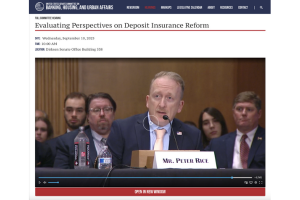
Today, during the Senate Banking, Housing, and Urban Affairs Committee hearing, “Evaluating Perspectives on Deposit Insurance Reform,” Hanscom Federal Credit Union President/CEO, Peter Rice, addressed Committee leaders on behalf of all credit unions across America and overseas. Rice warned that implicit protections for the largest banks create dangerous ripple effects—driving deposits away from local financial institutions, starving small businesses of credit, and undermining the defense supply chain.
“When their payroll is at risk, America’s stability is at risk. When their local banks are weakened, Main Street is weakened. And when small businesses stumble due to corporate greed, our national security stumbles, too.”
Rice recounted the collapse of the Silicon Valley Bank, which lost “a quarter of its deposits in a single day,” with Signature Bank and First Republic following soon thereafter.
“Depositors moved roughly $119 billion out of small banks in one week—double the previous record—while the largest institutions saw inflows. Per JPMorgan’s analysis $550 billion moved to big banks and money funds during the crisis. This wasn’t about better interest rates. It was about confidence. Americans believed the biggest banks were safer.”
Multiple studies, Rice stressed, show that Americans fled smaller institutions even when big banks offered no better returns. The result: confidence is now equated with size, eroding the foundation of community banking.
Impact on Small Business — and National Security
Rice reminded that two-thirds of small businesses depend on local and regional lenders.
“When confidence drives them to move deposits to Wall Street, communities lose credit, payrolls become unstable, and our defense supply chains grow brittle. We’ve already seen the cost.”
He cited recent examples of significant fallout:
· In Lindsay, Oklahoma, the 2024 failure of a community bank left local manufacturer Brandon Conner of C-Star MFG with a $150,000 uninsured loss—payroll funds lost in real-time.
· When SVB collapsed, Patriot Software in Ohio had its accounts frozen, leaving 8,100 small businesses without payroll access. One of Chicago’s small businesses, “Fry the Coop,” missed paychecks for 227 workers.
“For those workers, this wasn’t a debate about liquidity or systemic risk. It was rent, credit card bills, and groceries that couldn’t be paid. And I can’t help but wonder who paid their late fees?”
Rice’s testimony called on Committee leaders to recognize the urgency to secure payroll accounts for all Americans.
“So far the only message we have sent to Main Street has been clear: if you’re big, you’re safe; if you’re local, you’re at risk.”
Rice also bridged the discussion to evaluate risks posed to national security, with DoD depending on small businesses for critical parts, innovation, and supply chain resilience, reflected in over $80 billion annually through direct defense contracts and $59 billion through subcontracting agreements.
“History—from the 1980s savings and loan crisis to the 2008 recession—shows that when small banks fail, small defense suppliers often exit the market. That weakens our industrial base and ultimately our deterrence.”
Solutions Credit Unions Propose
Rice outlined six targeted reforms for Congress to protect communities, payrolls, and supply chains without encouraging reckless risk-taking:
1. Targeted coverage for business payment accounts. Protect payroll, payables, and tax deposits—without blanket coverage for all accounts.
2. Price risk properly. Require higher insurance premiums from banks with heavy concentrations of uninsured deposits.
3. Strengthen mid-size bank transparency. Mandate faster reporting and stress testing for $50–250B institutions.
4. Standardize reciprocal deposit protections. Safely spread balances across multiple banks for small businesses.
5. Clarify the systemic risk exception. Establish clear criteria to reduce uncertainty and favoritism.
6. Protect defense supply chains. Direct DoD to provide emergency financing when bank failures jeopardize payroll or contracts.
“The challenge is balancing stability with avoiding moral hazard. Blanket guarantees calm panic but encourages reckless behavior,” Rice noted. “The crisis taught depositors a simple lesson: size equals safety. That perception drained community and regional institutions, leaving small businesses—and even our defense base— exposed. Let us not ask what small businesses can do to survive our financial system—let us ask what our financial system must do to ensure small businesses, and the nation they sustain, will endure.”
“This was a pivotal moment for credit unions to bring this perspective to the center of key discussions that impact not only their members but also small businesses they serve across America,” said Anthony Hernandez, DCUC President/CEO.
Jason Stverak, DCUC Chief Advocacy Officer, added, “We are grateful to Senator Elizabeth Warren for providing Hanscom Federal Credit Union the opportunity to bring the credit union voice to this critical discussion. We look forward to continuing to champion credit unions and advancing policies that protect and strengthen their service to their local communities and members.”