

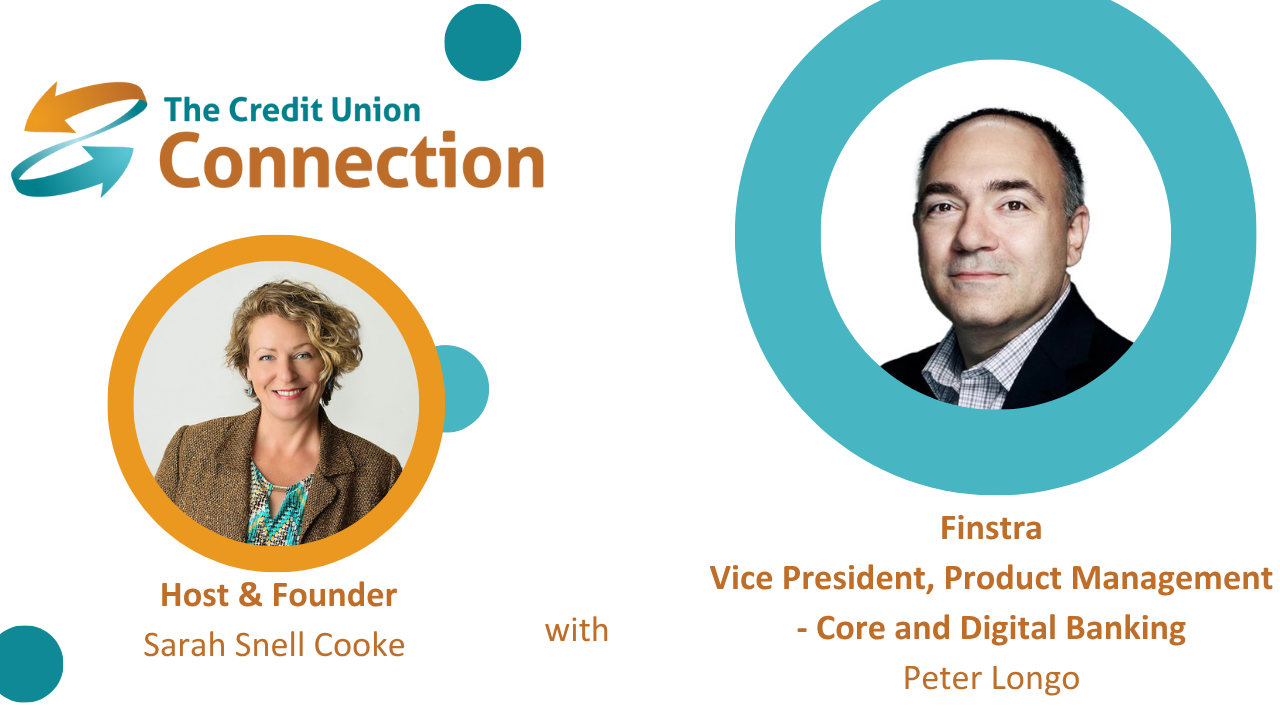
“Can someone sitting on their couch, annoyed with their bank, become a new credit union member in the time it takes to watch a Hulu ad?”
That single question from Pete Longo does not just linger – it reframes the entire conversation about how credit unions compete in a world shaped by instant digital gratification. In his conversation with Sarah Snell Cooke on The Credit Union Connection, Pete points away from rate wars and toward something far more disruptive. The real competition is not only big banks. It is lifestyle platforms that members already trust and use every day.
As Sarah explores how deposits are shifting across generations and digital behaviors, Pete points to a growing divide between financial institutions and lifestyle ecosystems like Starbucks, Venmo, and Cash App. Convenience, ease, and familiarity are becoming the deciding factors, and members are choosing tools that fit into their daily routines without friction.
Credit unions do have an advantage when it comes to mission and member focus. According to Pete, the next step is applying that strength through hyper-personalization that mirrors how people interact with technology across all areas of their lives. If Amazon, Instagram, and mobile ordering apps set the bar, then digital banking must feel just as natural.
Sarah presses on whether purpose can keep pace with convenience. Pete believes it can, and suggests that credit unions blend their human roots with modern journeys that are simple, fast and familiar. Trust is still the asset, but it has to be paired with effortless onboarding and daily use that fits modern habits.
Credit unions do not have to change who they are. They only need to change how they show up. And rates aren’t the only thing members want to see.
NOTE: The below AI-generated transcript to the video might not be 100% right, but are any of us really?
Sarah Cooke
Hello and welcome everybody. I am Sarah Snell Cooke your host here at The Credit Union Connection, I have a lovely, lovely guest today, Pete Longo, welcome.
Peter Longo
Thank you, Sarah and thanks for having me.
Sarah Cooke
And Pete is the Vice President of Product Management at Finestra. So, Pete, tell us a little bit more about yourself in Finestra. Sure.
Peter Longo
Thanks. Sarah, well, I’m a former banker, so financial services executive for about 15 years prior to becoming a technologist, I was in startup FinTech world for a few years with a couple high growth startups, and then came over to Finestra a little over four years ago to lead our core and digital banking products. I also added our analytics products under my remit over the last couple of years. So super excited to help credit unions grow here in the US with our open banking platform.
Sarah Cooke
Yeah, awesome. So as right now, of course, deposits are tight, and they have been for a few years, a little bit up, little bit down, but mostly tight. So as that continues to intensify, most discussions have been centered around the high yield the credit unions losing accounts to high yield accounts to the big banks. However, you know, I think, I’m sure you, you think, given your position, that it’s really going on more at the FinTech level and the Neo banks, and if you could discuss a little bit more how the nature of deposits are changing and that that battle for them. Sure.
Peter Longo
I completely agree. You know, I believe, five to 10 years ago, it really started with the digital only banks, right? The chimes, the simple banks of the world, of arrows, etc. And now it’s kind of more. There’s more of those, right, affinity banks or niche banking, but it’s also morphed into these lifestyle apps, right? The Venmo’s, the cash apps, even the Bank of Starbucks, as I like to call it, right? Was an early adopter into it. So there’s all this competition for low cost deposits and high yield savings, all that jazz online and digital world, right? So it’s really about providing the gap fill for digital first experiences that the current consumer member of the credit unions really seeks. So I think it’s evolved into what it is today, which is, which is a big challenge to our credit unions in the US.
Sarah Cooke
Yeah, and as those consumer preferences are splintering, and it’s not just the young people, although I know my kids, my brother even, who’s two years younger than me, then mow me the money, whatever. But so it’s not just the younger ones. What can credit unions do to keep up or even get ahead?
Peter Longo
Yeah, so I think, and I tell my team this all the time, I believe it’s really centered around hyper personalization, right? So having a technology partner, or technology partners that allow you to really craft your messaging and the journey to be as frictionless as possible, right, just like these competitors air quote in the lifestyle apps and fintech solutions do. So, you know, gone are the days where we just provide a snazzy UI UX experience for a credit union member, and today, it’s about where do we meet them, and how do we meet them in the experience, so that we create journeys that are similar to them and what they’re using, even outside of financial services, in not just A PayPal but an Amazon shopping experience, you know, Instagram, Shopify, Wix, all these experiences that they may be using in their personal lives or business lives. We have to emulate that experience for our credit union partners on the technology side. So that’s where I think things need to go, and are starting to go, and then also meeting that member with the type of features and functionality that they really need. So sometimes credit unions and community financial institutions, they get really focused on providing this whole breadth of services. And in reality, what you just described, Sarah with your own family, is sometimes people just want to send money or store money or spend money, right? There’s only really three or four main things that people want to do conveniently on and on and on and on. So really being able to put those at the forefront and do it in a simple and. An easy to execute way.
Sarah Cooke
Yeah, no, that totally makes sense. And what I’m hearing from you then is it’s not so much about the AP wise, although that’s still important, but it’s about the experience and that widening gap between the traditional, more traditional user phase interfaces and the expectations of these youngins. And that evolution too less more about the experience care. There’s this whole generations that care more about the experience.
Peter Longo
Yeah, so obviously, another situation that many of our credit unions are dealing with is the generational transfer of wealth. Right? Those previous generations were more concerned with insurance and protection of their assets and having someone to talk to in a member center or branch. This generation that’s inheriting this wealth or growing the new generation of wealth is concerned with ease of functionality, security and online standards, or at least the assemblance of security right to make them feel comfortable, and being able to do this while they’re watching Netflix or Hulu on their couch right when you go through Starbucks or the Dunkin Donuts line, you can deposit money into that virtual account in five seconds, and it feels secure and easy and they do it, and that that wealth, whether it’s $5 or $5,000 tends to stay there until they execute the spend or the move right to their brother or sister or the point of sale that’s taking their money to Get their goods and services. So I really think that’s what this generation of wealth builders is concerned with, right, ease of access, security. It’s there when they need it, and it’s very reliable, right? They don’t want the spinning Circle of Death or out crashes, etc, right? Whereas the previous generation, they didn’t really necessarily do those type of transactions every day, and they were more concerned that they could call Sarah or Pete and talk to them, or walk in and see them and see it on a screen or a piece of paper. Not the case today.
Sarah Cooke
Yeah, talk a little bit more about this aging out of the traditional financial institutions, which of course, includes credit unions, because craniums are so mission focused that, you know, they should be a no brainer for millennials and Gen Z, but it doesn’t seem to be the case. Talk a little bit more about that. Yeah.
Peter Longo
So, so the generations, needs, wants and desires have changed as far as financial services, right? Like I mentioned before, and to reiterate, it’s really about the experience and the convenience, and less about the whole suite of financial services. They still want that. When they want to buy a house, they want to know that their credit union can do that. Or when they go to buy a car or an RV, they want to know that their credit union can do that. But when it’s not applicable on a Tuesday, they just want to be able to log in, check a balance or execute whatever they need in a way that feels familiar to them, and that is not necessarily the traditional member experience. It’s the Amazon experience, right to where they can just go in, log in with their face ID or biometrics easily and do what they need to. And maybe it’s 30 seconds, maybe it’s two minutes, but without a lot of hiccups, and to feel comfortable doing it on a mobile device, predominantly, especially in the consumer credit union space, or maybe it’s an online situation on a laptop for a small business while they’re traveling on an airplane or, you know, in their car, wherever they might be. So it’s really about that experience, emulating what they’re really spending the bulk of their lives using technology?
Sarah Cooke
Yeah, no, because they’re using that every day, multiple times a day. That’s the brand in front of their face all the time, and credit unions need to fight to be that brand in front of their face all the time. It’s no longer necessarily the credit card or what have you. So that’s correct, yeah. Where do credit unions fit in? How can they build the same or better experience?
Peter Longo
Well, you know, I think the big advantage potentially that credit unions have is to your point earlier, they are incredibly mission and member focused, right? So just pivoting that focus to say we’re still going to focus on it, but we’re going to use technology a little bit differently, outside the box of traditional financial services, and maybe doing things like embedding social media workflows where and journeys where applicable into the financial services experience or community based functionality right into that. That digital banking application, where we are capturing more of the experience and time when needed for the new generation of depositors, I think that is potentially a big advantage, because credit unions tend to know their core demographic of their members very well, and they are hyper focus, so it lends naturally to using technology to do hyper personalization right, and giving the member what they want, when they want it, and how they want it for the for the purpose of financial services.
Sarah Cooke
Okay, okay, I think you also touched on my next question, which is, where can they win? Alan, have you anything to add about that?
Peter Longo
Well, you know, I like, you know, I’m gonna use a buzzword, but I like the convenience factor of a frictionless journey, right? So I, when I was a bank professional, I always used to say this to our, to our other executives or compliance team across the board, right? Product folks, is, if someone is sitting on their couch and they’re upset with Bank of America and they know credit union XYZ made a good impression on them, can they be onboarded to be a new member and deposited in a frictionless way while they are watching that ad on Hulu, or while they’re watching YouTube? If they have to get off the couch to get a checking account number or get a debit card number or something to that effect. They’re not making the switch, right? So it’s got to be frictionless. It’s got to be as easy as onboarding to Venmo, PayPal Cash App, etc, basically, yeah, you can do it with their face and their thumb, and it makes them feel secure and easy while they’re on their couch. You know, watching Netflix. That’s the change effect, right? That’s where we need to go.
Sarah Cooke
Yeah, yeah. So, lots of great information here. Appreciate your time and your insights that you’ve shared. Any final thoughts you want to leave our credit union audience with today.
Peter Longo
I would just say, look at sometimes it seems insurmountable, and it seems some of these challenges are, you know, a big dark cloud over the traditional credit union growth model and experience to impact your members. But it’s not there’s partners out there with open platforms, with great next generation banking experiences that can help you evolve and survive and thrive with the advent of these new competitors outside the traditional space. So we’re here for you, and I do think there’s a path forward.
Sarah Cooke
Yeah, awesome, always a path forward for credit unions. Thank you so much for your time. Pete, appreciate it.
Peter Longo
You got it. Thanks for having me. Have a great day. You too. Bye.