

“Sometimes you take a vitamin. Sometimes you need an Advil.”
It lands as a joke, but it sticks because it captures something uncomfortable and familiar. Credit rarely feels urgent until it suddenly is. And by then, it’s often the thing standing between someone and their next move.
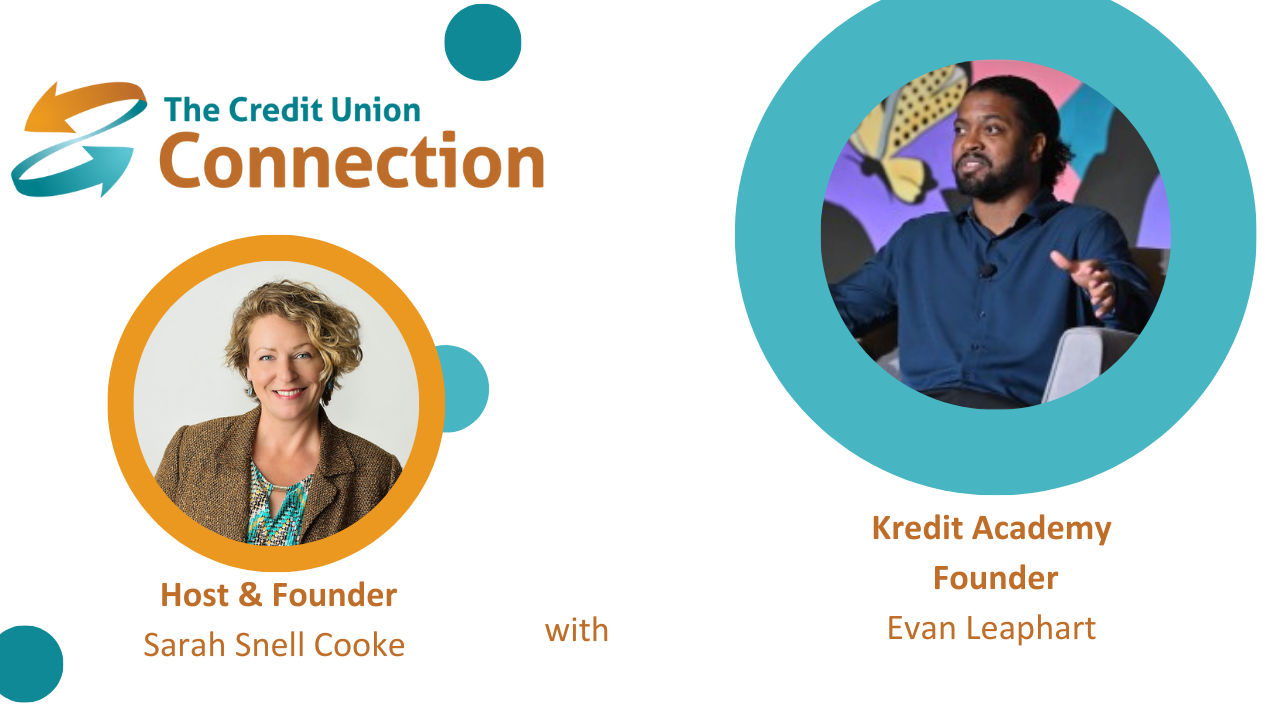
That idea surfaces early in a conversation between Sarah Snell Cooke, host of The Credit Union Connection, and Evan Leapheart, founder of Kredit Academy. What starts as a discussion about financial education quickly shifts into something more human. Shame around credit scores. The invisible barriers faced by people who did nothing reckless, just uninformed. The quiet power a three-digit number holds over opportunity.
The more they talk, the clearer it becomes that this isn’t about teaching people to budget better. It’s about access. About why credit is so often misunderstood, emotionally loaded, and left out of the broader financial wellness conversation. And why credit unions may be uniquely positioned to change that dynamic.
Watching the full interview, Evan’s openness stands out. He doesn’t talk like someone who solved credit once and moved on. He talks like someone who’s lived the cycle, rebuilt and understands why so many people feel stuck before they ever start.
Sarah brings the conversation back to something credit unions know well. Money decisions are rarely just financial. They’re about families, second chances and momentum. Rates matter, but context matters more.
There’s also a subtle challenge embedded in the discussion. Education doesn’t stop when the workshop ends or the loan closes. The real influence happens in the quiet space in between. That’s where trust is built and where understanding either compounds or fades.
It’s a short conversation that opens up a much bigger one, and it’s worth hearing it unfold in their own words.
NOTE: AI is human, so it ain’t perfect. This transcript will have errors; it will receive its punishment later.
Sarah Cooke
Hello, welcome everybody. My name is Sarah Snell Cooke. I’m your host here at The Credit Union Connection. I’m joined today by Evan Leapheart, welcome.
Evan Leapheart
Thank you for having me.
Absolutely. Evan is with Kredit Academy. Tell us a little bit about yourself and the Kredit Academy.
Evan Leapheart
Well, simply put, I started this because I was the use case Kredit Academy centered in financial education, but a little bit about myself. Was born in Pittsburgh, big Steelers fan. That’s tough thing to be when you grew up right outside of Baltimore, so pretty much all my friends, yes, are Ravens fans, and so there’s two weeks out of the year we don’t talk, sometimes three. And then when I turned 18, I moved to Miami, went to warmer pastures, and kind of spent the last 2020, years out there. But always been an entrepreneur, but like many, I was the kid that turned 18 got a credit card right away and maxed it out and spent my whole 20s paying for it. So always been an entrepreneur, but in my 20s, it was tough to get a loan or line of credit because I made dumb decisions, and then I effectively said, you know, how can we change that? So I started out on this journey building the vitamin to the issue, and kind of grew up a little bit as a company and also in the age that we serve. So now we’re a bit of the pain pill with our core product credit quest.
Sarah Cooke
So pain pill, huh? For the for those of us with arthritis in our knees.
Evan Leapheart
Sometimes you take a vitamin, sometimes you need an Advil.
Sarah Cooke
I think I’m on double dosing right now. So, yeah, we used to be neighbors. I forgot about that. Practically, neighbors, indeed, good old Columbia. Yes, Columbia, Maryland. So, yeah, I love and credit unions love, obviously, financial wellness, financial education. And in particular, you focus on credit. And it’s such a piece that maybe I feel like is ignored, because everybody’s like, Oh, budget, save and then put some money aside that you can donate. And that’s kind of like budgeting typically, for, at least for younger people, the starting point. So like, talk a little bit about why you’re focused on credit. I mean, you mentioned your personal situation, but also, I mean, there are millions who have done the same thing.
Evan Leapheart
Yeah, yep. So that’s a status spread grown since I last said this, but over 90 million adult Americans are considered credit challenged. But yeah, no. I mean, effectively, why we focus on credit is, when you think about wealth building in our country, there’s kind of two components. It’s either ownership in a business. Equity in a business doesn’t mean entrepreneur. You just own a decent amount of stocks, or ownership in a home, right? But the biggest barrier to being able to get a loan, a line of credit for your business, or being able to obtain a mortgage a lot of times is that credit score, and it’s not always rooted in bad reasons, right? You could have somebody that’s coming to this country where credit wasn’t a thing and they have tremendous financial habits, right? I don’t spend more than what I have. I live within my means. I have 40% down to buy this home, but I’m credit invisible. And or you could have a more unfortunate circumstance where you have somebody that might have been incarcerated and when they were younger, and they come out in this system, and they just don’t know what’s going on, right? So it’s one of those things that’s taboo to talk about finance, just in general, is but when you go into credit there’s a lot of there’s a lot of shame or pride associated with what your number is, and so we just kind of want to remove some of that stigma with it. So we talk about all things financial education. But that’s like, kind of the we call credit mastery, like the end boss in, you know, financial comprehension.
Sarah Cooke
And I like that? You brought up the idea of the feelings around money. One of the things that that I know a lot of people talk about is credit unions are often advertising their rates, and rates are important absolutely but I mean, it’s so it means so much more than that to the person getting the loan. Or whatever it could be life saving. It could be life changing. It could be, you know, helping them get their kid, you know, buy a new car, so then get their kid to soccer practice. Whatever it is people have a lot of feelings around their money because of, not because of money, but because of what it does for them. And so anyway, yeah, talk a little bit about that, connection the feelings and the mental health, emotional side of money and credit?
Evan Leapheart
I mean, when you think about your credit score, right, starting on the negative side, right, like there’s a lot of shame around things that you may not have known. Right? Like you didn’t understand that you had this $1,000 credit limit and you shouldn’t spend more than $300 of it, at least when your statement reports, it shouldn’t show more than that. And so you internalize that, and think to yourself, like, man, like I’m messing up. I’m not making the right decisions, right? And, and I think just, you know, our capitalistic society, right? Like it’s we kind of measure folks based on, you know, where their ranks are financially. So it’s a lot of things that people keep to themselves, and it shouldn’t be that way, right? I’m always transparent about my score, right? Like I had terrible credit, then got it to great credit, and then launched the business and maxed out cards, and, you know, saw a dip again before I brought it back up, right? So, but I’ve never, not never, but like once, I started to understand that this is something I just didn’t know about. I started to be more transparent with folks about what’s going on, and the more relatable you can be. So it’s not just about speaking about these things. We try to make our products have that same sentiment. You know, people get more comfortable and give themselves a break, right, to not feel so much shame and say, you know, I’m human. I made a mistake here. But, you know, my credit score is not final, right?
Sarah Cooke
And it’s, you know, the number is information, is data that you can intake. It doesn’t measure you per se, which I think, yeah, it’s like, you know, age, weight, whatever, all the numbers that we judge ourselves by, right? Yep, but you’re young. You don’t care about the age part.
Evan Leapheart
I celebrate 40 next year.
Sarah Cooke
Oh, well, I’ll be 50.
Evan Leapheart
We’re still under the half a century mark, both of us.
Sarah Cooke
That’s right, that’s right. We’re technically young, so you work with banks and credit unions, but yes, so many fintechs in particular, just well, and maybe this is a little bit in the past, but it’s changing. Now. They’re moving towards serving credit unions. I feel like, in the past, it’s like they’re too people would think they were too slow, not tech savvy enough. You know, all the all the things that we all have heard in the past, but it does, I do feel like granny has, maybe have turned a corner and even leapfrogged some generations of technology, especially like the all the hype that AI gets or has gotten in the last two years. Why do you choose to work with credit unions?
Evan Leapheart
There’s a lot of mission alignment, right? If you think about what credit unions are all about, right? I was at a conference earlier this week, and I talked about people helping people, right? And that’s effectively the spirit of what a credit union is. I think that’s why you’re starting to see more fintechs come around and start to try to find ways to serve credit unions right. Because fintechs, when built the right way. Are really there to help people, right? And they’re like, Man, I okay. I didn’t realize how mission aligned these things were, right? Like, just even the company formation style of a credit union is philosophically different, right? It’s really member driven. So, I mean, I’ve always appreciated it, right? I always tell my friends, hey, if you’re getting the auto loan, seek out your credit union first, right? And it’s that principles never changed. And so when I try to ask questions, just even in product improvement and making sure that we’re doing this the right way, that the first people I’m asking are people that come from the credit union space. So it’s, you know, above all mission alignment.
Sarah Cooke
Yeah, yeah, for sure, obviously, a big it’s been a big deal, and even a brand maker for some of them across the United States. And really, I mean, it could be for all credit unions, but yeah, I’m not going to get on credit union industry branding right now, industry as a whole, I mean, but anyway, so, yeah, why or how do you work with credit unions?
Evan Leapheart
So what we do, we’re not trying to be the hero in the story, right? Effectively, what we do is, we, you. So our core product, credit quest, right? Think of it like a Duolingo for finance. It’s something that we white label for the credit union. We can do it in a way to where it integrates with the core that they’re using, right? But we found a lot of success and simplicity, right? So the standalone version, it allows to operate separate we white label it for the credit union, and then basically what happens is they offer it to their members. And like I said, it’s dual lingo, in a sense, but we say that for two reasons. One, very similar look and feel. But more importantly, we put the credit union in charge of the rewards, and we use the concept of adaptive learning. When you think about most solutions that we’ve seen today around the topic of financial education. It’s typically age based, and the content is static. What we do is we either skill up or skill down based on where somebody’s at in their journey. Duolingo is around languages, and we say the same thing should apply to financial education. It doesn’t matter if you’re 15 years old or 50 years old, if you’re learning Spanish for the first time, Ola is Ola, and you got to start there, until you can prove you know differently. We should be taking that same approach to financial education. And then the key component past that, right? Is like, that’s what’s the value for the member, but the value that we bring back for the credit union is we put them in charge of the rewards, right? So we do have simple options where they could use those points they’ve obtained through learning for things like gift cards, but we encourage and actually are incentivized ourselves, because we do pay for the gift cards if the members redeem them to create rewards that are going to be a value directly to the bottom line of the credit union. So instead of using 5000 points for a $5 gift card at Chipotle. Use those 5000 points for a match savings bonus or reduced APR on an auto loan, right? Whatever they feel would be kind of the key, key KPI for them.
Sarah Cooke
So those benefits sound like they’d be great for the credit union and the member as well, because it still ties back and reinforces the financial literacy piece of it. Talk a little bit about that tie in there.
Evan Leapheart
So one of my favorite books is Seven Habits of Highly Effective People. I think it’s habit four. Don’t quote me on this, but it’s think win win. So I feel like it’s a win, win, win, right? You know, effectively, for the end member, they’re gaining the benefit of financial education, and there’s enough incentive to make them continuously come back. For the credit union themselves, it’s saying, like, what can we do as a reward that brings value to the member but also drives value back to us? And we spend a lot of time with him on that right? Like the white labeling of the product takes is honestly less than a day, but the curation of what the reward should be, how we strategically plan a rollout, that’s like, where it can take a couple of weeks for that to happen, and then there’s the end product stuff, but then also outside of it, too, we’ll work with credit unions to create brand activations, right? We’ve done this series called barbershop speaks on occasion, where we’ll find a local barbershop within the community and have straight talk around finance. Done that in DC. We also did that in Miami. So it’s just continuing to keep them the hero of the story. And saying my credit union has helped me learn about all these topics on finance, in particular, credit my credit union has helped me get my first car. They helped me obtain my first mortgage, my first credit card, like, whatever the case is. And then, you know, these, these things are all important, but how do you track them, right? So on the back end, we make sure that there’s a dashboard which is super transparent, so you’ll know exactly like, how members are engaging. You know, where, where it’s working, where it’s not working. And you know, we give tips on additional ways to kind of incentivize folks. And then, you know, I know credit unions, you know, for the 3000 plus that are under 10,000 members, right? They’re small but mighty. But sometimes the market. Team can be a team of one who serves 10 roles. So we do have some tools internally to help them to where they can use AI to generate marketing assets, etc.
Sarah Cooke
And, you know, one of the things that credit unions have had challenge with is their age of their membership, as you kind of mentioned earlier when we were talking, you know, credit Academy can serve all. Obviously, want to get them young when you can. And that’s also, not only is that create a good society, but it’s also good for the credit union itself, whose age, even in the time I’ve been working in credit unions, the average age has gone from like 40 to 5050, and so yeah, do you see credit unions that are using this to No, no, I guess maybe not bring in members, but maybe bring in members, but also just help keep them engaged and keep especially the younger ones, involved in the credit union down the road.
Evan Leapheart
Yeah, no, we definitely do, and there’s tools to within to encourage that engagement, right? So it doesn’t just have to be them learning to earn points. The credit union themselves could incentivize, hey, come in and do a budget review and get 5000 points, right? So that’s why those kind of standardized rewards are valuable too. Because I say, Well, I’ve, I’ve already got my auto loan. But okay, cool. I can come in and do this, and now I could get a gift card at DoorDash. Cool, right? And then we have some shareability, some kind of viral components, where they can share with friends and gain points. Also, we try to make sure that the UX is it’s a very friendly experience for the member to use. So we don’t take any PII outside of emails. But what we do is we do incentivize the member to add some additional information to their profile, which collects additional things on demographics, which the credit union can then see on the back end. So if they start to see some outliers or just a specific cohort of folks that are really engaging and getting value of the product, they know where they can you know market or market a little more, and vice versa.
Sarah Cooke
And then they can also bring in the parents of those kids as well, potentially, but also and keep using but I got a dialectical behavior therapy. And, you know the I imagine this could be helpful for somebody who, say, is recently divorced in their credit is now trash, or they don’t, because it was all based on their husband’s job or wife’s job, whatever. So yeah, talk about maybe how adult, how you focus it differently when it’s talking about people who already have that kind of life experience built in a little bit?
Evan Leapheart
Yeah. So, you know the learning journey, it’s, again, it’s, it’s intended to be adapted for whoever’s using it, right? So if you are that 45 year old person and really feeling like you’re starting from the beginning, right, like you, there’s not too many platforms out there that will allow you to start from the quote, unquote, beginning of that journey without making you feel like you’re behind. And that’s never our intention here. When you first download the app and utilize it, we try to understand a couple of things, like your attitude, cognition and emotions around money, right? And then some of your desires. So you could be coming into it, because you did have one house, and now you need to buy another house. And right, the first time you did it, you weren’t on the mortgage. You could be going through a midlife crisis, and you want to buy that Porsche, but you want to make sure that you can right. So there’s just, you know, myriad of reasons. But you know, we all as adults in this country have to interact with finances in one way or another, and the best thing we can do is to be able to have the knowledge to be equipped to handle any situation. Yeah, yeah, absolutely.
Sarah Cooke
Evan, I appreciate your time. I always allow. I always appreciate this final thought. What would you like to leave our credit audience with
Evan Leapheart
Today, I would say to anybody listening, first off, thank you for listening. But think about how you educate your members, and think about how you educate them in between, the times they’re not in front of your face, and it’s those times in between is where we live. We want to help, have you. We want to help give you a continuous communication tool to say, Hey, keep up. Keep it up. Keep up the good work. We see you’re taking your financial education seriously. Here’s a couple of additional points to reward you on your journey. That way they don’t forget about you. And I mean that in a positive way, right? Like you’re continuously the heroes here, and you’re doing the work that really can help change families, lives, so again, right after you do the financial workshop, when do you communicate with them again and all that space in between, that’s what Kredit Academy is here to help you out with.
Sarah Cooke
Literally a part of their lives. Thank you so much. Appreciate it. Thank you.
Evan Leapheart
I appreciate you, Sarah, you.