

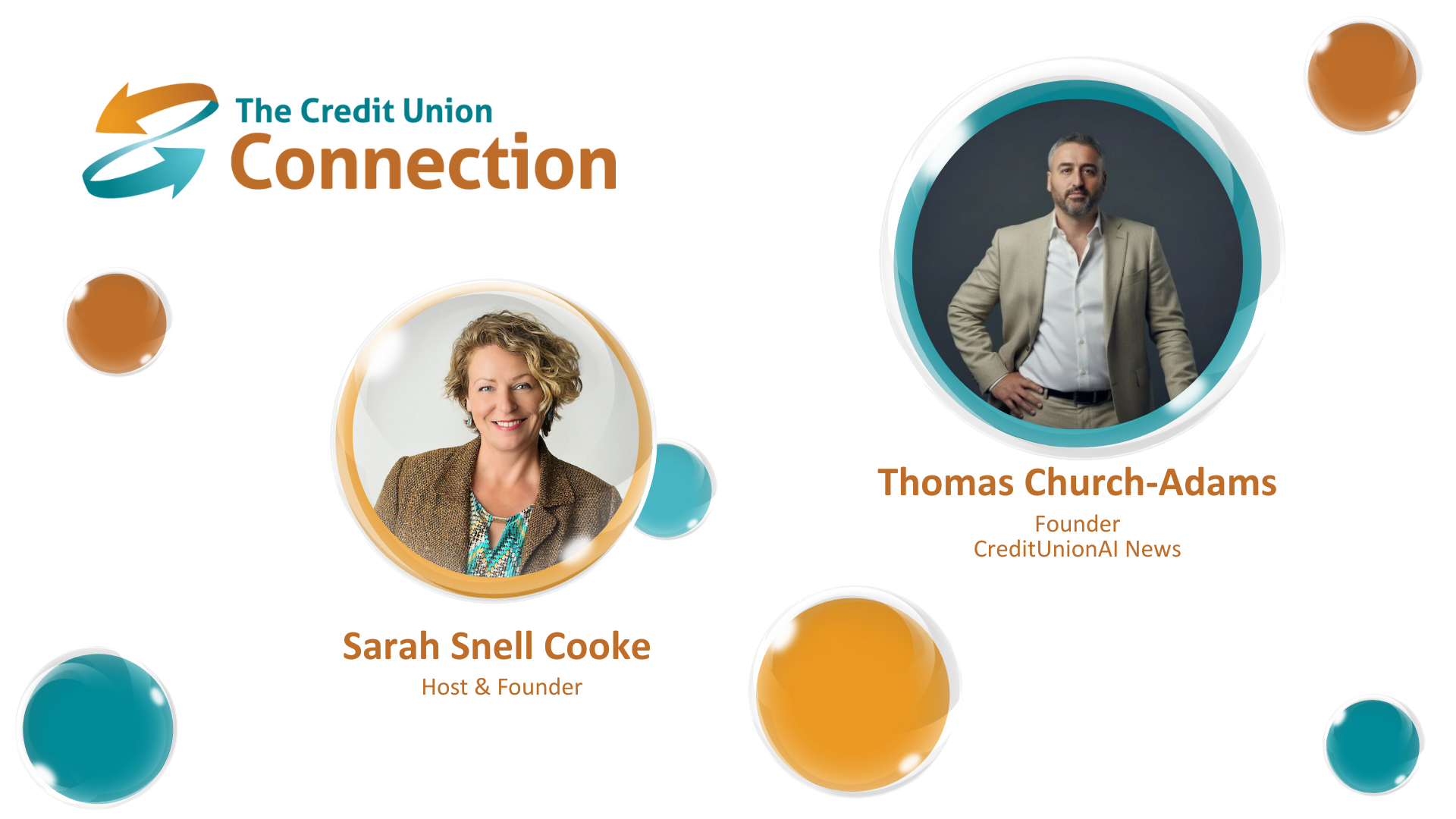
What began as curiosity across the industry has quickly turned into pressure to act; we’re talking AI. And Sarah Snell Cooke sets that stage immediately on The Credit Union Connection. AI is reshaping how credit unions think about operations, members, and the future of work itself.
Tom Church Adams enters the discussion not as a futurist but as someone who has spent years inside financial services watching technology evolve slowly, until now. The launch of Credit Union AI News was not about chasing hype. It was a response to how fast the ground started moving. Credit union leaders, he notes, are past the education phase and into a moment where hesitation carries real risk.
“If they sit back and wait, they’re going to be in a much worse position.”
That line lands in the middle of the conversation and reframes everything around it. This is not about rushing blindly into tools or vendors. It is about recognizing that AI is learning, adapting, and spreading across every function at once. Fraud, member service, product teams, and back office operations are all being pulled into the same current whether leadership plans for it or not.
What makes the discussion especially compelling is how often it returns to people. Employees partnering with technology instead of being replaced by it. Credit unions as institutions that still prioritize members over shareholders. Tom suggests that those values may actually give credit unions an edge in an AI-driven economy that is about to test trust and adaptability at scale.
The conversation never wraps itself up neatly, and that feels intentional. Instead, it leaves you sitting with the idea that AI is not waiting for consensus, comfort, or perfect strategy. Credit unions will shape how it shows up in their organizations, or they will be shaped by it.
NOTE: The below AI-generated transcript to the video might not be 100% right, but are any of us really?
Sarah Cooke
Hello. Welcome everybody. I’m Sarah Snell Cooke, your host here at The Credit Union Connection, I am joined today by Tom Church Adams, welcome. Thanks so much for having me. Sarah, absolutely. Thank you for being here. And he is the founder of the brand new Credit Union. AI News, and when I saw this, I had to reach out to him. Tom, would you tell us a little bit more about yourself and what you’re trying to accomplish?
Thomas Church Adams
Yeah, sure thing. So I’ve been in financial services and fintech industry and technology industry now for over 15 years, and I’ve worked at credit unions and credit card companies and banks and technology organizations, and I really wanted to sort of spend some more time in what I’m passionate about, and connecting that to what I do. And so for many years now, I’ve been sort of reading about understanding and staying in touch with everything that’s happening with AI, and all of a sudden it’s sort of blown up and become a real, sort of talking point across all channels. And I realized there was an opportunity for a platform that was purely focused on AI for credit unions, you know, and helping them navigate through these really turbulent times.
Sarah Cooke
Absolutely, and AI, of course, has been part of the turbulence. It’s moved so quickly, you know, I feel like, since it released, a chat GPT, you know it because it’s so accessible, it’s so easy to understand how it how it works, at least on the front end, maybe not the little gidgets and widgets in the back end, but how it works and what you can do with it is so obvious. So I feel like that kind of spurred people to move swiftly. And credit and credit union leaders have really moved beyond that initial education phase that I feel like we were in the first year, year and a half, and now we’re really starting to act swiftly, to engage somehow, to better run their credit unions, to better serve their members. Have you ever seen anything like this in tech in your time. And why do you think AI has been such a, you know, Gangbuster?
Thomas Church Adams
Yeah, I have not. And it’s such a it’s honestly such an exciting time to be in this industry, because things are moving so fast, and there’s obviously plenty of risks and that kind of thing, but there’s this huge amount of opportunity, I guess a lot of the reasons why it sort of is moving so fast is because the technology builds on itself every day. It’s learning from itself. It’s being taught how to learn from itself. We as a people are learning how to use it every single day, and we’re sort of shaping it as we go. And because of that, and also the fact that the technology can be applied to almost every aspect of our lives, including within the credit union industry. And so it just is. It’s such a exciting and turbulent time that, you know, I think that, you know, we should lean in and enjoy the moment.
Sarah Cooke
Exactly No. I love the way you just phrased that, because, you know, there are obvious use cases that get really, get people excited again, kind of going back to that Gen AI with, as far as writing, any kind of writing or presentation, talking points, things like that. And also at a credit union in particular, you’re going to have the member experience aspect through the agentic AI, which is super, again, pretty easy for people to understand chat bots that actually function on their own. And it’s kind of been in existence, just in a different way. Now I think that AI has really exploded. And so let’s start there with that, like, kind of, I want to say obvious kind of use case. How are credits using these elements, and how could they be doing it more effectively?
Thomas Church Adams
Yeah, I mean, there’s no sort of, you know, team or department or function that can’t use this technology, whether it be in the fraud teams, custom service, member service teams, technology product teams, and it can apply to anything, right? It can apply to a product manager who wants to manage their portfolio better. They want to understand their products better. Maybe they want to teach other employees and members about the credit the product more. But really, my advice to a lot of credit unions is to make sure they have a central Harbin team that are really focused on the direction they’re taking the credit union as it relates to AI, because I think that you know, if you have sort of lots of different teams and groups within the organization, there’s a lot of sort of communal knowledge that they can bring in together and share, and sort of make sure that as an organization, they’re on track and sort of aiming for the same trajectory.
Sarah Cooke
Because, yeah, the technology team needs to work with the lending team needs to work with the marketing team needs to work with the executives. Yeah. I mean, I definitely want to ask about strategy. One of the first things that I want to get to is, you know, coming off of that the what I call obvious use cases. There’s also the back office stuff, the less sexy stuff that tends to get less attention. And so some other use cases, like in fraud prevention and detection. Huge issue right now for credit unions, top of mind, definitely for a lot of leaders, automations, document review and handling, how many, how many documents you sign in a mortgage, right? Or like a business loan, so many things that could go, seems like they could go more efficiently, and that could be the real time and money savers. Am I correct in saying that?
Thomas Church Adams
Absolutely right. And I think that the one thing that you have with AI tools today, is there a group chat functions? Right? There are project chat functions that allow teams to sort of communicate directly, and as long as you’re sort of entering in your system details, what’s existing within the credit union, your portfolio data, you can actually have communal conversations about managing these sort of back office systems and be more in touch than ever before. And there’s one thing I know about credit unions, is the amount of tribal knowledge that sort of exists within individuals and teams within different departments is one of the biggest sort of assets and challenges they have, and it’s one of the reasons why, if an employee leaves the credit union, they’re often stuck with losing that tribal knowledge. Whereas now you’ve got people that are sort of engaged in these sort of group chats, these group projects, that can share what they know about the system, share what they know about the legacy data, and they can say, Hey, I know this is here, and I know how to work this information, and I know how to apply it in this situation. And then if they’re not there, there’s a track, and there’s a record of that being talked about. And that makes it a lot easier for leaders, operations, different teams, to really sort of stay in sync, whether someone’s present or not.
Sarah Cooke
Yeah, which is, is great. I love the idea of using new technology to maintain the legacy knowledge, right? And so, getting back to your earlier point about setting a strategy, having a hub, investing in AI, how where should cranes be, investing? How much like not exact dollars, obviously going to be different for every credit union. But where does a credit union start and continue?
Thomas Church Adams
I mean, obviously the biggest thing is their fraud. Right? With AI, fraud is going to go up. It’s going to become more sophisticated. You’re going to get. Different players and different sort of bad actors now using different tools in different ways. And I think Koreans have to match the moment with investing in that area primarily and with a big focus now. That being said, there are plenty of other functions within the organization that they can invest in as well, and the great thing about AI is there’s actually, it’s a lot, it’s very easy to stand up certain tools and technology in the beginning, just to sort of figure out how to use them and how to apply it to the organization. And I think before you know, if you had a new technology that you had to bring into the organization, you had to sort of teach and train employees on how to use it. Ai, as we all know, I mean, someone could log into chat GPT or Gemini today, and they immediately have an intuition of how to use the tool, right? And I think that that’s true of a lot of the sort of chat bots that exist within AI technology that credit unions can use so they don’t need to sort of wait to sort of stand the tool up. They don’t need to sort of, so go real slow in sort of starting off with the initial sort of launch of it. I think there’s a way to sort of iteratively learn from the tool and build on it within real time, as long as they have the guardrails around it.
Sarah Cooke
And so people are concerned, obviously, about it replacing their jobs. That’s a huge and many of our creating business partners out there are emphasizing no it really helps people employees perform better. It helps make them more efficient. They have more face time with members, that kind of stuff, which, I mean, I assume, is partly true. But would you do you agree with that kind of assessment of where it’s going?
Thomas Church Adams
Absolutely do, and it’s going to be a really sort of turbulent few years over the next sort of 123, years. That being said, there is a big opportunity for credit unions to figure out how their employees can partner with the technology, right. And at the end of the day, you know, the employees of credit unions are always members of that credit union as well, and so they’ve got to take care of their members that live in on the office floor as well. And I would say, you know, as long as they’re thinking about, how can these employees leverage the technology moving forward, I think they’re going to set themselves up for the best possible future that they can. And honestly, if there’s any kind of organization or movement or business platform that is ready for AI. I think it’s actually pretty because if you think about the nature of them, they’re technically not for profit, right? They have managed to sort of navigate sort of this neutral ground between both side of the political aisle, right, in terms of how they engage in Washington. And so they have sort of a community sort of feel and sort of drive, but they also have a sort of a cactus way of, sort of generating revenue for an income for their members to put back into the credit union. And so if you think about that model, that’s actually a lot better position than a bank right for the future, because they really are driven by their shareholders and their shareholder value. Credit Union is going to sort of sit back and say, How is we as organization can apply our mantra, our philosophy and our mission statement to AI and the environment that’s happening right now, and I think you know that might be a great platform moving forward.
Sarah Cooke
Yeah, I love it. I love that credit unions are the survivors. Yeah. And more than survive, I would hope. But yeah. So when we were like prepping, when we first, when I first reached out to you, we talked a little bit about some of the huge tech names and what they’re saying about AI in the world, and how down the road, whoever knows how long that road is, it will displace jobs, but maybe that, and that’s going to cause a huge shift in in everything in American life. A lot of us, you know, we, a lot of people, define themselves by their jobs and or like, you know, government support, and how that, how it supports its people in a democracy that is shifting from capitalist to potentially something different, you know, as well. Yeah, no, go ahead.
Thomas Church Adams
One thing I’ll add about credit unions, as well as they, you know, they lend out to people with commercial loans, with personal loans, and I think that even if they lose a lot of jobs over the next few years, there’s a big opportunity for them to fund a lot of the entrepreneurship that’s going to happen as well. And so, you know, maybe it’s enabling their members and their. Employees to sort of branch out right, to be able to sort of live in the new environment. And we are going to live in a very sort of creative environment. We’re going to live in a very sort of generative in terms of production for individuals. And a lot of the all the experts are talking about is think now about, how can you sort of build a business out of the tools that exist today. Credit unions might be in a good position to sort of help with that shift.
Sarah Cooke
Yeah, no, I think that’s a great explanation of what may be coming down the road for us, because, you know, it’ll create new jobs as well as, you know, as then time goes on. And so I want to ask you a little bit we’ve talked very talked very high level about AI, but I know when we were you mentioned credit union AI news is going to get a little more in the weeds. Can you talk a little bit about that, who your audience is and what you’re going to be speaking to?
Thomas Church Adams
I mean, I’m really focused on credit union leaders and thinkers within credit unions who need guidance on what’s happening around them and need to have sort of a filter and on the existing AI and technology news and how that is applicable to credit unions. Now it could be sort of a first CEO, a head of a department, a technology leader, but it’s also the people that work in the credit unions that are sort of helping to sort of change and live within the movement. And I think I want to sort of make sure that this is, this is the sort of main, central path for people to go to sort of think about those things in their credit union.
Sarah Cooke
Yeah, I love that, because I think, I think it’s very much needed. And so, yeah, I always allow my guest to have the final thoughts. What would you like to close the show out with and talk to speak to our credit union audience today?
Thomas Church Adams
The one thing I would say, I mean, I’d say a couple of things. One is, you know, credit unions in the past have been often very conservative when it comes to new technology or changes in the fiscal environment. You know, whether it be sort of, you know, digital currencies or, you know, whether it be sort of medical marijuana or things like that, there’s always something that’s sort of changing the industry. And often what credit unions will do is they’ll sit back and wait, because obviously they have to take care of their members and their portfolio and their money in a way that’s different to banks. You know, they can’t go and make any big sort of risks or big changes, because there’s a lot of risk for them. I think AI is going to be a little different. I think if they sit back and wait for things to happen, I think that they’re going to be in a much worse position. And the big challenge is that no one really knows what our society, in our sort of country is going to end up being like, and I think that they’re going to have to lean forward into that and be a little bit less conservative than they have been in the past. And I think the great thing about AI tools. Is it going it’s going to help them to think about that, strategize about that in real time, and as long as they’re staying up to date with what’s happening in the industry, what hat’s happening with the technology, I think they’re actually in a better position than they would be with other sort of risky environments. The other The second thing I would say is, this is here. This is coming. You know, our world is going to change dramatically. I would say, lean into it. That’s what my sort of mantra is. I love this technology. I know that it’s going to come with a lot of sort of challenges and risks and problems and issues as time goes on. But I think the more we lean into it, the better we’re going to set ourselves up for the future.
Sarah Cooke
Thank you so much for your time and your expertise today. Appreciate it. Tom,