

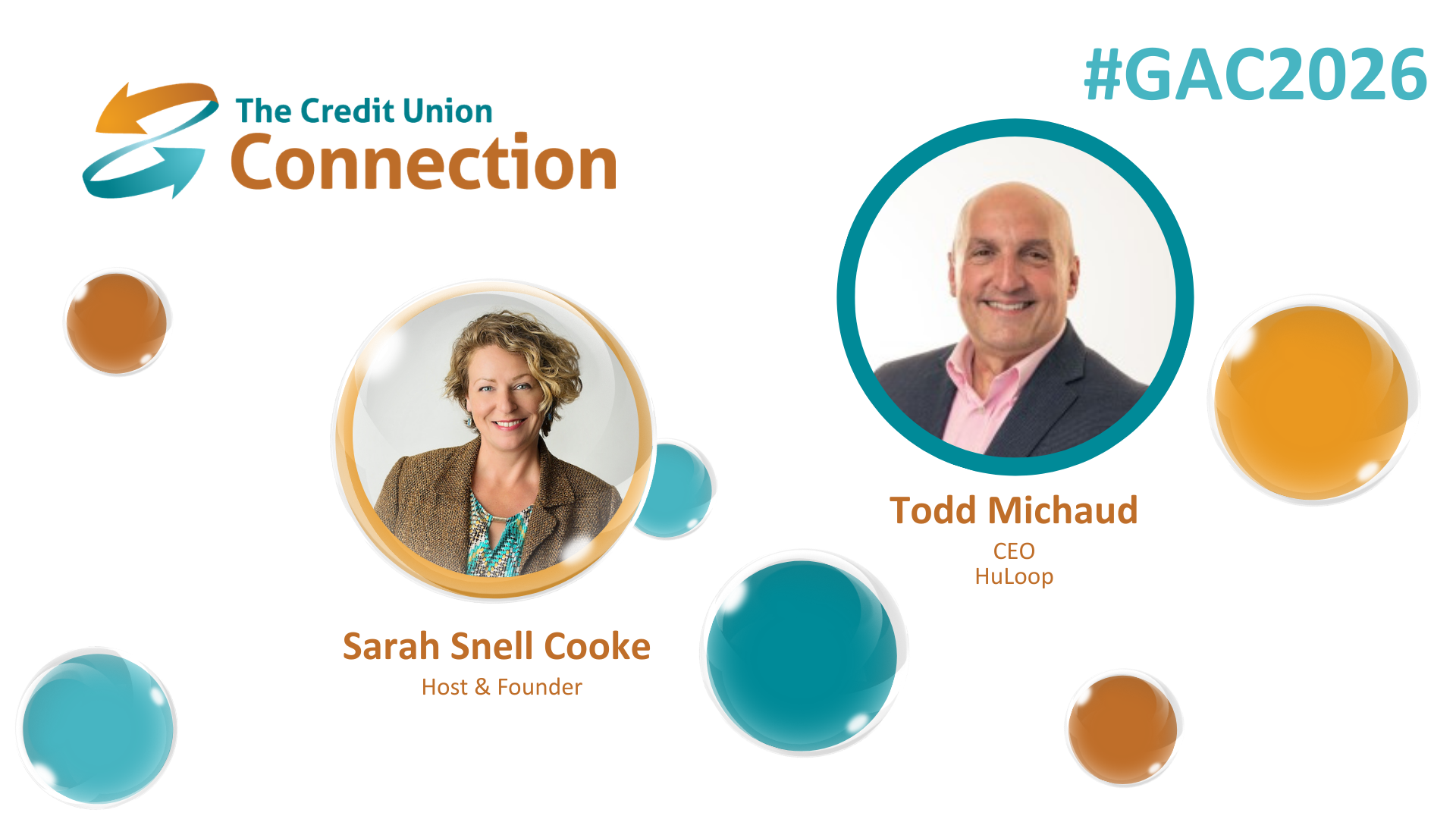
One third. That is how much of your team’s capacity Todd Michaud says is being burned on work nobody actually wants to do.
Todd Michaud, founder and CEO of HuLoop, which stands for Human in the Loop, joined Sarah Snell Cooke of The Credit Union Connection live at GAC 2026 for a honest conversation about what AI adoption actually looks like inside a credit union. The real one, with resistant employees, anxious boards, decade-old business processes and legacy core systems nobody wants to touch.
HuLoop’s whole approach is built around a simple premise: start where it hurts. Todd and his team identify four to six pain points within an organization and tackle them first, racking up quick wins before delving deeper. For most of their 65 credit union clients, that means the lending lifecycle, which is document-heavy and data-entry-intensive. Member onboarding and back office functions like HR and accounting are usually close behind.
What sets the conversation apart is how Todd talks about people. Across all 65 clients, he says, nobody has lost their job to AI. The goal is to scale without proportionally growing staff; that is a very different conversation to bring to a board. He also makes a strong case for starting with your change adopters rather than trying to win over the skeptics first. That one comes from experience doing it the hard way.
The “human in the loop” philosophy is worth understanding too. Credit unions are people businesses, and the idea that humans should govern AI rather than just defer to it is baked into everything Huloop builds. Boards, examiners, auditors, they all get a say. Todd talks about building the company from day one to be both employee- and regulator-friendly. In our heavily regulated industry, that framing matters more than most AI vendors seem to realize.
If your credit union is somewhere between “we know we need to do something about AI” and actually doing it, this conversation is a good place to start.
NOTE: The AI responsible for this masterpiece should probably stay in its lane—which, based on this output, is not transcription.
Sarah Cooke
Hello. Welcome everybody. We’re coming live from GAC 2026 I am Sarah Snell Cooke, of course, your host here at The Credit Union Connection. I’m joined with Todd Michaud, welcome.
Todd Michaud
Thank you. Thank you, pleasure to be with you.
Talk a little bit more about yourself in the company.
Todd Michaud
Well, I am the founder and CEO of Huloop, which stands for human in the loop. Work optimization. We help credit unions identify places within their organization that are candidates for efficiency, improvement, automation agents, etc, and then we help them facilitate transformation around the systems that they already have in place.
Sarah Cooke
So where does the credit union start? If they’re just looking to begin their AI journey, if you will.
Todd Michaud
They give me a call. That’s the first thing.
Sarah Cooke
Where’s the easy start?
Todd Michaud
You know, everybody is looking for, you know, quick wins. And so we built our whole process around starting with some quick wins, usually, we’ll identify four or five six things that are pain points within their organization and help them transform those activities first, and then we’ll move on to secondary or tertiary opportunities. It’s very situational, depending upon the credit union’s pain points, though, right?
Sarah Cooke
So if they offer business services or business loans, that’s probably a pain point with all.
Todd Michaud
Yeah, you know, virtually everybody that we work with is struggling with some part of the lending life cycle. So we’re touching that for sure. We’re oftentimes touching their member relationship. We touch back office functions like accounting and HR, and it functions. So, you know, wherever the pain is, that’s what we drive towards.
Sarah Cooke
Drive the pain away, drive the pain away. You guys, obviously human in the loop. That’s right. So talk a little bit about why that’s so important, rather than just running into AI head first.
Todd Michaud
Well, so let’s first recognize that humans are better than AI at many, many things. They’re, you know, capable of those tough judgment calls. They’ve got emotional IQ, they’ve got a lot of capabilities that AI will never have. And when we’re talking about credit unions, these are fundamentally people, businesses serving people. And so the concept of bringing in human in the loop capabilities gives them comfort that they can have human governance over AI, whether it’s an automation or a decision that’s being processed. And so we’re big believers in augmenting humans, freeing them up from the mundane, tedious work that occupies way too much of their day, so they can invest more of their time on value, adding work that they enjoy doing, right? And so it ends up being a win for the credit union, and then ultimately a win for the employee who’s now all of a sudden doing more enjoyable work, right?
Sarah Cooke
Yeah, we’re looking at AI to automate our newsletters. And so one of the biggest things, though, with AI and any technology, really, is the culture. Yeah, could you talk a little bit about that? How does a credit union prep for this kind of change and train their people and not scare their people?
Todd Michaud
Well, first we bring them in to the process. You know, we don’t do AI to them. We do it for them, right? And so, you know, involving them in the transformation, providing them with some education, helping them to understand the benefits. So we do spend a lot of time up front, just making sure that we’re building consensus and support from end users, decision makers, etc. When we were talking a few moments ago about just getting started, oftentimes, we’ll encourage our credit union customers to pick change adopters. So we’re going to work in different departmental areas on key business processes that need to be optimized. Let’s support those that are change adopters, rather than change resistors initially, at least, and then ultimately, we’ll come back and we’ll get the change resistors once they see that it wasn’t so bad with the change adopters.
Sarah Cooke
There you go. smart, smart play.
Todd Michaud
This is only because we did it the opposite way, where, you know, we did it with the hard to convince people up front. But, you know, I think that it is about demystifying AI and helping them to understand how it can improve their work, how it will benefit their organization, and ultimately, how it benefits their members. That’s what it’s all about, right? Why do it otherwise?
Sarah Cooke
Yeah, because if you’re taking them out of the mundane work, then they can deal with the human beings and use that emotional intelligence and other things to pick up on what they need.
Todd Michaud
Well, you know, I’ll share this with you. So when we talk about what is the opportunity statement for the typical credit union, easily, we can identify at least 1/3 of their existing employee capacity. Be is being wasted on stuff that they would not want their people doing routine, tedious, mundane work. Now, if we could liberate that 1/3 of that capacity and focus it on more value adding work that would be high impact. There’s sort of a secondary benefit for the organization, since so many of these organizations have got legacy systems that have been around for a few years. They all do. Oftentimes, it is decades. That’s true. We’re able to show them that oftentimes the business processes that they have in place today at the credit union were put in place a decade ago, or two decades ago, whenever they did their core upgrade, or whatever it happens to be. So what’s critically important in this new AI era is nobody wants to go through a core conversion. Let’s avoid that, but we need the future of work benefits. And so how do we transform business processes without disrupting the underpinning software? And so we’ve got to find, you know, new, more efficient business processes, through automations, through agents, through content processing, and these human in the loop experiences where humans are governing AI, and if we do our job right, we can take messy, complex, aged business processes and really set them up to be a lot more efficient, and, You know, a lot more beneficial for the organization. The end result is that it’s rare when I don’t talk to a CEO, a CFO, a CTO, whatever the case might be, where they’re saying that really what they’re looking for is they don’t want to get rid of people at all. They don’t, and they can’t. And in fact, I can just tell you, across our 65 clients, I haven’t seen anybody lose their jobs. What I have seen, however, is that these leaders are looking for, how can I scale my organization, assets under management, members served whatever the growth metric is without adding head count at the same growth rate. And so that’s fundamentally what our core mission is.
Sarah Cooke
If that makes sense, absolutely makes sense. And so you mentioned the word governing. How do you get this past a board, a credit union board that might be a little resistant?
Todd Michaud
Well, so we educate them. And so because we work with regulated industries, we’ve built our whole company to satisfy the needs of their security, privacy compliance, their examiners, their auditors. And so we hold ourselves to a really high standard in terms of all of the practices that we use. And so when we first started the company, north of three and a half years ago, we decided that we were going to deliver employee friendly and regulator friendly AI, and that means something to us. And so we just slowly help them to understand how AI is coming. And so if they’re going to choose something to start with, let’s start with something that is a safe choice, you know, as maybe your first step into the future. And so that’s helped us a great deal. And again, those things mean specific things, ultimately, to depending upon who we’re talking to and making sure that we operate with the highest standard of care. Whether we’re using our own AI or we’re using some of the public AI that’s out there, depending upon the use case.
Sarah Cooke
You mentioned results, yeah. What kind of do you have a case, classic case study, or something like that?
Todd Michaud
Gosh, you know, I’ll tell you it’s really interesting. With the number of clients that we have, everybody sort of has different pain points that they want to focus on. And so I’ll give you a generalization, and I’ll give you some specifics. So a generalization is, is that it’s rare when I can’t show a client, a prospective client, of Huloop, that they can get a $20 return on investment for every dollar that they invest. Now that’s very situational to what use cases that they pick, but we were talking earlier. It’s pretty rare when they don’t find that credit unions and other FIS don’t want to focus on the lending process that’s so tedious and so laborious and document intensive, lot of data entry so that almost exists in every single environment, maybe multiple times, depending upon the type of lending that’s being done. And then there’s a lot of work that goes around. Member lifecycle, new member onboarding, member maintenance, member, product, enrollment, things like that. It’s pretty rare where we don’t see those being areas that our clients want to focus on. But in the end, you know, if we do our job right over a time horizon, you know, we’ll do five or six, you know, use cases per quarter. And you know, Huloop ends up being part of the transformation initiative, part of their, you know, AI adoption initiative, and over, you know, time horizon, it becomes a meaningful impact to their business while they focus on the higher priority things. And so I always position us as sort of a secondary solution. We’re not going to be the. Main thing that an organization ever does. We don’t want to be that, Oh, you got that core conversion, yeah, good luck to you. What we’re going to do is we want to be something that is always thought of, always discussed at the board meetings. You know that has executive championship inside the organization. We’re part of the Efficiency Initiative. And by the way, we’re not the enemy of other AI, whether it be a FinTech or whether it be a Microsoft copilot, or whether it be chat G those are all our allies. Our real job is to help bring all of that AI to the organization in a safe, friendly way, but in an orchestrated way.
Sarah Cooke
Yeah, yeah, for sure, this security and compliance must be insane.
Todd Michaud
Well, you know, we go into it with an eye towards making sure that we meet the highest standards. And so, you know, what I found is that we just have gotten really good at being prepared, at asking, at being able to answer the hard questions, and we get asked them every single time. And so we should get, you know, very good at, you know, responding to them. And you know that there’s so many, you know, threats and a risk associated with not leveraging AI, you know, all the more reason to make sure that we’re doing it, but we’re doing it in a safe, risk averse fashion.
Sarah Cooke
Better to do it, take that risk, do nothing. I like that. Yes, exactly. So, yeah, I always allow my guests final thoughts. What would you like to leave our credit union audience with today?
Todd Michaud
Todd, we love the industry. The more that we learn about this industry. You know, it’s a people business, and that’s what we’re building our company to focus on is our people serving your people who are serving great people on the member side. And you know, I’m very excited you know about the growth opportunities for Huloop and the problems that we can help credit union solve?
Sarah Cooke
Yeah, definitely efficiencies. All right. Great. Thank you.
Todd Michaud
Thank you for the time. Bye.