

It is 6 p.m. on a Sunday. The pool contractor just handed over a $50,000 proposal. Your member loves it, and the fintech on the contractor’s iPad is ready to approve the loan before the guacamole turns brown on the chip bowl.
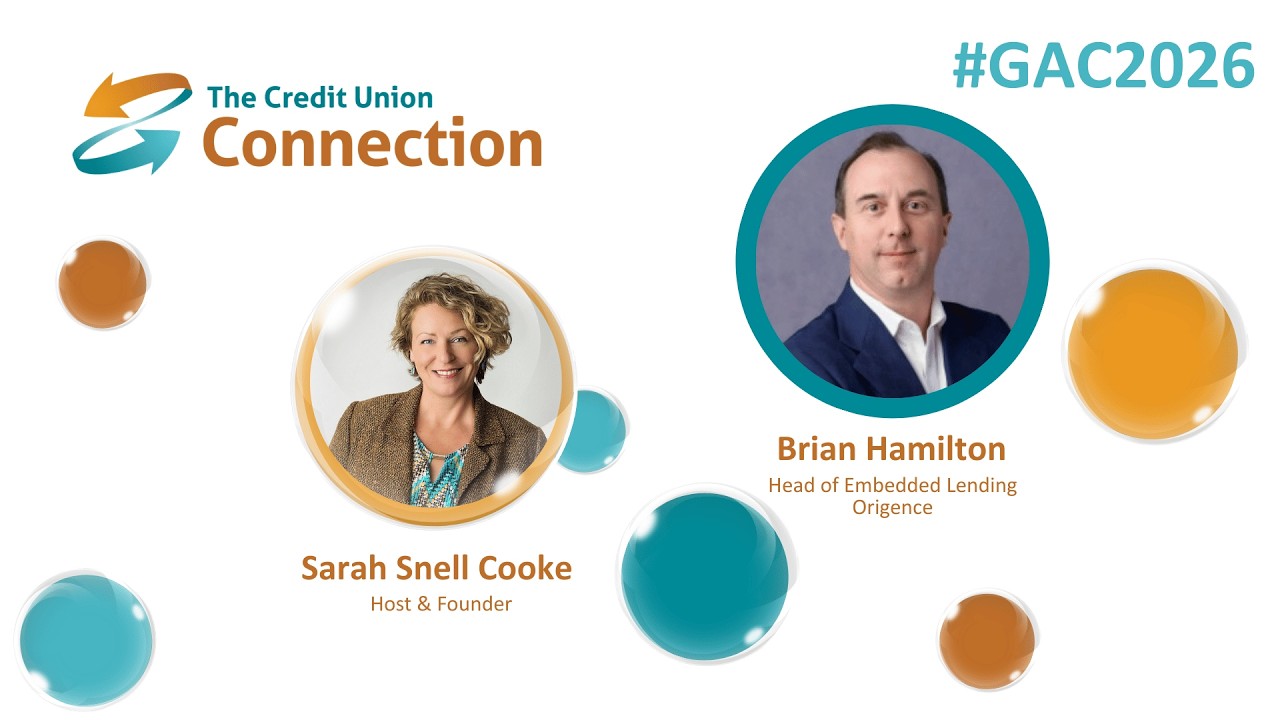
Brian Hamilton, head of embedded lending at FI Connect, an entity under the Origence umbrella, joined Sarah Snell Cooke of The Credit Union Connection live at GAC 2026 to talk about one of the more interesting shifts happening in consumer lending right now: The moment a borrower makes a financial decision has moved, and credit unions need to move with it.
FI Connect started as a proof of concept about three years ago, built around the idea of pushing credit unions into the Tesla financing platform, competing in real time. It worked. Now the company’s embedded lending model is expanding into digital auto retail, national rental car resellers and the burgeoning home improvement vertical.
The case for embedded home improvement is almost a no-brainer; these are prime and superprime homeowners adding value to their homes, with funds disbursed directly to vetted contractors. The average term is 15 years, but most borrowers pay them off in less than five years, once they have enough equity to refinance. Technically unsecured, but performing like a much safer asset, this lending opportunity has not been one that credit unions have been leaning into.
However, Brian puts the home improvement loan market at around $400 billion, and credit unions need to be there to compete on Sunday afternoon. As many people are still holding onto their 3% mortgages and aging homes, you can see the kind of opportunities credit unions can have here.
When a loan applicant comes through the FI Connect pipeline and is already a member of a credit union in their network, that loan goes straight to their credit union. Not to the highest bidder, not to whoever is next in the queue — to their institution. In a world where members increasingly enjoy financing at the point of sale, we can’t afford not to do it.
NOTE: If transcription were this AI’s superpower, it would be a very disappointing superhero origin story.
Sarah Snell Cooke
Hello. Welcome everyone. We are here today at the GAC live. I am Sarah Snell Cooke, your host here at The Credit Union Connection, and I am joined by Brian Hamilton. Welcome.
Brian Hamilton
Good morning, Sarah.
Sarah Snell Cooke
Brian is with Origence. Talk a little bit about yourself and what you do with the company.
Brian Hamilton
Sure. And it was right to be a little bit confused there. So Origence owns a couple of other entities. One of them is FI Connect, and we spun up FI Connect as a startup about three years ago with a proof of concept. Now we are fully committed and I’ve actually transitioned roles a few months ago to focus exclusively as head of embedded lending for FI Connect, because we truly see embedded lending as something that is going to be significantly relevant for credit unions to be involved in as the ecosystem shifts, if we want to stay ahead of all of the other lenders and finance companies.
Sarah Snell Cooke
Which makes sense that you’ve expanded into home improvement lending too. Talk a little bit about how that works for the end user, for the borrower.
Brian Hamilton
Absolutely. So first, at a high level with respect to the importance of embedded lending it used to be that a consumer would go to their financial institution or their credit union and find out how much they could afford for whatever they were purchasing: a car, furniture, home improvements. Then go and shop with that budget. The shopping experience has now flipped. Consumers find what they want and then figure out how they’re going to pay for it. Over the last decade, what has transformed and where this term embedded finance or embedded lending comes from is that those two transactions are no longer disjointed. When you’re buying your Starbucks, your financial transaction is embedded in the experience. When you’re shopping on Amazon, you don’t really think about it anymore. That’s all embedded finance. And if you take that to the next level, even beyond just attaching a credit card to a shopping site, this is now happening in larger ticket areas as well. The reason we chose Tesla as our first endeavor is that for those of you who have not bought a Tesla, you can buy it on your phone in about six clicks, and you finance it at the same time. Tesla has their financing and their lenders embedded within their application. That’s why it was hard for credit unions you’ve got to be national, you need billions of dollars to lend. FI Connect solved that problem. We sit right on the Tesla platform with everyone else. Six clicks in, you’re purchasing and financing your Tesla. We match that application to the credit unions. We are actually a lender, but we don’t carry a balance sheet. It’s called forward flow similar to correspondent lending in mortgage, where you go to close your loan and it says congratulations, somebody else is going to service it. We do that, but digitally in real time for consumer loans. Tesla was a great proof of concept. Now it’s time for FI Connect to expand all the channels and verticals. We’re focused on two for the next couple of years. The auto vertical will continue to expand beyond Tesla into digital retail, where you’re shopping for cars and getting preapproved. We’re live there and will add more. We’re also contracting with a national rental car reseller very soon. The other vertical we’re going into is home improvement.
Sarah Snell Cooke
And when we think about home improvement, we usually think about getting a mortgage or a second mortgage or refinancing.
Brian Hamilton
Right, and the reality in the consumer space is that everybody wants to move faster. That contractor is in your house, you’re thinking about getting a swimming pool, a backyard deck, and you get creative and kind of outstrip your budget for cash, or maybe it’s too much to put on a credit card. A decade or fifteen years ago, $25,000 or $30,000 for a swimming pool and a patio was normal. Now it’s $50,000, $75,000, $100,000. Consumers don’t want to wait for a mortgage process, or maybe they don’t have the equity in their home. So there’s a niche financing space there that’s very unique, because technically it’s an unsecured loan.
Sarah Snell Cooke I was just going to ask that.
Brian Hamilton But it doesn’t perform like an unsecured personal loan for debt consolidation. These are homeowners, prime and super prime borrowers. They’re adding value to their home. Funds are dispersed to contractors to make sure the work gets done. The average term on these loans can be 15 years, but the reality is they pay off in less than five, because by that time the borrower has equity in their home and they’re rolling that loan into a first mortgage, a refinance, or a home equity line of credit. So it’s more of a bridge loan for very solid borrowers. We’ve started with a broker called Visio. These brokers sit between the lenders and the contractors. They do all the vetting of the contractors, make sure the documentation is there, and that funding is allocated appropriately. Other lenders have been doing this outside of the credit union space for years big finance companies, national banks. These loans are being done. Credit unions just aren’t taking advantage of capturing these really solid asset classes and great members.
Sarah Snell Cooke
How are they performing?
Brian Hamilton
They perform really well. In our model, when we calculate a return on yield for credit unions, we’re using the straight national unsecured loss rate of about 2.5%. But lenders who have done this specific lending tell me these loans certainly outperform regular unsecured personal loans, because of the risk profile, the purpose, and the actual duration being shorter. We’re bullish on that.
Sarah Snell Cooke
And back to your earlier point how does this actually work at the moment of decision?
Brian Hamilton
This is what’s really important for credit unions. We have to be present in the moment a shopper is making a decision. The pool guy or the window guy or the HVAC person is not in your home at 3 p.m. on a Thursday when your credit union is open. They’re there at 6 p.m. on a Sunday after dinner, and now you’re looking at a $50,000 plan wondering how you’re going to pay for it. The rest of the fintech and big bank world are on the iPad right there, making an instant decision, ready to say sign here digitally and we can start the work this week. We as a credit union movement have to be there. FI Connect, through our partnership with Origence Lending Services, underwrites loans 21 hours a day, seven days a week. We’re only closed two or three days a year, and processing runs six days a week. We are present when members need us, at that point of sale, making high-quality instant decisions. When we don’t make an instant decision, we make one in less than ten minutes. We can go head to head with the biggest finance companies in the country and win this business. And the returns are phenomenal for credit unions 4% to 5% net returns after all costs and losses, with great member profiles.
Sarah Snell Cooke And that helps with member growth too, which credit unions desperately need. At the same time they’re getting money out the door, putting their assets to work.
Brian Hamilton Absolutely. I’ve been a credit union guy for a very long time, and we talk about loan to share ratio. If a credit union is under 90%, 95%, even 100%, you have to question if we’re really serving our members. We should be putting that money back out. Diversifying your asset classes and getting some loans that might have slightly higher risk but significantly higher yields is a really good way to put money to work effectively for your membership. And the other thing is retaining your own members. If I’m a member and I’ve got a car loan with you but a finance company is present when I’m making a decision at 6 p.m. on a Sunday, I’m not thinking of my credit union. I’m thinking of the opportunity right in front of me. One part of our secret sauce is that we already know if an applicant is a member of a credit union on our network. When that applicant comes through the pipeline, we take them out of the allocation pool and give them back to their credit union. Credit unions always retain their own members when they come through FI Connect. We don’t place that loan with a different credit union.
Sarah Snell Cooke
What if they have two credit unions?
Brian Hamilton
Then whoever is up next wins. We always get that question.
Sarah Snell Cooke
I imagine this also helps strengthen the bond between businesses, and for credit unions that offer business services, it brings that relationship in as well.
Brian Hamilton
That is impressive strategic thinking, and you’re right. Not all credit unions do business lending, but for those that do, they absolutely can leverage that relationship on the business side. That is a real opportunity for credit unions structured to do so.
Sarah Snell Cooke
And how are you connecting with the home improvement contractors, the plumbers, those guys?
Brian Hamilton
In all sorts of ways. FI Connect has relationships with companies like Loanear Technologies, which is kind of the hub of retail merchant lending. We also have direct relationships with brokers, and we’re cultivating relationships with larger manufacturers directly Pella for windows and doors, for example. That’s where this is going.
Sarah Snell Cooke
What’s after home improvement loans? You can’t rest on your laurels.
Brian Hamilton
No, you can’t. For the next couple of years, auto comes in more than one flavor. You’ve got OEM primarily EV OEM. All of the other EV manufacturers want direct to consumer financing, and even some traditional ICE vehicle OEMs are now looking to partner with credit unions more directly. Those conversations are in flight. Then you’ve got digital retail cars.com, Carvana, CarGurus, that vertical. And then national auto resellers like Enterprise and CarMax, where the entire shopping experience is now on the phone. Buyers used to visit more than three dealerships before buying a car. Now they go to one because they’ve already done all their research online. We want to make sure credit unions are present there too. I want to be very clear though this does not compete with what happens at the dealership level through the finance desk. That model still accounts for about 70% of purchase transactions. We’re just making sure credit unions are set up for success as the ecosystem shifts. Beyond auto and home improvement, you can look at elective medical, student lending basically anywhere you’ve got to solve for financing at a decision point becomes very relevant. And with so many homeowners locked into low mortgage rates and staying in their homes longer, home improvement is only going to grow. The $400 billion market isn’t all ours, but it’s a big space.
Sarah Snell Cooke
And for people who don’t have equity yet, this is exactly how they do it.
Brian Hamilton
Exactly. These loans have a 15 or 20 year term because borrowers want a low payment, but within three to five years they’ve got equity and they take it out. It’s a very savvy financial move. You never want to pay high interest rates, but if you put it on a credit card that’s an even higher rate. Why pay cash when you can keep that cash working for you, pay a modest interest rate for three to five years, then refinance and enjoy the home you’ve earned.
Sarah Snell Cooke
Final thoughts what would you like to leave our credit union audience with today?
Brian Hamilton
At Origence, we talk about CUSOs and how they serve the movement. Origence is what we call a true CUSO owned exclusively by credit unions. As a fintech, we have no exit strategy. We’re in this for the long game. We’re not chasing the fast dollar. We know that embedded lending is going to be very significant for the movement. Reach out to us and get connected in the ecosystem today. We already have three opportunities available, with five by the end of this year. The vision is that within a year or so, a credit union has eight, ten, twelve opportunities across different asset classes and risk profiles, and they can literally dial one up and dial one down without having to worry about underwriting, credit reports, quality assurance, or compliance. FI Connect handles all of that. You’re just getting the member and the asset. It creates an exceptional member experience right out of the gate, and it’s so much more important than just competing on rates anymore as long as you’re competitive on rates.
Sarah Snell Cooke
Thank you so much for your time and insights. I appreciate it.
Brian Hamilton
I appreciate you. Thank you.