

“Technology changes every day. Your headcount does not.”
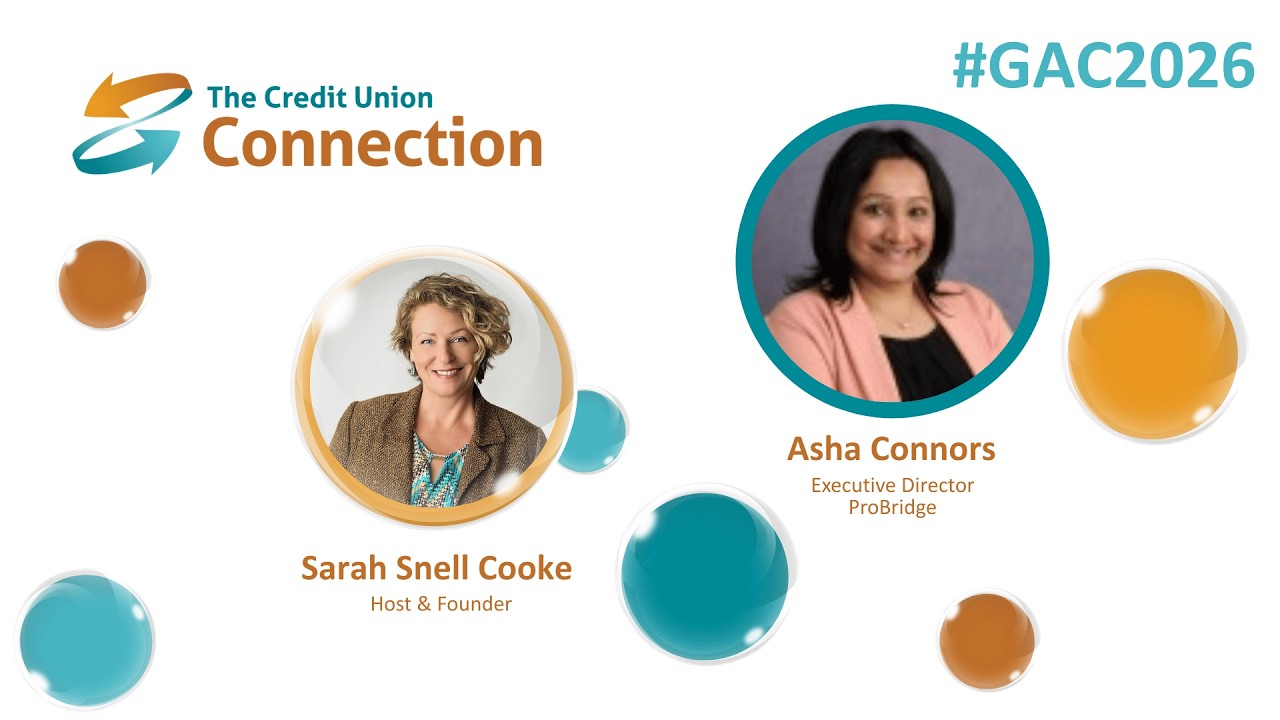
Asha Connors, executive director of ProBridge, a fully owned subsidiary of Trellance, joined Sarah Snell Cooke of The Credit Union Connection live at GAC 2026 for a conversation about one of the more practical challenges credit unions face right now, and that’s getting the right technical talent, exactly when they need it, without the overhead of a full-time hire.
ProBridge started as the internal support team behind Trellance’s Rise Analytics and its data platform, then spun out into its own entity last year with a broader mission. The model is straightforward: Credit unions can bring in contract staff, engage ProBridge for end-to-end professional services or use staff augmentation to fill specific skill gaps. Some credit unions need an extra 20 hours a week, while others might need six months or longer. The flexibility is the point.
Right now, the biggest demand is in data and analytics, and Asha is candid about why. The skill sets required for machine learning, predictive modeling and building data pipelines are genuinely hard to find and expensive to keep on staff full-time. For a credit union that needs that capability for a quarter but not forever, paying for a specialist on rotation is a much smarter use of budget than trying to compete with big tech for a permanent hire.
AI is where things get especially interesting. ProBridge is not just placing people who know how to use AI tools. They are building out a consulting practice around AI governance, Asha explained, helping credit unions develop a roadmap, understand the regulatory landscape, and implement responsibly without displacing the employees who are already worried about exactly that. They are also developing something called AI Labs, a sandbox environment where credit unions can test use cases using synthetic data that mirrors their real environment before committing to anything in production. For an industry where examiners and boards need to be comfortable before anything goes live, that kind of safe proving ground matters.
The flex plan Asha describes is worth understanding if your credit union has ever had to choose one project because you could only justify one hire. The idea is that the same budget that would cover one full-time resource can instead rotate two to four vetted specialists across multiple projects throughout the year. It is a different way to think about staffing, and for credit unions running lean, it might be exactly the model they have been looking for.
NOTE: If transcription were this AI’s superpower, it would be a very disappointing superhero origin story.
Sarah Snell Cooke
Hello, welcome everyone. We’re here live from GAC 2026. I am joined by Asha Connors. Welcome.
Asha Connors
Thank you, Sarah. How are you?
Sarah Snell Cooke
Good, how are you doing? Asha is with ProBridge, which is a Trellis company. Tell us a little bit about yourself and the company.
Asha Connors
I’ve been in the financial services industry for more than 25 years. I originally came from the larger corporate world and finally found my way into the credit union industry. I started working for Trellis in 2022. When I first came in I was their head of risk, because that’s my background. My background has always been technology and risk. I came in to start their risk department, was there for almost two years, and then transitioned into a business leader role. Right now I am the executive director of ProBridge, which is a talent services company and a fully owned subsidiary of Trellis. We were originally just a business unit and then last year we decided to create separate entities for all of our business lines. That’s how we became ProBridge.
Sarah Snell Cooke
Talent services, so we’re talking fractionals, part-time people, temporaries?
Asha Connors
We do a lot of that, yes. When we originally started, we were a support organization for Rise Analytics. They have an analytics platform, so we started out being the staff that supported the M360 product and the cloud product. When we rebranded last year, we were given the freedom to go find out what else we could do to help credit unions. So now I am in the process of setting up ProBridge as a full-fledged talent services company. That means you can use our contract services, our professional services where we do end-to-end assessments, recommendations, and execution, or you can use us purely for staff augmentation. We have a variety of skill sets, mostly technology, but we’re also doing a lot of core banking expertise. There’s a fractional aspect too: if you only need somebody for three months, or part-time, we do that. Some credit unions just need 20 hours a week or maybe 40 hours a month. Other credit unions will sign a contract for six months, one year, or even ongoing. We do both.
Sarah Snell Cooke
What do you see as the biggest need right now?
Asha Connors
In the analytics space there’s still a very large need, because you need experts who understand data, who know how to pull insights, who understand machine learning and how to build models. It’s a very specialized skill set. It’s not easy to find, and when you do find those people, they tend to be very expensive. So when you don’t have the need for a full-time person, it’s probably better to use a talent services provider like ourselves. You get a person or a couple of individuals with different skill sets for a defined time frame. When you’re done, they move on.
Sarah Snell Cooke
I would think as a credit union leader, risk might be a concern there. If I’ve got this person coming in on a temporary basis, are they going to leave with my members’ data?
Asha Connors
This is exactly where my risk and technology background comes into play. Before I became a business leader, one of the things I set up within Trellis was making sure that all staff dealing with data understand the regulations, understand the requirements from NCUA, and understand that member data cannot leave US borders. So we take great care in establishing that, even when we use providers like Azure or Snowflake. Our contracts spell out very clearly that the data centers they use have to be inside US borders. We have offices in India and people who work from India, but none of the data ever leaves the US. My staff within ProBridge are assigned to a client and they work within the client environment. There are two layers of security: we monitor their computers when they log in, and when they connect into the client environment, the client also gets to monitor them on their network. We also do not allow copy paste or sending data via email. All of those controls are in place so the data stays secure.
Sarah Snell Cooke
It’s such a highly regulated industry. You really have to watch for that when you’re dealing with people’s money.
Asha Connors Absolutely.
Sarah Snell Cooke
What is the bigger demand you’re seeing right now? You mentioned analysts. Are you also looking at executive level placements?
Asha Connors
We did explore the idea of doing fractional C-suite, but we did not proceed with that just yet. We are still establishing ourselves and we see great demand in the technology and data space, so we want to address that market first. As we build this out, we’re also talking to the CEOs of credit unions to understand their needs and potentially build that out. Possibly next year, but this year we’re really focused on providing technology skill sets and especially AI. Everybody wants to be able to do AI right now. So we’re curating those skill sets within our team, upskilling our data analysts and engineers who are already doing predictive modeling to be able to support credit unions on their AI journey.
Sarah Snell Cooke
When you say doing AI, what does that specifically mean in this context?
Asha Connors
On the analytics side, we already do a lot of predictive modeling. We take member data, segment it, look at spending patterns, identify member personas, and determine what they’re likely to need next. If someone just graduated from college, their life stage dictates what they might buy next. Not just credit cards, maybe an auto loan or something else entirely. Those are custom development projects we build out for credit unions. When you come into AI, the scope gets larger. Now you’re talking far more data and large language models. We want to make sure that if a credit union wants to engage with LLMs and use them to deliver their own products faster, we have a consulting practice for that, including AI governance. We have a framework that addresses the evolving regulatory landscape around AI: transparency, fairness, non-discrimination. We provide that framework so credit unions can comfortably use AI within appropriate guardrails. We also have consultants who can help you build a roadmap and a strategy, because using AI well requires more than just the technology. It requires training your people, making sure employees are not worried about losing their jobs, and making sure you do not displace your workforce in the process. We walk credit unions from point A to point B and try to make that transition as smooth as possible.
Sarah Snell Cooke
There has to be a cultural shift involved too.
Asha Connors
Absolutely. The first thing that happens when any company talks about implementing AI is employees start worrying. There’s so much hype in the market that AI is going to displace jobs. The good part is that while recurring, repeatable tasks can be automated through AI agents, it is also creating a new need in the market. You need people who can actually use that technology. So it is really a shift, not a displacement. It is about reskilling people so they can start using these technologies to deliver better for their members. Those are all things we address through our strategy work. We also have programmers who can come into a credit union and help on a specific project if you know what you want. And for those who are not sure what they want, we provide the strategy. We are also now developing something called AI Labs, which is a sandbox environment that we want to provide for our credit union clients. It gives them a safe space to develop use cases using synthetic data that emulates their real environment. They can see how it works, understand the regulations, and understand how to implement it at a later date without any risk to live data.
Sarah Snell Cooke
That makes a lot of sense. And honestly one of the most expensive things for any credit union is human resources. Being able to bring in someone temporarily, whether someone is on maternity leave or you just need a specific skill set for a short window, is incredibly valuable. Some of these credit unions have ten people and the CEO is the backup loan officer.
Asha Connors
Exactly. And that is actually a perfect setup for what we offer.
Sarah Snell Cooke
I appreciate your time today. I always allow my guests a final thought. What would you like to leave our credit union audience with?
Asha Connors
With the amount of change happening in the market, especially around technology, you cannot anticipate every need or hire every skill set you will require. So right now we have a very exciting service we’re calling the ProBridge Flex Plan. It allows a credit union to contract two to four resources that are available to them on rotation. Let’s say you have five different critical projects but you can only hire one person because of budget restrictions. With the Flex Plan, you use that same money to contract temporary resources that cycle through each of your needs throughout the year. You can schedule a different skill set each week or each month, however frequently you want to make that change, and you get vetted professionals with real experience and certifications. You do not have to worry about hiring, onboarding, or carrying a six-figure salary. It is almost like getting four individuals for the price of one, and you get to move multiple initiatives forward in a year rather than choosing just one.
Sarah Snell Cooke
Awesome. Well, thank you so much for your time. I appreciate it.
Asha Connors
Thank you so much for having me.