

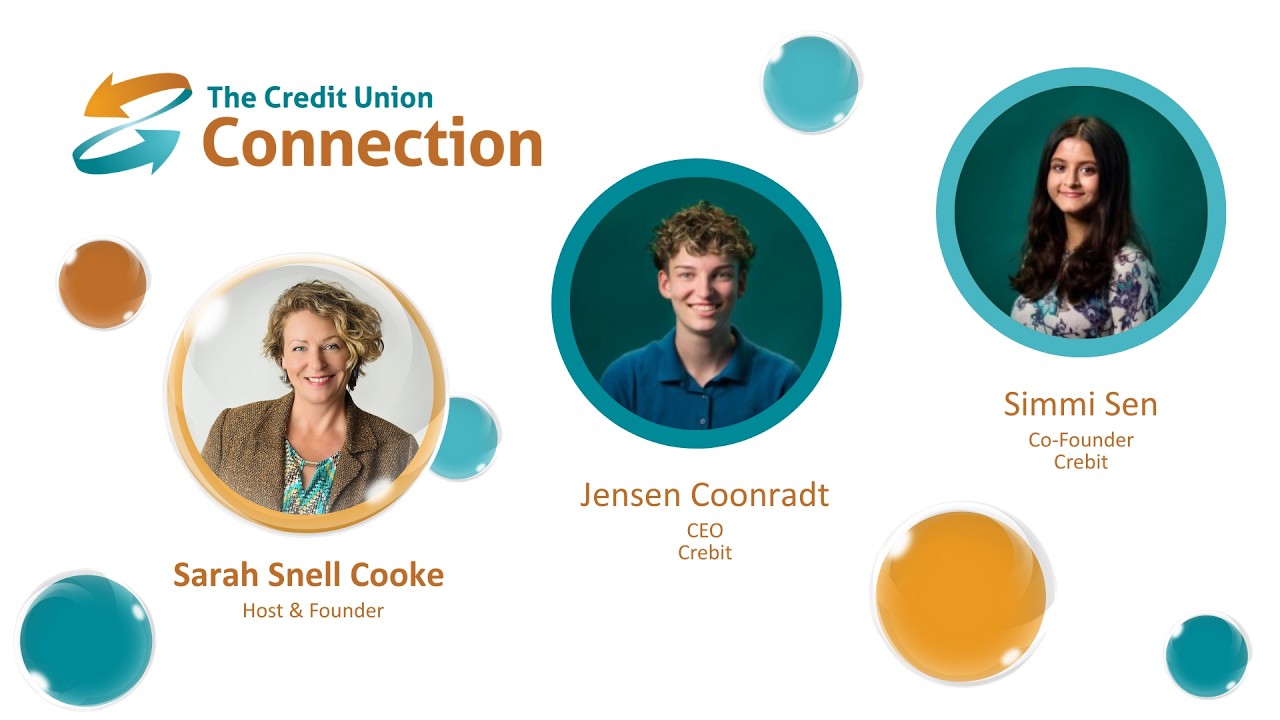
How much does it cost an international student to wire tuition money from home to their US university? If you said way too much, you are right. And two MIT and Stanford students on leave from their respective universities are doing something about it.
Jensen Coonradt and Simmi Sen, co-founders of Crebit, joined Sarah Snell Cooke of The Credit Union Connection to walk through their stablecoin-powered foreign exchange platform, why credit unions are the perfect partner for it, and why the compliance team does not need to panic. Over a million dollars in tuition payments have already been processed. Thousands of dollars in fees have already been saved. There are use cases ad nauseam.
The core problem is straightforward. International students and immigrants trying to move money into the United States face a broken system. Traditional wire transfers bounce through multiple intermediaries, each adding their own fees. In countries like Argentina, liquidity constraints mean most providers cap transfers at the equivalent of around $1,500. In some countries, the only option to send funds digitally into the US simply does not exist, leaving students to physically carry cash across borders or pay a 10% premium through services like Flywire.
Crebit solves this with what Jensen calls a stablecoin sandwich: accept the sender’s local currency via their country’s native QR payment method, convert it to USDC on a blockchain exchange at better rates than any traditional intermediary can offer, then deliver US dollars via a domestic ACH or wire into the recipient’s US bank or credit union account. The whole thing takes about 10 seconds. The end user never touches a stablecoin directly. They just get cheaper, faster money movement.
The compliance piece is one that credit unions will want to hear about specifically. Crebit runs full KYC, AML and BSA programs, screens against OFAC sanctions lists and checks for politically exposed persons. The fraud profile is actually comparable to a traditional wire transfer because Crebit partners with the same banks in each country that institutions are already working with. If a credit union is already running compliance checks on its international student or immigrant members, Crebit can work on a reliance model and share documentation rather than duplicate the effort. They are already inside Michigan State University Federal Credit Union’s Conquer Accelerator, which tells you something about how the compliance conversation is going.
The market opportunity for credit unions is huge. International students are disproportionately banking with Chase and Bank of America because their university credit unions have not had the tools to serve them. Crebit is building the onboarding pipeline to change that: ITIN registration, first credit card, first US bank account, foreign exchange, all through the credit union. That makes a member for life who entered through a door most credit unions have not even opened yet.
“The ones who took that leap were able to secure these systems and reach more members.” — Jensen Coonradt
Jensen and Simmi close with a challenge: Every major technology shift in financial services, from debit cards to mobile banking to video onboarding, was met with hesitation before it became standard. The credit unions that leaned in early retained members and grew. Stablecoins are next.
NOTE: If transcription were this AI’s superpower, it would be a very disappointing superhero origin story.
Sarah Snell Cooke
Hello and welcome everyone. I am Sarah Snell Cooke, your host here at The Credit Union Connection. I have a pop quiz for you. How much does it cost an international student to wire tuition money from home to their US university? If you said way too much, you are right. Traditional wire transfers can eat up hard-earned money in fees and terrible exchange rates. Today I am talking with Jensen Coonradt and Simmi Sen, co-founders of Crebit with a B. They have taken a leave of absence from MIT and Stanford respectively to build a stablecoin-powered foreign exchange platform to help international students paying tuition to US schools. It also has many other practical applications. We are talking USD stablecoins, QR code payments, full know-your-customer and anti-money-laundering compliance. Over a million dollars in tuition has already been processed, with thousands saved in fees. This is not a wild west blockchain experiment. It is regulated, it is working, and credit unions are starting to partner with them. Jensen and Simmi are going to explain how stablecoins can solve exchange rate problems, why international students and immigrants are an underserved opportunity for credit unions, and how you can offer this service without your compliance team having a meltdown. Let’s dive in.
Sarah Snell Cooke
Welcome, Simmi Sen.
Simmi Sen
Hi everyone. I’m Simmi.
Sarah Snell Cooke
And Jensen Coonradt.
Jensen Coonradt
Hey, nice to meet you. Great to be here.
Sarah Snell Cooke
Great to see you both again. Tell us a little bit about yourselves and the company without getting too detailed because we are going to get into a lot of detail shortly.
Jensen Coonradt
I am Jensen, co-founder, CEO, and CTO of Crebit. I studied electrical engineering and computer science at MIT and have been a software engineer at Amazon and NASA. I got into the credit union space through hackathons, coding competitions where they give you a problem and you work to build a solution. I have done a lot of them across the nation and am actually one of the top 50 hackers in the world out of over 600,000 people. One of my projects was a secondary lending platform on the blockchain for credit unions, which gave me the chance to present at NACUSO. I really fell in love with the credit union space and building technology to help solve problems they face. The specific problem Simmi and I are solving came from my work doing college counseling. I help a lot of international students get into US universities, and a common issue once they were accepted was figuring out how to convert funds to pay their tuition, rent, and other expenses. Simmi and I actually met back in high school.
Simmi Sen
I am Simmi, one of the co-founders of Crebit . I studied computer science and design at Stanford. With Crebit we are doing stablecoin-powered foreign exchange, helping international students convert their tuition payments using stablecoins so they get the best rates, save thousands of dollars, and move money really fast. Jensen and I met at a Bank of America scholarship program in high school, then did a Jane Street program together. This past summer is when we started working on Crebit, right after the GENIUS Act passed on July 18th. We saw a huge opportunity to reimagine cross-border payments and help students save thousands of dollars on their tuition payments.
Sarah Snell Cooke
I saw you both present and it was amazing. I have a 20-year-old and she is smart and eloquent, but nothing like you two. So, what is your dream goal? What happens with Crebit when it goes viral?
Jensen Coonradt
That is definitely the dream. We envision working with college credit unions all over the nation to make it seamless for international students to onboard. We support ITIN registration. We are actually registered with the IRS to help students get an ITIN through their college credit union so they can easily get a credit card or start building their credit score. We want to make it simple for them to send money from their home country, whether that is Brazil or China, into the United States using their local payment method. Our dream is to make sending money as easy as sending a text message, for students, for immigrants, for businesses sending money back home to pay employees or families. Sending money should just be that easy.
Simmi Sen
With Crebit we really want to work with credit unions because of the strong community and member base they have. We also learned that a lot of international students are banking with Bank of America and Chase, not with their university credit union, and university credit unions have not always had the tools to serve their international student members. With Crebit we are building the ultimate onboarding pipeline for college credit unions: ITIN registration, foreign exchange, helping international students get their first credit card and open their first US bank account. Since starting Crebit , we have processed over a million dollars in tuition payments and saved students thousands of dollars. We are significantly cheaper than options like Wise and Flywire that use traditional SWIFT transfers because we use stablecoins. We are four to ten percent cheaper than traditional transfer methods.
Sarah Snell Cooke
Before we go further, explain stablecoins, how they compare to other types of crypto, and how credit unions can use them safely.
Jensen Coonradt
Stablecoins are a truly amazing innovation. You have probably heard of cryptocurrencies like Bitcoin or Ethereum, which are volatile assets that go up and down in value. What is special about stablecoins, specifically USDC which is what Crebit uses, is that the GENIUS Act passed this year ensures every single USDC stablecoin on the blockchain is backed either directly by a US dollar or a US Treasury bill. That means USDC will always be at a one-to-one rate with real US dollars. What we do is something called a stablecoin sandwich. If a user is paying from Brazil, they scan a Pix QR code, which is Brazil’s local payment method, similar to Venmo in the US. They pay using their local payment rail. We accept the Brazilian reais and use it to purchase USDC on a blockchain exchange. Because of this flow, we get much better rates than our competitors. Right now we have the cheapest Brazilian to USD rate on the market. Then we sell that USDC for US dollars and do a domestic ACH or wire into the US credit union or bank account. The whole thing takes about 10 seconds. And the user never has to work with stablecoins directly. We have done thousands of user interviews and students do not want to learn how stablecoins work. They just want faster, cheaper, and easier transfers. We support QR payment methods for the majority of countries we work with. About 80 percent of countries now have a QR payment method, and that is genuinely how most people in those countries transact. Brazilians rarely use a debit or credit card. They scan QR codes everywhere. We also integrate with UPI in India, Alipay and WeChat Pay in China, Transferas 3.0 in Argentina, Brie in Colombia, and others.
On compliance, we have full KYC, AML, and BSA programs. We use industry-standard tools and do World-Check PEP screening, KYC, KYB, identity verification, and OFAC sanctions checks. If a credit union is already running compliance checks on their international student or immigrant members, we can also work on a reliance model and share documentation rather than duplicate the effort.
In terms of where Crebit is going, we want to become the go-to infrastructure for all cross-border payments, whether that is international students, new immigrants sending money home, or businesses purchasing goods in different countries. We recently got a government partnership with Senegal. We are working with Senegal’s central bank to build out stablecoin on-ramp infrastructure, with a vision to expand across West Africa, all of Africa, and Latin America.
Sarah Snell Cooke
Why is it so much cheaper using blockchain than a traditional wire?
Jensen Coonradt
It depends on the country. In Latin America, Africa, and Middle Eastern countries, there are two big issues. First is liquidity. If you are from Argentina and want to send funds to the US to pay tuition, most providers cap you at the equivalent of about $1,500 because individual banks just do not have enough of both currencies to do larger transfers. Blockchain exchanges have a far larger liquidity pool. With Crebit we can send the equivalent of five million US dollars from Argentina to the US, with the proper compliance and paperwork. Second is intermediaries. A SWIFT transfer bounces through several intermediaries who all add their own fees. With us, it is just one exchange doing the conversion automatically, comparing across exchanges to get the best rate and covering gas fees so users do not need that technical knowledge. We also support traditional transfers for countries where tax structure makes that cheaper, so we always route to the best option for the user.
Sarah Snell Cooke
What about security? That is a big concern for credit unions.
Simmi Sen
At Finnovate I met Jim McCarthy, who has over 20 years of banking experience and led risk and compliance at several banks and credit unions. He has been helping us build our compliance and risk program. Right now we are part of Michigan State University Federal Credit Union’s Conquer Accelerator and discussing potential integrations with them. The fraud profile is actually very comparable to a traditional wire because we partner with the same banks in each country that institutions are already working with. In the US, because we are off-ramping with a domestic ACH or wire, we do essentially the same paperwork and compliance checks as a traditional SWIFT transfer. It is just a faster and more efficient system.
Sarah Snell Cooke
Jensen, as a real person, not as a Crebit co-founder, what do you think of your credit union?
Jensen Coonradt
I use Earth Mover, my local credit union, and they have been really great. I actually joined because they had a scholarship program to support the local community. I applied with an essay about plastic waste and it really helped me afford college. I love how the credit union gives back at community events and even has a branch at a local high school to make it easy for students to open accounts. The one thing I wish they had was a better high yield savings rate. I am getting three percent APY which makes it hard to keep all my deposits there. I have been looking at Michigan State University Federal Credit Union because they have a savings account that offers five percent APY for balances under $1,000 to encourage students to start investing. They also have tools to round up card payments to pay off student loans. Really cool programs for students. I wish my credit union would adopt more fintech innovations.
Sarah Snell Cooke How about you, Simmi?
Simmi Sen
What I found really exciting at Michigan State University Federal Credit Union was their FaceTime customer support. When I am using mobile banking apps, I sometimes get frustrated calling customer support or talking to a chatbot. Being able to FaceTime a real person and even show them my screen so they can help me navigate the app is something I would really appreciate. I think more credit unions, banks, and fintechs should offer that kind of human support. It made me realize that Michigan State University Federal Credit Union really cares about their members. They even have video calling on the ATMs. If you have a question at the ATM, you can hit a button and a real person appears.
Sarah Snell Cooke
I always allow my guests final thoughts. Simmi, let’s start with you.
Simmi Sen We are living in a really exciting time. When the GENIUS Act passed and all of this innovation started happening in the stablecoin space, Jensen and I got excited enough to take a leave of absence from university to work on Crebit. We are right now at the very cusp of the stablecoin revolution and I am really excited to see how it plays out over the next couple of years and how Crebit is going to help lead that revolution.
Jensen Coonradt
The biggest thing I would say is that credit unions have to be ready to embrace innovation. It started with physical checks and cash, but the credit unions willing to start issuing debit and credit cards retained and grew their membership. Same with digital banking from the phone. There was hesitation about security, but the ones who leaned in secured those systems and reached more members. Even video onboarding during COVID caused a lot of credit unions to take a huge technology leap out of necessity. I really think it is going to be the same with stablecoins. Credit unions need to get ahead of this technology and embrace the innovation. That is exactly what we want to enable with Crebit: completely compliant, credit union-first systems that make it as easy as possible for credit unions to give these benefits to their members. Members do not want to learn what stablecoins are. They want faster and cheaper transfers into and out of the United States. We are really excited to be helping credit unions embrace this change.
Sarah Snell Cooke
Thank you so much for your time today. Appreciate it.
Jensen Coonradt
Thank you.
1 thought on “Sending Money Across Borders Should Be as Easy as Sending a Text”
What an amazing concept. Such innovation and vision! I grew up along the boarder of Maine and Canada (New Brunswick). It would be great to not have to worry about getting money changed before going to the next town (which just happens to be in Canada). Even with the use of credit cards, the exchange rates are not usually in your favor.