

Tax status threats. CDFI funding stuck in limbo. A partial government shutdown is squeezing Coast Guard members. A looming reconciliation bill. An NCUA Chairman whose replacement has been “coming soon” for weeks. And all of it happening at once.
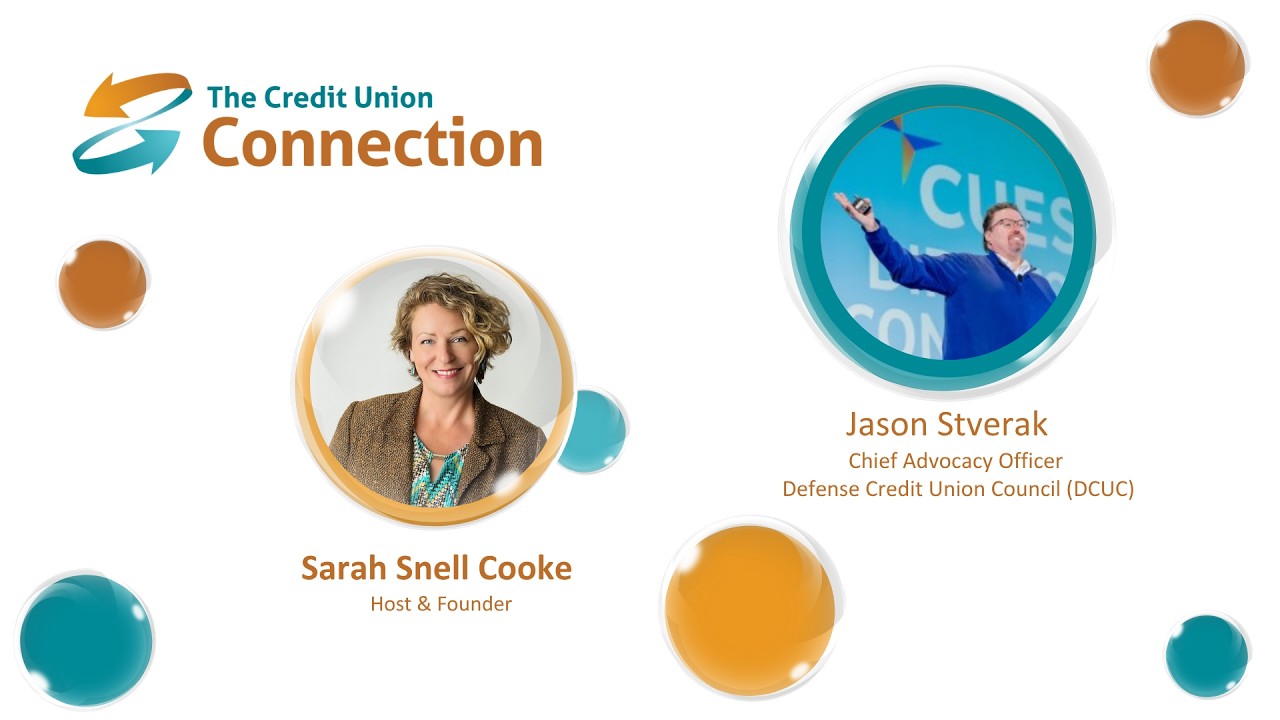
Jason Stverak, Chief Advocacy Officer at the Defense Credit Union Council, joined Sarah Snell Cooke of The Credit Union Connection to break down the legislative landscape credit unions need to be watching right now, why storytelling is not just a conference session topic but an actual advocacy weapon, and what credit unions have been doing for members during the current government shutdown that no bank in the country can match.
The credit union tax status question is not at crisis level, not yet. Jason is measured about that. The primary congressional champion for taxing credit unions has shifted focus to a gubernatorial race, which buys some time. But the groundwork has been laid. Questions about whether credit unions at certain asset thresholds should keep their tax exemption are being asked more frequently in congressional offices, and the banking lobby has been effective at planting them. Jason’s concern is not imminent action. It is slow erosion, and the antidote is the same thing it has always been: showing up in congressional offices with real stories from real members.
“I asked many offices: can you tell me a bank in your district that’s doing that? Not a single one could point to an example.” — Jason Stverak
The shutdown story is the one that matters most for that advocacy work right now. Keesler Federal Credit Union has been going into airports in their service areas and signing up TSA workers, advancing their salary for 90 days, no questions asked, on the assumption that the government will eventually pay. That is not a press release. That is a credit union making a real financial commitment with real safety and soundness implications, backed by an NCUA that understood what was happening and did not penalize them for it. Jason has used exactly these kinds of stories to stop taxation conversations cold. When a congressional staffer who was actively considering supporting a tax on credit unions heard what credit unions were doing during the last shutdown, the response was direct: we are done discussing this.
On CDFI funding, the picture is complicated on three fronts simultaneously. Approved funds are sitting unspent in Washington. The president’s budget zeros out the program going forward. And credit unions that were counting on those resources to keep branches open in rural and underserved communities are making hard decisions right now. Jason is cautiously optimistic that the strong bipartisan CDFI caucus in the Senate will hold the line, but the fight is real and the stakes for communities that would lose access to financial services are not abstract.
The digital assets legislative update is genuinely useful if you have been trying to follow where the Clarity Act stands. The Senate has been stuck on a few specific sticking points, one of which involves the Trump family’s involvement in digital assets creating a Democratic ethics objection. Jason thinks it will get done. He just cannot say when. What the Defense Credit Union Council has been focused on is ensuring credit unions have equal regulatory standing with banks under whatever framework emerges, and that the NCUA sits at the same table as the FDIC and OCC. That message, he says, has been heard.
NOTE: If transcription were this AI’s superpower, it would be a very disappointing superhero origin story.
Sarah Snell Cooke
Hey everyone, I am Sarah Snell Cooke, your host here at The Credit Union Connection. Congress has been working on a reconciliation bill that touches credit union tax status and CDFI funding, and of course all the TSA agents and Coast Guard members who are not getting paid during the partial government shutdown. I am here today talking with Jason Stverak, Chief Advocacy Officer at the Defense Credit Union Council, who was gracious enough to sponsor this webcast. He is talking about exactly what is in this bill and why credit unions need to pay attention. We are also going to talk about the ICBA’s upcoming fly-in to Washington, CDFI funding, digital asset oversight, speculation around a replacement for NCUA Chairman Hauptman, and the value of storytelling in lobbying.
Hello, welcome everyone. I am Sarah Snell Cooke, your host here at The Credit Union Connection. I am joined today by Jason Stverak. Welcome.
Jason Stverak
Hey Sarah, it is great to be with you.
Sarah Snell Cooke
Jason is the Chief Advocacy Officer at the Defense Credit Union Council. Tell us a little bit more about yourself, your background, and the organization.
Jason Stverak
The Defense Credit Union Council is an organization that has been around for over 60 years. We were created as a council to serve the credit unions advocating on behalf of those serving on military bases across this country and around the globe. We still primarily are the most experienced and largest voice for defense and veterans-related credit unions. We have over 200 member credit unions representing over 40 million individuals and assets of over $500 billion. We are a very large portion of the credit union industry. As those credit unions have grown beyond just the bases, we now serve the communities surrounding them not only here in the United States but all around the globe. It is a mission we take very seriously, advocating on behalf of issues that impact credit unions serving our military, Coast Guard, and veterans. For myself, I am a proud South and North Dakota native. I used to be the Deputy Chief of Staff for US Senator Kevin Cramer. At the end of COVID I left Capitol Hill to go to CUNA as the Deputy Chief Advocacy Officer. Then through the merger I had the opportunity to become the Chief Advocacy Officer at DCU, and I have found my perfect role and niche in the movement.
Sarah Snell Cooke
Nothing going on in DC, right?
Jason Stverak
Not a bit. We are in a recess week right now but there is an incredible amount happening. We are still in a partial government shutdown which is impacting one of our primary membership groups, the Coast Guard. We are hopeful Congress will find its way to solve that problem soon. The NDAA process has started. We are already in the fiscal year 27 budget process and just received the president’s budget last Friday, which has some issues and concerns for us as a credit union trade association. And then we have one, two, or possibly three reconciliation bills that may happen this year where we have to make sure the credit union tax status does not, as we like to say out here, end up on the menu. We were included as a possible pay-for last year by the House GOP conference. On top of that, the ICBA will be in town in a couple of weeks for their GAC. And we are still waiting for a replacement for Chairman Hauptman on the NCUA board.
Sarah Snell Cooke
Back when I was the DC reporter for various credit union media outlets, the credit union tax status would come up a lot when the budget came up. How serious is it this year?
Jason Stverak
I think it is not as serious as it was last year. The primary congressional champion for it, Congressman Feenstra from Iowa, is now running for governor so his eyes have shifted back home. But that is when I begin to worry a little more, because the groundwork has been laid. There has been an eroding of credit union support among some members of Congress. The bankers have done an effective job asking the question of when are credit unions getting too big, are they going away from their original purpose. I have been getting more and more questions from congressional offices asking whether we should tax credit unions at $5 billion, $10 billion, $1 billion. I am by no means raising a flare that it is imminent, but if we do not engage and re-engage with more members of Congress and primarily their staffs to educate them on the value of what credit unions bring and why our structure justifies the tax status, this could be a slow erosion to the point where Congress decides they need that $4 or $5 billion a year from credit unions and acts on it.
Sarah Snell Cooke
I want to get on my soapbox for a second because credit unions often have sessions at conferences about storytelling, and this is exactly why it matters. Being able to go up to Capitol Hill not just with small credit unions as a human shield, but with larger credit unions that are retaining their credit union qualities. Not every large credit union is becoming a bank.
Jason Stverak
I agree 100 percent. Whether you are PenFed or a small church credit union that is only open from 2:00 to 4:00 on Sunday afternoons after mass, it is in our DNA to serve people. The importance of storytelling is real. I will take stories from outlets like yours and send them as a note to staffers: did you miss this in your district? And we have seen the impact through the shutdowns. During the last one I was getting calls from both the Senate Republican Conference and the Senate Democratic Conference asking what credit unions were doing for government employees. We were able to share stories about credit unions providing zero interest loans, skipping mortgage payments, moving credit card payments, working with their members in every way imaginable. Keesler Federal Credit Union was even setting up food banks on bases because a sad fact is that a portion of our active duty military is on food stamps, and that was not being paid. They said, we do not have a choice. We are going to come in and serve our members. That was an incredibly important story. I had two members of Congress staffers say, we were entertaining talking about tax status issues. We are done. We are not anymore because of what credit unions did. The ability to continue telling those stories is critical. It is not bad to brag about yourself. It is not a problem to share those stories.
And that has been amplified in the current shutdown. Keesler went into airports in their service areas and signed up TSA workers. They have a program where they literally say, we are going to advance your salary. They made a commitment in the first shutdown for 90 days. We are ready. Anybody who is a federal government employee and has been a member, we are going to assume you are getting paid whatever your normal pay is and put it in your account and deal with it afterwards. That is a pretty significant commitment that can create real safety and soundness concerns if you are continually paying out without payments coming back in. You are covering mortgage payments, credit card payments, car payments, school loan payments, and by the way also advancing their salary. That cuts into reserves significantly. Thankfully the NCUA understood what was happening. The telling of that story is so incredibly important. I ask many offices: can you tell me a bank in your district that is doing that? Not a single one could point to an example. And I can bring up two or three stories from every district in this country. When you share statistics it is just facts, but when you put a face to it, that is an entirely different story. That is one of their voting constituents.
Sarah Snell Cooke
CDFI funding is also affected. Can you talk about that?
Jason Stverak
It is a two-front issue. We have current CDFI funding that was approved by Congress and signed into law that is still sitting in Washington. It has been appropriated. It just has not gone out the door. We are continually asking what the holdup is. There are credit unions and banks that are CDFI certified who are saying how much longer do they have to wait. Some are going to have to cancel their plans. I was talking to a CEO about 10 days ago and they said they had to cancel plans to keep a branch open in a very rural area because part of the CDFI program involves grant funds to provide access, and they could not keep fronting it as a loss leader while waiting for the money to arrive. So more people are becoming unbanked because this is not moving forward. Whether you agree or disagree with CDFI, Congress has passed it and the president has signed it. The money needs to go out the door. Then you have the president’s budget released last Friday which essentially zeros out CDFI going forward. He did that in the first administration as well. I think credit unions have done a great job since the first Trump administration through Biden and into the second Trump administration of educating members of Congress on the importance of CDFIs. There is a very strong CDFI caucus, particularly in the Senate with Senators Crapo and Warner leading it. I am confident that the zeroing out will get rolled back. We may not get massive increases but if we can hold the line, I think that is good. We are fighting on multiple advocacy fronts on CDFI right now: get the current money spent, protect the program into the next budget cycle, and then navigate the appropriations process. That is a three-front effort just on CDFI.
Sarah Snell Cooke The NCUA has issued proposed rules on stablecoin and digital assets. Talk a little bit about where things stand and what it means especially for defense credit unions with members overseas.
Jason Stverak Starting at a high level, the value particularly for defense credit unions serving overseas is the ability for members to interact with the local economy without having to exchange currencies. A real world example someone shared with me: they were stationed in Italy and had hired a local person to clean their house. Instead of going through currency exchange, imagine just being able to say I am going to pay you in a digital currency and that transaction is handled instantly, cutting out the middleman. That is a benefit members could already have access to in some form. In the United States, the GENIUS Act has passed and we are working on stablecoin rules now. Banks will probably take the lead because they have additional resources to invest. There are CUSOs being set up on this issue for credit unions to participate in, because that is really the only scalable way for credit unions to be involved. Those rules and regulations are still being written. Where things are stuck is on the broader digital asset structure. The House has passed the Clarity Act, which is now in the Senate. It has to go through both the Senate Agriculture Committee and the Senate Banking Committee. Agriculture has advanced its portion. Banking is still stuck on a few issues, primarily a Democratic objection around ethics given that some Trump family members have gotten into the digital assets business. The White House has indicated where the bill currently stands is not where they will sign it. I think it will get done because the president wants it done and there are enough bipartisan supporters. Tim Scott has been a primary driver. I just do not know exactly when. What we have been advocating throughout is that credit unions should be treated equally and that the NCUA should be on equal regulatory footing with the FDIC and OCC. We are confident that message has been heard.
Sarah Snell Cooke
What about NCUA Chairman Hauptman’s replacement?
Jason Stverak
It is the worst kept secret in Washington who it is rumored to be. We have been told since about three weeks before GAC in February that it is coming soon, maybe the next day, maybe the next day. I just do not know when it is going to happen. We have been told they are still reviewing paperwork and background checks. The White House tends to nominate in batches of about 10 names at a time, and we think they are just waiting for the next drop date. It could happen today or tomorrow. We genuinely do not know. Thankfully Chairman Hauptman still has his hand on the tiller and is committed to staying at the NCUA even though he has another appointment at a division over at the SEC. The bigger concern is that even if a nominee is announced tomorrow, there is a very finite amount of Senate floor time available. With a possible reconciliation bill, the digital assets bill, the Federal Reserve Chair confirmation, and potentially Supreme Court nominations all competing for floor time, NCUA does not rank at the same level as the Federal Reserve Chair. We will just have to wait our turn. What we keep emphasizing is that we want to make sure there is somebody there so this does not become an opportunity for people to ask whether we even need the NCUA at all. We want to maintain a strong and equal structure for the NCUA as an equal partner with the OCC, FDIC, and others.
Sarah Snell Cooke
I always allow my guests a final thought. What would you like to leave our audience with today?
Jason Stverak
The credit union future is incredibly bright. Even though we have challenges, and let’s be honest we do, when you peel all of that back, the spirit and the reason credit unions were created is strong and needed now more than ever. Communities all across this country from vastly divergent areas are looking for institutions that will truly serve them. I have seen time and time again, and I can point back to the last two government shutdowns because that is my world out here in Washington, that when others were asking what they could do, credit unions were going in and saying this is what is getting done. As long as we have that mentality of financial first responders, people over profits, not worrying about a quarterly report or a stock price but about whether six families got fed this week or got a new car or bought a first home or were saved from foreclosure, that is how we are going to judge success. So if you are a CEO or a teller and you feel a little beaten down by everything going on right now, you are loved, you are respected, and you are so incredibly important to the future of this country and your community.
Sarah Snell Cooke
Awesome. Thank you so much, Jason. Appreciate that.
Jason Stverak
Thank you, Sarah.