


James Chemplavil, Founder/CEO, Salus
The credit union industry is in a constant state of evolution and change, as the members and communities they serve do the same.
From 2020 to 2025, credit unions have met numerous challenges and shifts in the way they serve members. Around this time of year, the annual data on the industry sometimes causes concern, but if you look at the underlying data, there is a lot to celebrate in terms of how the industry is meeting the challenges of the day.
When looking at the credit union industry data in 2025 vs. 2020, the headline often jumps to the number of credit unions. In the industry data, 5,207 credit unions existed in 2020 and was 4,374 credit unions in 2025. This is often used as the counterpoint to overall trends in the credit union industry’s growth in total assets and members. Could both points be true?
Credit Union Count Is A Nuanced Story
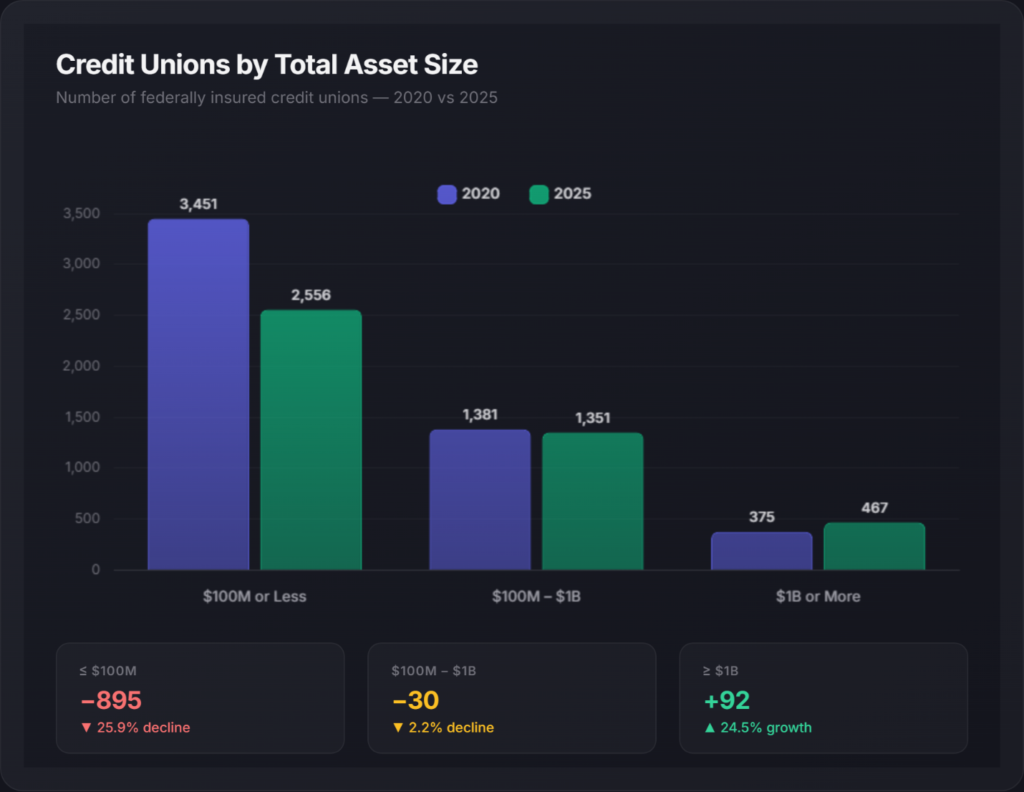
Most of the decline in the number of credit unions comes from credit unions with $100 million or less in total assets. But there are a few things to note in that number.
- Inside that decline of 895 smaller credit unions, 128 (14%) grew to more than $100 million in total assets. They are following a growth pattern that is also happening as credit unions in this middle tier grow above $1 billion in total assets.
- Of the remaining 767 smaller credit unions lost, 369 (48%) had $10 million or less in total assets.
- 250 (33%) of the credit unions that have disappeared had two or fewer employees. In an environment with expanding service and product needs for members, teams of that size would likely find it much harder to keep up with what members were asking for.
Looking at the data, it’s clear why the credit union industry can grow assets, members and deposits while the absolute count of credit unions has decreased. But that number prompts the question – if we are losing those credit unions, what members and communities are losing access to the credit union movement? This is a critical question, because credit unions are supposed to meet members where they are.
Credit Unions Serve More Counties (And Rural Counties)
There are 3,232 counties in the U.S. split into urban (1,131), suburban (624) and rural (1,477) categories.
While the majority of the population lives in urban counties, geography shouldn’t dictate whether a community has access to credit union services. So, how has the industry done in getting services to every county?
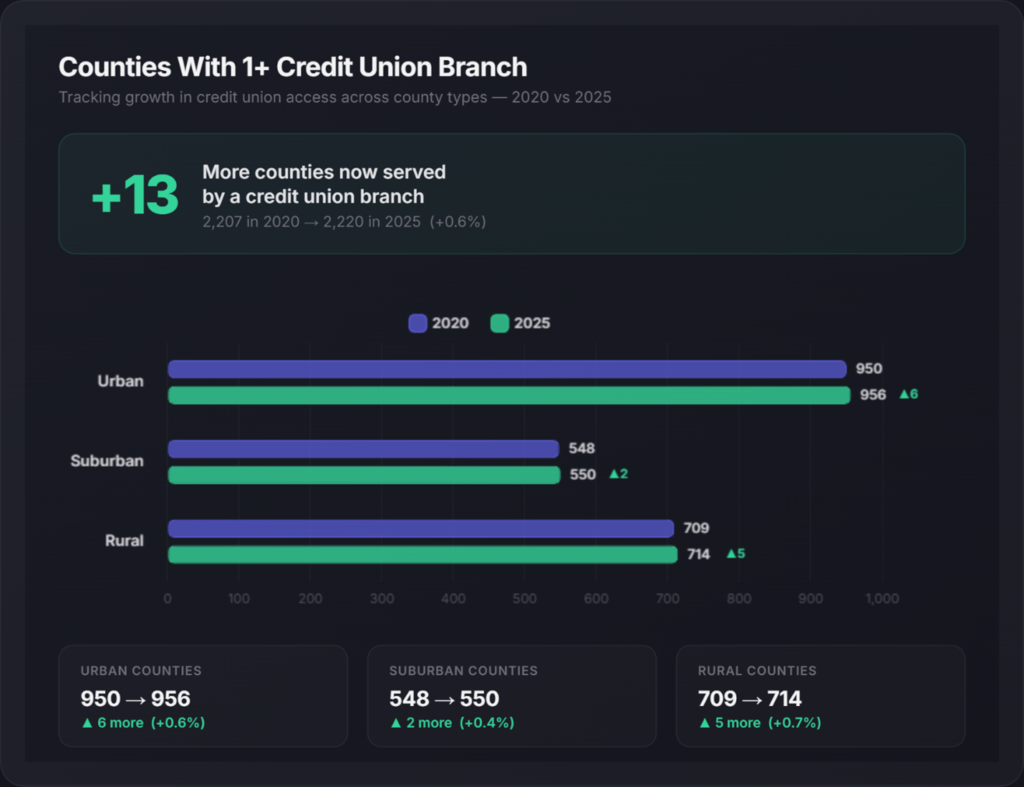
The data show that credit unions have increased their collective presence in urban (+6), suburban (+2) and rural (+5) counties. In rural counties specifically:
- The number of rural counties with no credit union branches has decreased by a net total of 5 since 2020
- 28 rural counties lost their only credit union branch since 2020; 15 of the 28 (54%) were from a credit union with $100 million or less in total assets, and two (7%) were from credit unions with $1 billion or more in total assets
- 33 rural counties gained their only credit union branch since 2020; 5 of the 33 (15%) were from a credit union with $100 million or less in total assets, and 18 (55%) were from credit unions with $1 billion or more in total assets
As an industry, credit unions aren’t just increasing their presence in one type of county – they’re increasing it in all geographies. The industry is doing better at meeting members where they are than they did in 2020.
But physically meeting members where they are, and then meeting members where they are financially, can be two different questions. Credit unions have always worked to help those underserved by the marketplace. How has that picture changed since 2020?
Credit Unions Expanding Reach to the Under-Served
The CDFI identifies areas where underserved communities reside to help communities and organizations understand where they can more effectively serve underserved populations. Given credit unions’ broader mission includes serving underserved populations, how are they doing in accomplishing this mission since 2020?
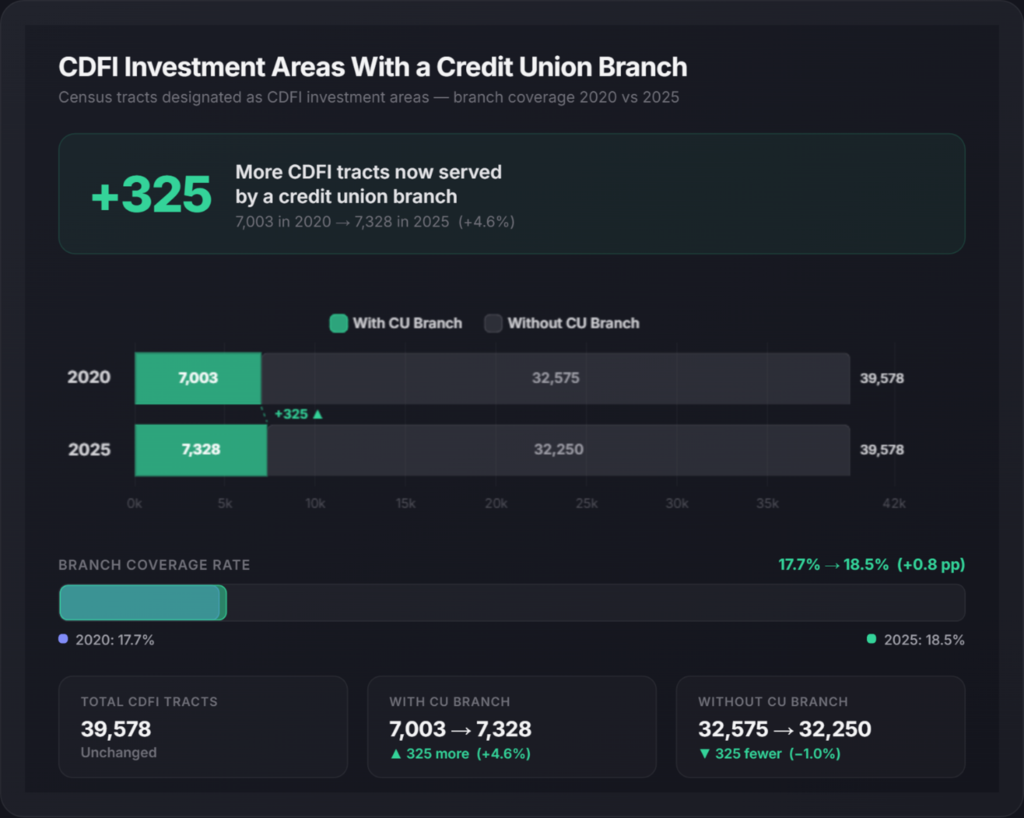
Credit unions have 325 more branches in CDFI investment areas in 2025 than they did in 2020. Within the data:
- 687 investment area tracts lost credit union branches since 2020. Of those branches, 366 (42%) were from credit unions with $100 million or less in total assets, and 215 (25%) were from credit unions with $1 billion or more in total assets
- 1,012 investment area tracts gained credit union branches since 2020. Of those branches, 175 (16%) were from credit unions with $100 million or less in total assets, and 613 (56%) were from credit unions with $1 billion or more in total assets
As an industry, credit unions are increasing their physical presence in areas where underserved communities reside. In places where banking deserts often deprive people of needed financial services, the credit union industry is meeting these members where they are and doing it better than in 2020.
Credit Unions Are Meeting The Moment
After years of significant changes in how members want to access financial products and services, the credit union industry as a whole is achieving its mission. It’s doing so with an improving focus on meeting members where they are physically and financially.
That’s not to say there aren’t challenges to balance as the industry evolves. For the 809 credit unions with less than $10 million in assets (492 of which have two or fewer employees), what avenues are available to ensure those institutions and members have what they need to thrive today and in the future? For the communities with only one credit union branch, how can they retain access as credit unions consolidate and decide where to go next?
I’m encouraged by what I see in the credit union space, now and in the future. Yes, credit unions in aggregate are becoming larger, and the number of billion-dollar credit unions has increased 25% since 2020. But those credit unions aren’t shying away from rural counties and underserved communities – they’re driving credit union growth in those areas.
We have the data necessary to measure progress against the industry’s goals going forward – and the data show the industry continues to meet the moment for its members. Let’s acknowledge those successes and continue them as the industry moves forward.