

Are your business members walking out the back door without you even knowing it?
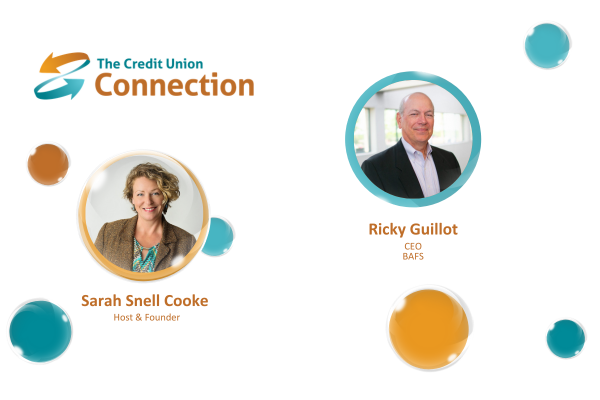
In the latest episode of The Credit Union Connection podcast, host Sarah Snell Cooke sits down with Ricky Guillot, founder of BAFS, Business Alliance Financial Services, to tackle the “silent migration” impacting credit unions nationwide. Many institutions unwittingly push their loyal members toward online alternative lenders simply by lacking a streamlined process for small commercial loans.
Guillot breaks down how credit unions can easily scale into the $50,000 to $200,000 lending space—funding the essential work trucks, equipment, and service providers that keep local communities thriving. Discover how combining relationship-driven service with the right technology can turn a major member retention risk into a powerful growth engine.
NOTE: This transcript may contain minor imperfections courtesy of our AI overlords-in-training. We’re not complaining. We’re definitely not complaining.
Sarah Snell Cooke: Hello and welcome. I am Sarah Snell Cooke, your host here at The Credit Union Connection. I was joined by Ricky Guillot recently of BAFS, Business Alliance Financial Services. And we talked a lot about subjects that are near and dear to my heart: small business lending and how to do it right, how to do it well, how to do it efficiently so that it actually is profitable for credit unions of any size to make loans of most any size. And with that, let’s connect with Ricky.
Ricky Guillot: Business Alliance Financial Services, we’ve been in existence for almost 17 years now. I started the company in September of ’09 with a mission. That mission has not changed. We are still serving the credit union market in a big way. Our purpose was to really introduce and then grow the commercial lending, or small business lending aspect, for credit unions all over United States. That is what we do.
Sarah Snell Cooke: Cool. Yeah, no, it’s something that credit unions have definitely started more than dipping their toes into. But I wanna step back a little bit. Small businesses are turned down for funding every day. The number one issue among small businesses is just not having capital available to let them grow. And even credit unions are buying banks to get expertise generally in commercial lending. We’re gonna talk today about small lending. How is that defined, and why is this growing now?
Ricky Guillot: The lending aspect, when you say that in a credit union environment, especially those mid-tier to lower-tier in assets credit unions, it just seems a little bit overwhelming because they are so retail-oriented and very good at that in serving the community. We try to instill that it doesn’t have to be overwhelming, number one. Number two, there are two things you really need in order to be successful at that. One is a robust technology to make it seamless for a small business. Number two is to have the back office to do that.
Again, most credit unions in that mid-tier to lower-tier in asset size don’t feel like they have the resources to do that. And that’s where we come help them, to show that they can do it and do it very well, and they can do it at a pace that meets their needs. But also, they can grow their credit union in a really big way.
Because if you stop one business owner and ask them a question about their business, they will literally talk for the next hour. Seriously, business owners, entrepreneurs are just that way, and they love their business. They’ll talk about it for hours, literally. We help our credit union clients really begin a program at their own pace and then go from there.
Sarah Snell Cooke: Yeah. And getting back to the lack of capital, why aren’t these smaller-dollar loans getting made?
Ricky Guillot: Yeah. If you look at the marketplace right now, even in some of the community bank spaces, the $50,000 to $150,000 or $175,000 credits can be as time-consuming as a $2 million deal. They just can. It takes time. And again, therein lies one of the reasons for having seamless technology to facilitate that, right?
The other thing is profitability. Again, they’re looking at the larger deals that have, not necessarily more margin, but it’s a bigger dollar amount. And your small businesses, and I’m talking about your service providers in a community, the landscape folks, service-oriented businesses of any type, what they’re typically doing now is either going to an institution that offers commercial lending, or they’re going to these online lenders where terms and rates are not really that attractive, but it’s something that a small business can get to very quickly.
Again, that’s not always the best option for them. And to me and to our company, what really makes a credit union so valuable to small businesses is that they already have the community orientation. They know their community very well. Chances are they’ve got hundreds of entrepreneurs and small businesses in their membership. They just don’t know that because they’ve never really paid attention to that. So the transition for them to a small business is so logical and so seamless for them that it just makes a lot of sense. It also helps them to diversify and serve their communities even further.
We just believe that it’s a perfect fit for credit unions, especially in that small business lending space. And again, we’re talking about $50,000 to even $200,000 deals. Larger institutions just don’t wanna do it.
Sarah Snell Cooke: They might just give you a credit card and move on.
Ricky Guillot: Yeah.
Sarah Snell Cooke: Yeah. And so I know among credit unions, there’s a perception that it’s very expensive to set up a commercial business lending or small business lending program, and that it’s risky. And so how are credit unions successfully entering this market?
Ricky Guillot: Yeah. I can speak to what we do to help them. Basically, the old adage was, I gotta hire three, four, or five people, so you got additional human resource costs. The platforms don’t necessarily integrate with what we do, so you got a cost there. You got time. You look up and you think you’ve got a mid-six-figure investment, and then you gotta make four, five, or six million dollars worth of commercial loans to even pay for it.
That’s not true. We facilitate it by, first of all, what we call a blueprint. We do a feasibility study and a go-to-market strategy for them very inexpensively, to at least tell their board and their senior team, “Look, this is viable and feasible for these reasons.” You have to tell them why, right? So we do that first and take a very patient approach. Secondly, you have to have the technology in order to facilitate that type of loan. We have that as well. Thirdly, you have to have the human resources, the people who have the expertise to facilitate that type of credit. And what we do is we put that in position for those credit unions to do it at their own pace.
So the technology cost, we keep at a very minimum. The human resource cost, they don’t pay for unless they actually use it. So you don’t have this fixed cost that’s sitting there that you have to eat every day. You only pay for what you consume. So the business model that we’ve set up allows a credit union of any size—we’ve had some as small as 60 million—begin a small business lending program very successfully.
And what it does for them, and they’re beginning to realize this, is that business owner will now tell their employees. They may only have five or 10, right? But they’re gonna tell their employees, and those families are gonna now migrate to that credit union. Moreover, they’re gonna bring other consumer-oriented products to the credit union that they didn’t have to begin with.
So there’s a lot of very, I call it silent cross-selling, that goes on in a credit union that they don’t even know about. So what we’re trying to help them do is facilitate what we call a silent migration. We don’t want those members to migrate to other financial institutions to get a small business loan of $80,000 because their current credit union can’t offer it. So we’re trying to help those credit unions really maintain and then grow. That’s the goal.
Sarah Snell Cooke: Yeah, and so what should leadership teams, executives, as well as the boards, probably from different perspectives, I would assume, what should they be looking for and paying attention to when they look to enter or expand in their small business lending?
Ricky Guillot: Yeah, one of the first things that we do through our feasibility study and go-to-market strategy is you wanna mitigate your risk because if they’ve never done it before, they’re a little tentative coming out of the gate, and that’s okay. We recommend that they do. So the first step is to really institute a solid policy that everybody understands. Training is also very important to make sure that you don’t have to have a tenured commercial lender. What you need is someone that can build relationships in the marketplace. They know their membership, they know their community, and we want to help those people and teach them the vernacular. What do you ask for? How do you ask for it? Those are very routine things that we help our clients do.
What a board and senior management wants to look for is: do you have members coming in and asking about commercial products? Chances are you’ve got board members that have some type of small business. Or is it on their strategic plan? Are they waiting for the right time? Let me tell you, the right time is any time, because we’ve done it in down markets, we’ve done it in up markets, we’ve done it in markets that are expanding, and those that are contracting. It’s about mitigating risk and serving your community. It’s not gonna be different than a consumer product, and we try to make it as seamless as we can.
Sarah Snell Cooke: And how is that risk mitigated? What are the steps for that?
Ricky Guillot: Yeah. The first step is to really understand your market, and that’s why a feasibility study and a go-to-market strategy are really important, number one. Number two, probably the most critical piece is developing a very robust policy for small business lending and adhering to that policy. That’s one of the things that we’ve done in our technology: we are able to embed that specific credit union’s policy in the technology that says, “If you propose this type of loan and it’s outside of policy, it’s gonna flag it immediately before you ever start.” Then what you wanna do is adjust that credit request to a point where it does fit policy. It may be too large, it may be a certain structure, it may be rate-related—it could be many different things. But policy is very critical, and you wanna make sure that the board understands the policy and their senior team and their mid-level team understands it as well.
The policy and making sure that your rate of growth is reasonable, that’s the next step, is making sure that once you implement it, your rate of growth is reasonable. You don’t wanna throw up a lot of red flags for the NCUA, and you can. So you gotta be very careful, you gotta be patient. But that’s where we come in, and we help them do that. We help them really mitigate areas that they don’t need to be in. We look at loan size, we look at loan complexity, and where they can best serve their community. So that’s the key.
Sarah Snell Cooke: And tell me a little bit more about the go-to-market plan too. What’s that look like?
Ricky Guillot: When we look at a go-to-market strategy, we wanna make sure that they’re in a position to offer your basic commercial products, like a commercial checking account, a commercial savings account, and then concentrate on your loan documentation and compliance so that you mitigate any risk associated with just a normal everyday implementation of a program and a loan. Mitigating risk is something that comes on all fronts, not just the credit type. But the follow-up, I call it the honeymoon period where everybody’s giddy, right? You wanna make loans, and you got members that wanna borrow money, and everybody’s really happy about that.
The real challenge is after the loan is made. Commercial lending is a living, breathing thing. A commercial loan changes daily. A commercial business changes daily. It’s not like making a loan for a car, where when the payments are made, you know everything’s good. Things change in a commercial business, and we help our clients really follow that and mitigate that risk as well.
The go-to-market strategy also takes into consideration competitors. Who do you have in your marketplace? Can you provide something that they’re not? It could be something very simple. We’ve seen go-to-market strategies that accomplish very basic things, and that’s most of the time because your entrepreneurs are just looking for a relationship. And I think in lending in general, we’ve lost a lot of that with some of these online lenders, et cetera. That’s transactional. Transactions happen every day, but relationship lending is different. And I’ll tell you, I’ve been in this business a long time, the relationship part, especially for credit unions, is the key. It’s all about relationship. Like I said earlier, business owners wanna talk about their business.
Sarah Snell Cooke: For sure. They love to do that, and credit unions, that’s just their reputation to begin with is being more relationship-focused. So yeah, it makes perfect sense. So if a credit union is interested in getting started, is there a first step? Like, where do they begin?
Ricky Guillot: Yeah. I think really the first step, if you’ve never done it and you don’t know anything about it, you wanna test the feasibility. Is it something feasible for us to do? You wanna look at your market, you wanna look at demographics, you wanna look at competition, you wanna do some ROI calculations to see, okay, is this something that we really can do and do well? Another thing that I would strongly urge them to do is to poll their existing membership. How many small business members do you currently have? We spoke to one two weeks ago that started by opening commercial accounts. They have 600 commercial accounts—I’m talking about checking accounts. They have zero business loans.
Sarah Snell Cooke: Right.
Ricky Guillot: That, I call that low-hanging fruit. I’m from the South, so I use terms like that a lot. Yeah, test the feasibility, understand your market, look at your current membership, and then start slow. You don’t have to come out of the gate and build a $10 million portfolio. That’s not the objective. The objective is to create and maintain relationships in every facet of what you do.
Sarah Snell Cooke: Now, I know it varies by lender, but where is the point where it actually becomes profitable? What size portfolio would you need?
Ricky Guillot: I’ll tell you, we write feasibility studies constantly, and when you look at the cost associated with implementing a program—I’m talking about through BAFS—your ROI is in year one. Yeah, it doesn’t take a significant amount of commercial or small business loans for you to recoup your investment. And what you don’t see in that ROI analysis is the additional consumer and retail-oriented products that they’re gonna gain. Again, it’s that silent cross-selling that I talked about earlier. That happens, and it happens regularly. So I can tell you in most cases, we see a return of investment in year one. And again, that doesn’t take that many loans.
If your average loan size is $100,000… and look, in a small business today, if you buy a work truck and a trailer, just like that, it’s over 100 grand just to do that. And there’s a huge need for that. So facilitating those needs, getting a reasonable margin on those loans—and I will tell you in the marketplace, a gross margin of somewhere around four is probably normal if you look at today’s rate environment. So when you do the math, if you do eight to 10 loans in a year, then you’re okay. It doesn’t take that many, really doesn’t. And I’m talking about a credit union of minimal size. I say minimal, 65, 70 million in total assets is very doable.
Sarah Snell Cooke: For sure. And what about the business lending cap for credit unions, is that a real problem, or concern at least?
Ricky Guillot: No, it’s really not. The cap is currently 1.75 times your capital base, generally speaking. I could get into a lot of detail on different ways to calculate the cap, but I won’t do that. And then you have a lot of credit unions that are CDFI and low-income designation, and it changes the dynamics of what their cap really needs to be. So cap is typically not a problem. In today’s environment too, what we’re seeing is that community banks and other larger financial institutions have what I call a liquidity squeeze. In other words, you have to have the liquidity to do it. Most credit unions that are in that mid-level to smaller level don’t really have a liquidity issue. You see a liquidity issue more than you see a cap issue, but we don’t see that in the marketplace right now, not with the market that we’re talking to.
Sarah Snell Cooke: Yeah. I absolutely think this is a great opportunity for credit unions, and especially now, it seems vital. So I always allow my guests to have the final thoughts. What would you like to leave our credit union audience with today?
Ricky Guillot: I guess my final thought would be this: don’t be overwhelmed. Don’t think it’s overwhelming. We do this every day, and I’m not making light of it, because it is a change for a lot of them. But I think we’re in a market today, and I think going forward, you have an opportunity to expand, maintain, and expand your member base by offering small business lending. You’re in a perfect position, strategically, to do this. Don’t let the anticipated cost, the anticipated complexity of small business lending get in the way, because it’s not. It’s something that we as a company have really strived to do, is to help those people that really need the assistance in getting it done. So don’t be overwhelmed. Let us help.
Sarah Snell Cooke: Yeah. Awesome. Thank you so much for your time today. Appreciate it, Ricky.
Ricky Guillot: Thank you very much for having me, Sarah. You have a wonderful day.
Podcast: Play in new window | Download