

Your loans are up. Your ROA looks good. Your net income is solid. Everything’s fine.
Except membership is declining.
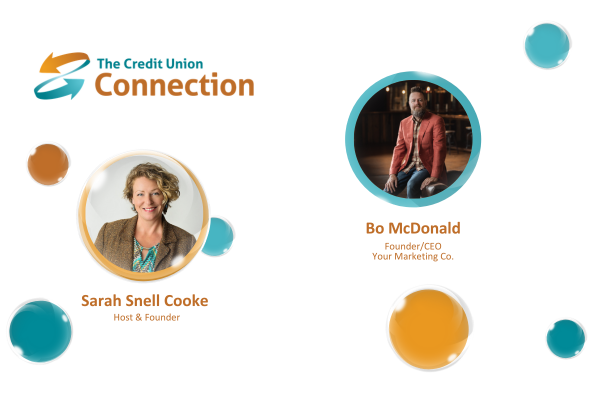
Bo McDonald, CEO of Your Marketing Co., calls this a false positive. It’s the biggest blind spot in credit union leadership right now.
After 18 years helping credit unions build real marketing strategies, Bo has noticed a pattern: most are chasing loan growth and mistaking it for institutional growth. Membership, the foundation of credit unions, is going backward. That’s not fine.
But here’s what’s really broken: credit unions haven’t figured out how to tell their story.
Marketing Isn’t What You Think It Is
Bo’s message is simple and stark: marketing isn’t a department. It’s everything. It’s what your branch smells like. It’s how long it takes to hear back from a loan officer. It’s whether your brand promise matches your member experience. When marketing says, “we’re here to help you,” and your operations say, “you’re not a member, so we’ll put you in a queue,” you’ve just broken trust.
This disconnect costs credit unions millions. One of Bo’s clients was marketing heavily for loans, but non-member loan applications were being sidelined. The marketing message worked. The operations didn’t.
Smaller credit unions with less than $250 million in assets face a particular challenge. A single marketing person with one skill set (great at social media, solid with design) leaves everything else to wither. Community impact work happens but never makes it to digital channels. Stories go untold. Brand potential evaporates.
The fix isn’t complicated, but it requires investment and focus. Intentional leadership. Mission-driven strategy. A holistic approach where marketing connects with member service, HR training and loan operations.
And something else: credit unions have to stop being afraid.
Listen to Bo’s full conversation to hear what successful credit unions are actually doing differently, why the cereal brand study still matters and why capital sitting at 15% is exactly the wrong time to cut marketing.
NOTE: This transcript may contain minor imperfections courtesy of our AI overlords-in-training. We’re not complaining. We’re definitely not complaining.
Sarah Snell Cooke: Hello, welcome everyone. I am Sarah Snell Cooke, your host here at The Credit Union Connection. I am joined by no other than Bo McDonald. Welcome.
Bo McDonald: Thank you very much. It’s been a long time. It’s good to see you.
Sarah Snell Cooke: It is. I think you had a giant old beard last time I saw you.
Bo McDonald: Yeah, we won’t talk about that story on this podcast.
Sarah Snell Cooke: Okay. Okay, but no more glitter in it. Okay. So, Bo McDonald, CEO and also founder of your marketing company, why don’t you do a little more introduction of yourself and the company?
Bo McDonald: Sure. This is the depressing part when I now say things like, “We’ve been going at this for 18 years.” I thought when I said 10 years, I started feeling old. Now I’m saying things like 18 or almost 20. We work with about 30 credit unions around the country. We do their outsourced marketing. We’re like a VP of marketing with an entire marketing team surrounding them, so when a small credit union has limited resources, we kind of fill that void and give them what they wouldn’t be able to afford otherwise in terms of strategy and creative.
Sarah Snell Cooke: Yeah, for sure. And so, you talked mostly about marketing, but you also do a lot of strategic work as well, and we’re going to talk about marketing as a strategic element at a credit union. So, I think it’s really poignant now because of the timing. We’ll get to it later, but marketing budgets are often the first things to get cut in credit union land. But we’re going to start at more of a strategic level and talk about how marketing and branding fits into that strategy, because I know you do some strategic planning with credit unions.
Bo McDonald: As we should. Oh gosh, where to even start? You just wound me up and I could go for three hours on this. I know we don’t have that much time.
Sarah Snell Cooke: You got maybe 10 minutes at max.
Bo McDonald: All right, I’ll keep it short. So if you were a new client coming in, I would say, “What is your brand?” It’s one of the things we do in onboarding, and a lot of times there is no answer to that. The answer is, “We have good rates and good service,” and that’s not really a brand. So we really start from the beginning as though it’s a brand-new company, a brand-new credit union, and we try to figure out who is the ideal member.
It starts there, understanding who you serve, and not just treating them like a deer we’re gonna go hunt, but treating them like a human. What problems do they have? What’s keeping them up at night? And how can we as a credit union solve that problem for them? And that’s easier said than done. That gets into the branding.
We know our ideal member, we know their problem, so we’ve kind of made this niche, but then you can start talking to them. You can turn that marketing faucet on and say, “All right, I know Sarah has this financial issue in her life. We can talk to her.” But if Sarah’s never heard of this credit union, there’s gonna be a lack of trust. It’s just another noisy ad, and that’s where branding comes in. Who is this credit union? What do we stand for? What do we look like?
Our VP of Research, Ty Thornhill, he’s a big stickler on marketing being everything. In a lot of team meetings, he’ll say, “Marketing is…” and if you’ve been with us any amount of time, you say, “Everything.” It’s what the branch smells like when you walk in. It’s the experience when you apply for a loan. So I could go any 20 different directions with what is a credit union brand because branding is marketing, and marketing is everything.
I don’t think we look at that as credit unions very often. We just look at, “Okay, we need loans. Let’s get a loan promotion out there.” Or, “We’re down on members. Let’s do a membership drive and offer everyone $50.” And then at the end of it, we’re like, “Well, damn it, marketing doesn’t work.”
Sarah Snell Cooke: Mm-hmm.
Bo McDonald: But we didn’t really put a lot of effort into answering the question: What is the problem we need to solve? If you say, “We need members,” or, “We need loans,” I always start with, why aren’t we getting members? Why aren’t we getting loans? And if we can drill into what is the actual problem we need to solve, typically, it’s not a marketing problem. There’s something else going on. And then if we fix that, marketing can really come alongside that and be even better.
Sarah Snell Cooke: Yeah, ’cause if you go to make a mortgage loan and then sit quiet for that two weeks or whatever while the member just waits and waits and doesn’t hear anything from you, that’s scary, and it can break trust. Like you were alluding to, trust being essential, and if you have that brand out there consistently and constantly, then that also helps to create more efficient marketing.
Bo McDonald: Yeah. And what are you saying in that marketing? Is what you’re saying connecting? I was recently sitting with a client, and they weren’t growing members, but they were growing loans. I’m like, “Something’s not connecting here,” ’cause we’ve got a pretty healthy digital budget. The numbers look really good, which I know doesn’t mean a damn thing if you’re not growing loans. But it helped us identify there’s a disconnect somewhere.
Turns out every loan application coming into the credit union from someone who was not a member was being set aside in this queue because they weren’t really a member yet. So as marketing is saying this thing—”we’re here to help you financially”—the warm and fuzzy stuff that the credit union is really good at, when a person says, “Okay, I’ll trust you, I’ll do that thing,” and then never hears back, or it takes three or four days to hear back, there’s another link in broken trust. That’s hard to recover from.
Sarah Snell Cooke: Yeah. And marketing is?
Bo McDonald: Everything. Ty would be so proud of you right now. It’s so important that it be part of your strategy and that you have a high-level person or outsourced agency to talk to you about how this trickles down into member service, HR, training, and that sort of thing.
Sarah Snell Cooke: ‘Cause I know you guys, like you said, you dig deeper than the surface level to find out what’s actually going on.
Bo McDonald: Yeah. A good brand guide really helps with that. We’re revisiting a lot of those with our legacy clients now, knowing a lot has changed, so let’s take a look at this and start fresh. That brand guide that we’re recreating really walks through what is our brand, what does it look like, here’s our logo, here’s how to use our logo, and here’s the words to say. All that is based on who they are.
But that brand guide also says, what does it look like in the branch? Because that’s critical to get in front of your frontline staff and in front of your lenders. If those folks that are interacting with members don’t know that brand or don’t understand it, there’s a huge disconnect. That’s that line you want to flow through—that funnel of a member hears about you, they consider you, they ask for your help, but what happens from there? Marketing is everything. We can’t control a lot of that, so that’s where a good partnership comes in to understand what’s happening in the credit union. Let’s look honestly at what’s going on and troubleshoot that.
Sarah Snell Cooke: Yeah, for sure. So, as we have observed, marketing tends to be the first thing cut when times get tough. What are your thoughts on that? I’m just gonna throw it out there.
Bo McDonald: I’m a marketer. Keep spending money, man. Don’t cut my budget. But you can look at the data. I’m a data person. What are the facts? Sure, it’s easy to say, “Don’t cut my budget. We have to market.” But when you’re talking to a CFO, that falls on deaf ears. Just like we in marketing have a job, the CFO has a job. There’s a budget we have to meet, which means we have to work together. If we’re just protecting each of our own—he’s protecting the budget, I’m protecting marketing—nothing’s ever gonna get done.
So when we start getting into economic times like this, and the first thing is, “Well, let’s cut the marketing budget. That’ll be easy,” look at the repercussions of that. You can look at so many studies back through the early 1900s—50, 100-year studies—like the cereal thing. I won’t go into all of that right now, but if you look up the value of marketing with cereal companies in the 1930s through about the 1980s, you’ll see two different cereal brands. One pulled back on their marketing when things got tough, and the other doubled down.
The one that doubled down on it was second in line for the brand, but they leapfrogged right over the other one over a course of about five to 10 years because it wasn’t just about them spending money, it was about them branding. They were the voice that was heard the loudest and heard the most. When someone went to the store, they remembered that, and that’s the cereal they bought.
Sarah Snell Cooke: Yeah. And that’s so important because branding doesn’t necessarily have a direct correlation to data, I suppose; it is more qualitative. But there are ways to look at creating more efficient marketing and being more efficient with your budget, and part of that is having a strong brand that’s constantly out there. Can you talk a little more about what we can do to be more efficient to prove the ROI?
Bo McDonald: Yeah. I mean, that’s a good thing to do every single month when you’re looking at the marketing report. We take a different approach to ROI. It’s easy to say A plus B equals C. What did we spend, what did we get, and what are the long-term results? But we go beyond marketing because marketing is everything. We take a lot of data from our credit unions every month, as much as they will give us, and we marry it with clicks, impressions, and all of our data on the marketing side. Then we start to put the narrative together of what’s happening.
For example, a recent great example of that: a credit union has been killing it with mortgage loans. They’re about 10% ahead of where they budgeted to be with lending, which is a great place to be. It ended up being in mortgages, which is great, but we saw car loans starting to pull back. We could have looked at just the line item, but you really don’t—you just look at loan growth and say, “Cool, we’re growing loans.” When we married all of that data together, we started seeing insight. Okay, we need to start shifting over here, because at some point, rates go up, something happens in the housing market, that house of cards could fall, and we have no backup. So from the marketing standpoint, constantly looking at where we are spending money, what’s working, and what’s not—reading between the lines is where you can find some really valuable information to drive the value in marketing.
Sarah Snell Cooke: I know a lot of credit unions are very involved in indirect lending. How are credit unions growing organically? What are the trends you’re seeing?
Bo McDonald: The trends are they’re not. I don’t want to be the bearer of bad news, but I’ll just call it what it is. It’s something I’ve written a few articles about and something we’re looking at. There’s a false positive out there right now when you look at certain numbers like loan growth, ROA, and net income. They look really good for a lot of credit unions. But there’s one number that we’re not looking at, and that’s membership growth, and that’s on the decline.
Sarah Snell Cooke: Every credit union under a billion, just about.
Bo McDonald: It’s negative.
Sarah Snell Cooke: Yeah.
Bo McDonald: So that’s a problem. We can talk about how branding solves that, but true growth is not happening right now. I’m not a fan of indirect lending, but indirect is a tool. A lot of people use that as a sole source of growth instead of just a tool on the balance sheet.
Sarah Snell Cooke: Right. And in economies where delinquencies are rising, you’re particularly probably gonna see that in your indirect lending too. So how much growth is that really?
Bo McDonald: Exactly. And that’s where a lot of credit unions win if they’ve got that relationship with the member. Time and time again, if you’re a student of Rex Johnson, you know if you have a risky loan out there and you have that relationship, there’s a good chance you’re gonna get paid. With indirect, there is zero relationship, so if that financial situation goes south, you’re probably on the hook for that.
Sarah Snell Cooke: For sure. So seriously, among your clients, what are the credit unions that are successful doing?
Bo McDonald: I’m a huge data nerd and I’ll look at everything. I can go down a rabbit hole and sometimes I just have to stop myself. But the commonality is an intentional CEO and intentional leadership. The credit union CEOs who have goals stay focused on that and hold their teams accountable to doing what they should be doing to meet those goals.
Mission is important. Not only is accountability important with the CEO, but being mission-focused—not just chasing asset growth, but knowing who we serve in the community and who needs the help. It’s a focused CEO. The ones that are chasing, “We need loan growth, we need membership growth,” and shifting every quarter without really having an ideal member to serve, they’re not growing. The ones that are slow and steady every quarter have a focused CEO that understands what the word accountability means.
Sarah Snell Cooke: And I think, too, that kind of gets back to the brand. Currently, it’s approximately—according to some industry research I read—about $500 to add a new member.
Bo McDonald: You can say anywhere from $300 to $700 are the numbers.
Sarah Snell Cooke: Let’s split the middle. But yeah, so obviously that is a number you want to make more efficient. How can branding play into actual member growth? ‘Cause that really is something that 90% of credit unions are struggling with.
Bo McDonald: It’s simply just making it a priority. It’s very difficult, exactly what you said. When we look at the marketing budget and we spend some dollars on branding, it’s really hard to show what the ROI is. But I can point to our credit unions that have a strong brand within the community they serve, and when you talk about growth, they’re growing.
It’s no different than someone walking up to you at a bar saying, “Hey, you wanna go home with me?” That’s the equivalent of a lot of marketing for credit unions right now. “Hey, wanna get an auto loan from me?” Just picture that. Someone walks up to you at a bar and says, “Hey, wanna go home with me?” That’s what a lot of credit union marketing is right now: “Hey, you wanna get an auto loan from me?” I know nothing about you.
Sarah Snell Cooke: Exactly, yep.
Bo McDonald: And you can hook someone on rate, which I don’t think is very efficient unless you’re just strictly going after A and B credit. Branding, I think, does that job at the top of the funnel so that someone doesn’t have to go to search. If you’re efficiently branding the credit union and you’re top of mind, I’ve always said our job in branding is to make people think of you first and like you the best when there’s a need, so they don’t have to go to Google and search “cheap auto loan” in whatever city you live in.
Instead they think, “Gosh, I’m not gonna put another cent in this car. Hey, I heard about this place, they seem fair, they’re talking my language. I feel comfortable with them. Let me go see if they can help me ’cause I don’t think I’m gonna get approved.” There’s some sort of comfort there. I think that’s where branding comes in, whether you get pissed at your bank and go find a checking account because you’ve heard of these guys, or you need a car, or it’s time to buy a house. If you can be inside their heads rent-free when they need you, that’s a whole lot better place than competing when someone has to go search for it.
Sarah Snell Cooke: Yeah, and I think, too, credit unions have had trouble for many reasons with storytelling. Like, real storytelling. At the end of the day, anybody can beat you on rate. Anybody can beat you because of your mobile app, because they can buy the same one from the same vendor. The only thing you have to differentiate yourselves is brand. So how do we make that happen industry-wide? We’re gonna solve all of the problems industry-wide.
Bo McDonald: I think it depends on scale. As a billion-dollar credit union, you have a lot more flexibility. One, you have a bigger budget. You’re throwing your name on a stadium, you’ve got billboards up all over town, and you can compete on quantity. A $100 million credit union is a very different approach. We don’t have the budget to go slap our name on a stadium or to buy a dozen billboards in town. But the $100 million credit union is still kind of stuck in that mentality of, “Well, they’re gonna come to us because we’re good people.”
It’s not wrong, but we haven’t gotten past the days of the SEG relationship, where they took you by the hand, walked you into the HR office, and said, “We’re gonna open your account here at the credit union.” We didn’t have to work for it.
Sarah Snell Cooke: Right.
Bo McDonald: And we still kind of assume people are just gonna walk through the door because we’re nice people. We haven’t evolved into having to go out and hunt for our food, and as Dave Ramsey would say, “Knock it over the head and drag it back to the cave and eat it.”
Sarah Snell Cooke: There’s another image to take in. Are there some tactics or strategies that help a credit union that hasn’t been telling their story out in the community? You made a good point a minute earlier, too, with digital. I know I’ve done a project before where I was looking up 36 credit unions, looking for their community work. The group I was working with knew they did community impact work, but for fully six of them, there was nothing on their website and nothing on their social media. I had to Google them, and the only thing that came up was robberies. So there is that digital brand that we also have to be aware of, too. But yeah, how do we be more efficient about all of this?
Bo McDonald: Efficient and strategic—that’s the piece that gets lost. It’s the piece that I think a lot of smaller credit unions, I’ll say under 250, struggle with. They have a marketing person, and that marketing person may be a bang-up graphic designer, a great social media person, or a great community development person, but they have one specific skill set. Whatever skill set they have is where the credit union excels, but everything else is kind of left to wither on the vine.
And that’s where I like our model, where we have a little bit of everything. It’s the gap that a lot of credit unions have. They have a skill set, and that’s where they go. So the things you’re talking about—how do we tell our story? When we’re out in the community and we’re doing this great thing, it never makes it onto social media because it’s not on anyone’s priority list.
Sarah Snell Cooke: Right. And sometimes it’s the CEO themselves doing all the marketing too. They’ve got a million things to think of, especially at a smaller shop, ’cause they’re also the backup loan officer, teller, and janitor. For sure. So I always allow my guests to have the final thoughts, Bo.
Bo McDonald: Yeah. I think it starts with removing fear. A lot of the things we talked about are new, different, and uncomfortable when they’re brought up as a strategy, as something that costs money, or as something that’s different. A lot of times the reaction is, “No, we can’t do that,” and you fill in the blank why. There’s a million reasons, but a lot of it comes down to fear. It’s something new, I don’t know about it, so I’m just gonna say no and let’s keep doing what we’ve been doing.
There’s a lot of cool technology out there, and I’m looking at you, credit unions, with capital sitting over 15%. If I hear any of you say, “I can’t afford it,” I’m gonna come after you. I do planning sessions and I threaten board members to throw them out the window—the first one of you that says we can’t afford it. You gotta invest. There’s a lot of stuff out there that can help you. There’s a lot of crap out there too, but there’s a lot of good stuff.
I think of Service Star Consulting, which has helped a lot of our credit unions with that front line—connecting the marketing message to what we say and what we do when a member’s in front of us. Vertice AI is a recent group we’ve started working with, and when we talk about ROI, holy cow, can we get ROI and do so much more with that. Yes, it costs money, but if you’re spending $2,000 a month for this tool, in reality, how many loans is it gonna take to just cover the cost of that? My guess is if you’re actually utilizing that tool, it’s gonna be a profitable tool.
Branding is the foundation, the baseline. You’ve gotta do that. But when you think about marketing, marketing is everything, and we just do a poor job of being holistic in that as credit unions.
Sarah Snell Cooke: Yep. I agree. Thank you so much for your time, Bo. Appreciate it.
Bo McDonald: It’s been fun catching up. Thanks for having me.
Sarah Snell Cooke: Yes.