

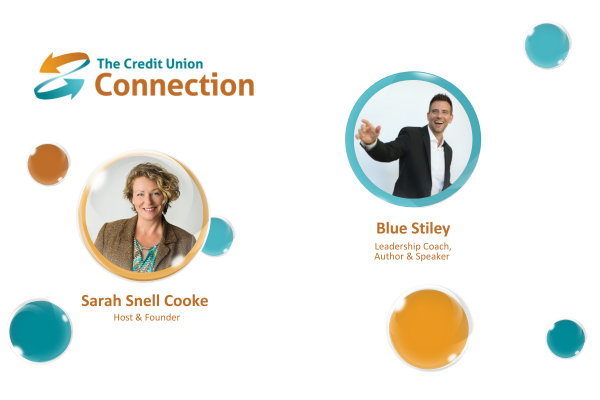
Blue Stiley lived the Karate Kid story. Picked on as a kid for his name, he was put into martial arts and discovered the power of belonging.
A leadership coach, author and speaker who works with high-trust industries, Blue brings a message credit unions need to hear: people stay because of small moments, not big ones.
The data backs it up. It’s not the pay raise or promotion that matters. It’s whether people feel heard, seen and valued. It’s whether they belong. That word sound familiar, credit unions?
The Small Moments That Matter
Blue calls it the 3-5% edge. It’s not a massive overhaul of your leadership approach. It’s what you do every single day in small ways that make someone feel special. The thank you card. Remembering they like maple bars and hate chocolate. Listening actively when someone talks about their kid’s baseball games or their favorite movies.
For credit unions competing against fintechs like Chime and Dave trying to strip banking down to a phone app, this is your actual competitive advantage. You already have it. The question is whether you’re using it.
Blue’s conversation with Sarah covers resilience, rejection and how to reframe failure. He walks through concrete examples of how mentorship shaped his trajectory and how credit union leaders can build that environment on their teams. When you’re surrounded by people who are better than you, and they make you feel heard and valued, you never want to leave.
Reach out to three or four people who changed your life and tell them so, Blue advises. Not only will it matter to them, but it will remind you of the long list of people who got you where you are.
That’s belonging. That’s the credit union difference.
Listen to the full conversation to hear why small moments pay dividends and how to build a culture where people want to show up.
NOTE: This transcript may contain minor imperfections courtesy of our AI overlords-in-training. We’re not complaining. We’re definitely not complaining.
Sarah Snell Cooke: [00:00:00] Hello. Welcome everyone. I am of course, Sarah Snell Cooke, your host at The Credit Union Connection. I was joined recently by Blue Stiley. He is a leadership coach, author, and motivational speaker. We discuss leadership, rejection, resilience, and how his life mirrors the karate kid. Let’s connect with Blue.
Sarah Snell Cooke: Hello, and welcome everybody. I am Sarah Snell Cooke, your host here at The Credit Union Connection. I am joined today by Blue Stiley. Welcome
Blue Stiley: How are you, Sarah? Thank you so much for having me on.
Sarah Snell Cooke: It is great to have you. Now, you may not know Blue, he is a motivational leadership speaker, author, podcaster, a lot of things. Dad.
Blue Stiley: And a Star, and a Star Wars fan.
Sarah Snell Cooke: Star Wars nerd, yes. Yeah. give us a little bit of background on yourself and what you’re doing.
Blue Stiley: well, I am, an ex-strength coach for Olympic athletes and a martial arts expert. I’m an actor and a model. I went to school thinking I was gonna do [00:01:00] international corporate law, and, I ended up taking a completely different path, and I became a strength coach. And, I loved that. I was working with Olympic athletes, with SWAT teams, with police units, and every single day talking about how to give a little bit better, right?
And the things and the lessons that I was learning from those athletes, those high performers, I was actually applying throughout my life. But then those are the lessons and habits that I had learned from my instructor and everyone- Mm-hmm … within the community that I grew up in, which was a dojo, which was martial arts.
And I basically lived the Karate Kid life. Like, I was picked on and made fun of because my name really is Blue, and, a lot of people think that that’s a really awesome name, and I, I agree, it’s a wonderful name to go through life with, but it sucked as a kid. And, I got beat up and picked on all the time, so my parents put me in martial arts, and it was the greatest thing, because it changed the trajectory of my life by being introduced by one single person, who then brought me into his dojo, where I was surrounded by people who were better [00:02:00] than me and I could learn from.
And they, every single person there made me feel heard, seen, valued, like Brene Brown talks about. But then more importantly, what I’ve found is that they created a sense of belonging. Mm-hmm. Because I did not wanna leave. Like, I wanted to do karate and judo more than anything in this world, and I felt that they saved a seat at the table for me every single day, and you couldn’t pull me away.
It was my, my literal currency, and I loved it, and I’m blessed that I, that I was able to experience that for my life.
Sarah Snell Cooke: Yeah. No, that’s, that’s awesome. Some of the, the, the… In your book, you talk about, the, the book is called The Sum of 4, and we’ll talk about that a little bit later, but in your book you talk about, this one, other student at the dojo, whenever they showed up, you just got so scared.
So scared to fight them, and eventually you r- ended up, taking him down. So yeah, as, you know, one of the things we definitely wanna talk about today is, one, the, the, discovering the power of a person’s potential is one thing, and, Yeah … that you talk about, and I [00:03:00] know, you know, as leaders at credit unions, that’s definitely something that, is critical, and that doesn’t matter if you’re the CEO or the best darn marketer out there.
there are leaders everywhere. But describe what that means to you, as, a- and add into there, too, the resilience that is needed, especially in times like right now, that could be a little uncertain, in particular for credit unions financially. Sure. But for humans financially.
Blue Stiley: Well, w- let’s break that ’cause you asked, like, seven questions.
Throughout my entire life, what I found is the easiest way for me to get to what I wanna do or achieve what I wanna achieve or have what I wanna have is to connect myself with a mentor, and because that’s the, the easiest route. and then to pick and choose the things that they give me, the nuggets that, the takeaways that can make me better, right?
So I can learn from their mistakes, or they can find my strengths and my weaknesses and, and push me in the right direction. Because it’s one thing to, to be, see somebody somewhere and you wanna attain that, but then there’s another thing when that person really cares about you that much that they’ll actually hold your hand and walk through that [00:04:00] fire with you.
And that’s what I’ve found has always worked for me, and that’s that power of that mentorship. and I was surrounded by that as a young kid, and I grew up in that environment, which was a, a blessing in disguise. and what I realized very early on was that you can learn from anybody. It doesn’t matter where you’re from, and as long as you ask questions, they’re gonna pour all their knowledge and experience and stories in you.
And so I was a kid who was an extrovert naturally, but at the same time, it was like I was curious and I wanted to know. And only until… The Japanese believe that you don’t know something truly until you can teach it, and so I was forced to be able to start teaching at a younger age, in my teens. And I realized, like, what the power of being a mentor or an instructor or a sensei or a sempai is what the Japanese call it, is there’s something to that, to actually help someone, to be a leader to a whole group.
And what I realized is that it wasn’t… It was filling my reward bucket. Because when I make somebody better and it, it [00:05:00] makes me feel good, of course, but really what it is is it’s, it’s reminiscing on the moment of the best times of my life. Like, when a, a younger student or a, a, an athlete asks me, “How, how did you do this?”
I get so excited because I get to relive the best parts of my life, like a movie, right? And so through a movie, we find that, it, that maybe transformed somebody or, or it, it changes your behavior because that was a really good movie, and that’s why we get excited. It’s not be- only because it fills your reward bucket, because that’s kind of vanilla, right?
It’s, it’s really, it’s because it creates an emotion within you where it’s a reminiscing. I get to relive the best times of my life, and that’s the power of being a mentor. That’s the power of being a great leader. So when you lead a team or an organization, your ability to connect with them- You kind of reminisce the best parts of your life when you were in their shoes, and that’s the greatest reward bucket filler is that you get to relive.
And hopefully they’re better than you [00:06:00] are when you started teaching them, because that’s the best part of it is when, when they surpass you, and that they’re better today than they were yesterday, and that you’re better today than you were yesterday. And so that talks about the resilience part, because resilience is like a rubber band, right?
Like in, in martial arts, you do the splits, but eventually you start to shrink down. I mean, I’m almost 50 years old, so I don’t do the splits like I used to. And unless you, you keep, keep them up. And resilience is coming back to the same spot that you were before, and there’s… That, I understand that, and people talk about resilience all the time now.
Like, “You’ve got to res- be resilient. You gotta keep getting up.” And it’s like you wanna keep getting back up, but you wanna get up better than you were the time before. And we all, as leaders or e- even as, as an employee, you’re gonna face challenges and setbacks in your life, and you’re… it’s not gonna be all green lights like Matthew McConaughey talks about.
It’s like you are going to have those red lights and sometimes yellow lights. And so when you’re stuck with one of those challenges or setbacks in life, it’s how you take [00:07:00] that and how you decide to get back up. Because eventually, if you keep getting back up, you will win, but you have to keep getting better.
And you’re learning from those failures. You’re learning from the setbacks. You’re learning what works, what does not work. And if you have a great leader, if you have a great team, if you have a… You can learn from employees, too. They’re making you better, so you’re becoming resilient, but you are growing, and that’s the, that’s the trajectory you wanna be on, not just to be better or not just to be the same as you were the, before that setback, but you do wanna grow and just always stay curious.
And so I hope that kind of answers the resilient question
Sarah Snell Cooke: Yes, absolutely
Blue Stiley: but it, I, I think also to, to apply it to, to times of today, like people, like we’re in a time right now where we are getting bombarded by problems, and you’re not the only person who’s gonna ever experience those things. Mm-hmm.
And, I mean, we all navigate our life’s nos, right? Like, rejection is when people tell you no. Failure is [00:08:00] when life is telling you no, and self-doubt is when we’re telling ourselves no. And so we’re constantly gonna be bombarded by those, and especially in today’s world, whether you’re on s- doom scrolling or whatever, you’re seeing other things, and it’s like, “Oh, everything’s against me.
I can’t pay my bills. My, my water heater went out. I can’t make my mortgage payment. She said no to me when I asked her to marry me. I got a, a, I got the acceptance letter, but I didn’t get accepted. I got denied. Like, I didn’t get the promotion.” And then delivering the no can be just as challenging and fearful.
So constantly, we’re fighting these rejections in our lives, and it’s like in today’s world, how you change your perspective and how you look at it is so important. So when you walk in and if you’re trying to get a, a job, let’s say you’re trying to get an HR job at, at a credit union and they deny you, well, there’s a, there’s a thousand credit unions, right?
Like, it probably- Sure … were just your region, right? Yeah. Just in your region. So it’s like, it’s not the end of the world. Being rejected is different than being ejected from a plane at 1,000 miles an hour when your face melts off [00:09:00] like in Indiana Jones, right? It is totally different. It hurts, but it’s not the end of the world.
So what are you gonna do about it? Are you going to take that no, or are you gonna flip a switch and actually do something about it and be better the next time? Are you gonna ask the right question, “Why didn’t I not get this job? Why did this member not join? Like, what did we do wrong? What, what could we do to better ourselves to do that?”
And you have to ask the right questions. And if you ask the right questions, you’re vulnerable enough, and you wanna learn and stay curious, you’re gonna be better the next time. And maybe it’s just a lo- a door that you haven’t unlocked yet, right? And if, if you find the key, as long as you keep getting up to that door and trying to find a way through, you eventually will find a way through.
Because if that boulder’s in front of you, you can crash through it, you can jump over it, you can go left, right, under it, you can dig it, or you can come back to it later. And that’s life, because life is going to be, full of challenges. There’s no straight line to anything that you wanna achieve, whether that’s a great leader, whether that’s being, starting a business and being an entrepreneur, [00:10:00] writing a book, achieving the splits in martial arts, or asking somebody out on a date.
Like there’s… You’re gonna get rejected all the time. So how you perceive it and what you do about it if you are rejected is the most important part
For sure, yeah. No, and, and credit union employees, you know, they, they believe very much in the credit unions that they work for and the, the brand that they stand for and what they do in the communities, and so they often have a lot of great energy and ideas, and sometimes, you know, they get a no.
Everybody gets a no, like you said. and it- but what’s kind of silent afterward is, it may just not be right now, or maybe the boss was cranky that day. You know, being persistent, resilient, getting back up, figuring out how you get to the end point that, that you wanna reach. I think that’s, that’s perfect, and I’m sure, you know, we were talking about sports earlier and how much that d- feeds into leadership as well.
Yeah. I know, an executive who said He, he specifically would, interview [00:11:00] people who had some sort of competitive, experience in their younger life or, even in their adult life, as far as sports or theater or band, whatever it was that you had to compete to be, you know, first chair or captain, whatever.
because that really builds, helps you build resilience as well as- Oh- … leadership internally …
because you’re, you’re learning to be an adult early on in your life in s- in school sports, right? And it’s like you’re, you’re, you’re going through all these setbacks ’cause you’re not gonna win every game, right?
Like most coaches, or, think back to the best time that this relates to you. Like, if, if you have your child in front of you and they’re, they’re, they lose the game, and you go up, a good parent, a good teacher, a good coach is gonna go up and say, “It’s okay. You did your best. Winning wasn’t, like, the ultimate goal, but don’t worry, there’ll be another game.”
Mm-hmm.
Because the reality is there will be another game. There will be another organization that can hire you for the same HR position, for the same manager position, for every- There will be [00:12:00] another opportunity to get a promotion. There will be another opportunity to do that, another game. And it’s like how you look at it and how you look at life is going to be like, “There will be another game.”
So why can we say that to a child but we can’t say that to ourselves? And the reason is it hurts. Like, it sucks. It’s like- It
Sarah Snell Cooke: sucks, yes.
Blue Stiley: It sucks. We have the scars. It’s like, “Oh, my gosh.” And so the more experience, the more repetitions that you get on through your life, and this is what sports taught me, it’s like you become a little bit, you can deflect them a little bit more.
You can pivot quicker. You can adapt quicker. You can become more resilient faster because you understand that on a scale of one to 10, a 10 being something that holds you back and it ruins your day, ruins your life, if you experience that 10, eventually not getting that home loan is gonna be the 10 for you, right?
Mm-hmm. And just asking someone out and they say no is gonna be a one now, right? Mm-hmm. And, like, if you didn’t make the play, it’s gonna be a one. So it’s a different level of that emotion. And the more experience that you have, then the easier that level [00:13:00] is. And so with sports, with me, it just taught me, like, you’re not gonna win every competition.
You’re gonna get beat up. You’re not gonna get every yes. Y- and y- there are gonna be a lot of doors you have to knock down. And, Cindy Crawford, she applied for, like, 18 agencies- And they all denied her, and it was the 18th one that finally said, “Okay.” And she became one of the, the, probably the best supermodel of all time.
That’s right. But she was denied 18 times. She was just a not yet, right? Mm-hmm. and you cannot take things personally, and that’s something that I learned as an actor and a model. Like, I could go into a casting and the casting director could say, “This guy reminds me of my brother, and I love my brother.
Man, I, this guy’s got the job.” And I, I land a national commercial, right? Or I can walk into the same casting director and he can look at me and say, “This guy reminds me of my brother, and I hate my brother.” I am not getting that job. Like, I didn’t do anything wrong, right? I can’t take it personally. It’s that person.
So all we can do in anything that we do, what, [00:14:00] in any industry or in any life skill that you’re wanting to, achieve, it’s like you can only do what you can control. And anything else you gotta let go of, because it’s not in your hands. You show up the best that you can, and you continue growing, and you stay curious, and you surround yourself around people that do lift you up.
And eventually, if you keep getting knocked down and you keep getting back up, you’re gonna win in the end.
Sarah Snell Cooke: Absolutely. Yeah, one of the… I always, always, always in my mind go back to, I think it was eighth grade basketball, and we’re in the locker room at halftime. I had four fouls, and we were losing to like…
We were a top seed. We were losing to, like, the lowest seed or one of the lower seeds. And, our basketball coach was so mild-mannered. You know, he’s coaching a bunch of prepubescent girls. Yeah. And he’s just so mild-mannered, but we go in that locker room. He gave us hell, you know? A- and we came out. We ended up, I played the whole second half, no fouls.
We won the game, after a, I don’t know, I’m, I feel like it was like a [00:15:00] 20-point deficit. But, Yeah, I think, one of the things I learned in talking about mentorship and things like that was, what really matters, you can get upset about. The other stuff is piddly. You know? It really is. When it matters, when you come down to, like, something important for you, then that’s the time to maybe get upset and, and re- reconfigure your thinking and, and get things back on track.
So, yeah.
That’s one of my favorite stories.
Blue Stiley: That’s a, that’s a really good point, and I, I would want people to hear that because that applies into, into so many things. Like take, for example, even being married to someone, right?
Mm-hmm.
Like, when you’re… Y- you can never… I always say never say anything that you can’t take back or that you don’t do anything that you couldn’t take back, right?
So it’s like it’s so important to make sure that you are, are staying in alignment, and it’s like being able to, to be able to have those conversations and it’s like y- you, you have to have a certain mentality when you’re [00:16:00] conversing with other people and you’re putting themselves in their, their shoes, and your ability to adapt and change is, is so important.
Because, like, taking for example, like, you coming out and thinking differently and like, “Okay, this isn’t the end. We can win. We, we can pick ourselves back up,” it is your mentality. Mm-hmm. And it’s, being able to survive those moments is so important and so critical. and the more repetitions, the more practice and experience you get in it, the stronger it’s gonna make you, whether that’s in marriage or whether that’s in, at your job with your teams, or whether that is with, you know, just, like, being an entrepreneur and, and putting yourself out there and, and being rejected and, and hearing those noes.
Yeah, for sure. And so we’ve talked a lot about, like, the one-on-one kind of leadership and devel- development, but, how is that different- ta- when you’re talking on an organizational structure level, the leadership and resilience as an organization
Okay. Well, one thing is is that as a leader, it’s up to you.
Because I, I believe that it’s not the big moments. In fact, [00:17:00] the data shows that it’s not actually the big moments that make somebody stay. Because we’re in a time now where people feel that they don’t have to stay anymore. They can leave, and it’s… They stay because they want to. And so that means that the way that you make people feel around you is more important than it ever is, right?
How do you make them feel in those moments? And a lot of people believe that it’s the big moments. Like, oh, it’s the pay, it’s, the promotion that they didn’t get or… It actually, the data’s showing that it’s actually the small moments, the ones that you don’t think about, like how you treat someone or the conversations that don’t happen, whether or not they feel like they actually matter.
And so do they feel heard, seen, valued, and like they actually belong? And I mean, like, putting your arm around somebody belong in a good way, right? It’s like they wanna be there. And so how can you have those kind of connections with people? The easiest way is something that I call find your table. Like, you spend…
When you walk in, when you’re walking in Starbucks or something and you see somebody go, and you see somebody you know and go, “Hi, George,” and you just walk out. Or do you [00:18:00] stop and you take two minutes and you find out about them? And you say, “Hey,” you know, and you take mental notes, and you actively listen to that person.
When you do that on a small scale with just one person, you take those mental notes, right? And those mental notes then become the equipment or the tools or the skills that you can then later use to create that real and genuine relationship with that one person. But imagine doing that on a team scale.
If you take the time to actually get to know your team. And I don’t mean, like, let’s have a quarterly meeting. Let’s have an all-conference meeting. Let’s do a hoo-rah, and let’s feel good about where we’re at. It’s like are you as a leader sitting down and getting to know your team on a deeper level? Are you unraveling that layer, right?
Or do you just know them on the surface level? Because the easiest thing to do is to get to know somebody about them. Like, do they have kids? Do their kids like baseball? why do they love martial arts? What’s their favorite movie? What… These stupid, I call them, icebreakers really [00:19:00] do reveal so much about the people that work for you or the team members that you’re, that you’re, you’re colleagues.
Like, put yourself out there. Put a little time and effort. The little moments are going to pay a dividend way farther than the big moments of whether or not somebody feels that they got a great pay raise, right? And so it’s taking those m- special moments, finding your table, and sitting across from somebody and actively listening to them and hearing about them Because they might reveal things to you that you didn’t know.
They might reveal things about the company that you didn’t know. They might reveal something that you didn’t know about yourself that you can improve. You’re like, “Oh. Mm-hmm. And makes you curious. And that just, that just makes not only you grow, but the organization and the team and the company and everybody grows.
And so as the Cs rise, everybody’s rising. So my suggestion would be take a moment and actually get to know the person in front of you, whether that’s on a micro level one-on-one or as a team, and then have each other build each other. That’s, that’s what I do love about mastermind [00:20:00] groups, like picking and choosing all these different things.
That’s what I love about the, getaways where people have these team events and you get to learn a little bit about more about each other. But what are you questions are you actually asking when you’re in those, right? Like, why, why are we gonna build this Lego together? There’s a reason behind it. If you can understand the reason, then you, as Simon Sinek would say, you would understand that person’s why.
I call it your currency. If you know a child’s currency, then you can get them to do things, right? Like if it’s video games or if it’s, a driver’s license or whatever, if you know their currency, you can pull out from them, and that’s what a great leader and a great mentor does. If you can do that with your teams, you can get people to move mountains for you.
Mm. That’s how you get people to scale. That’s how you get people to do things that they don’t wanna do. That’s how you get people to do things that they didn’t believe that they could do. But that takes you f- taking the moment, the time, the effort, the small moments, the 3 to 5% edge is what I call it, about being grateful to them, showing your appreciation to them, giving them a magical moment, making them [00:21:00] feel special, right?
Like do, do you send a thank you card? Do you, do you, remember that they like maple bars and, and they hate chocolate? Like those simple little things pay dividends long beyond just saying hello to somebody at Starbucks
Sarah Snell Cooke: For sure. Yeah, no, I, I, I, when I first started my career, I was always trying to be very professional all the time.
leave the, leave anything else at the door, . And, I- once I started opening up, being more personable with people, was when I found they were willing- they would work longer hours, they would understand better about why we were doing something. you know, which helps people, it helps motivate people if they understand the actual why of what you’re doing.
And so yeah, I totally experienced that in real life. I’m sure others have as well. and-
Blue Stiley: Well, and it, it does. It, it, that’s the greatest part. That’s what I love about… So I speak to financial institutions and credit unions, but a lot of high-trust industries. Mm-hmm. And that’s what I love about the credit union space, is [00:22:00] that they’re already people people, right?
They’re, it’s like HR. It’s like people do care, and so it’s like why is it they’re doing it? Well, they, they do actually care. So what are they doing every single day to go that little bit above and beyond? And it’s like, it’s at Nordstrom, they come behind the counter and they hand you something, right?
Like, “Here you go.” Mm-hmm. That’s what credit unions do, is they create that connection with a family, the li- legacy, the lineage. It’s like it is more than just them. It’s a, it’s about- Mm … the member experience and the member. It’s not about the credit union itself, and that’s what’s so special. And so if you can leverage that, and if people can really go above and beyond with that a little bit, that 3 to 5% more every single time- Mm
that’s what’s gonna be the difference. Because that makes you memorable, it makes you valuable, but it makes you referable. Mm. Because I’m gonna tell everybody about the, the credit unions that I belong to because they made me feel special. They actually came behind the counter and they high-fived my kid.
They called me and they said, “Hey, the, [00:23:00] our interest rate just dropped a whole percent for your car loan. Maybe you should do that.” Major financial institutions don’t do that. They don’t know who I am. And so it’s like that kind of connection that the credit unions have, that’s, that’s the bread and butter.
That’s what, that separates them.
Sarah Snell Cooke: And it gets back to that belonging you mentioned in the dojo. Mm. Like having that community and, in a world where credit unions are getting beaten up at times by fintechs like Chime and Dave and, others, you know, which is totally not a personal relationship, it’s entirely, through your phone.
but yeah, that belonging is, is more important now, I think, as, as people become more isolated, working from home more, all those kinds of things. So belonging, emphasizing that belonging is so critical, I think, to, the differentiation of credit unions like you were talking about. Now, we’re running way over time and I’d love to go more, but I, wanna, I always allow my guests to leave our credit union executive audience with final [00:24:00] thoughts.
What would you like to leave them with today?
Blue Stiley: that’s super simple. Are you ready?
Sarah Snell Cooke: Yes.
Blue Stiley: Think about a way that you can go 3 to 5% more in order to make somebody feel special. What are you gonna do every single day, and it’s just the little moments, that you’re gonna make somebody feel heard, seen, valued, and like they actually belong?
Because when you lift somebody up, you are lifting yourself up. And the, the s- flip side to that is that you are who you are. You have what you have because of a long list of people that have helped get you there, like a CVS receipt long, right? And I wanna continue adding to that, that receipt line, right?
I want people that lift me up. And so by giving that 3 to 5% edge and pushing people to get them to believe in themselves, to find their greatest potential, that’s the greatest thing. But to remember your roots. And the easiest thing that you can do to remember your roots is think of three or four people and reach out to them and let [00:25:00] them know how they made a difference in your life.
And let them know, because that not only will fill your reward bucket, but it’s gonna blow their mind. They might not even know that something they did or said changed the trajectory of your life. What better way to give back to your teams, to yourself, to your community, to anybody that you know, than to lift them up and say, “I am who I am because of something you said.
Something you did changed my life.” Man, that is, like, big time powerful. That’s powerful. So get your phone out, go to your contacts, slide through it, and whoever it lands on, there’s a reason they’re in there. Call them and tell them. Let them know why they’re in there. Mm. And it might make their day, and it might make your day.
And if you feel comfortable, tell Sarah about it. She’ll wanna know.
Sarah Snell Cooke: Yep, for sure. Thanks so much, Blue, for your time today. Appreciate it.
Blue Stiley: Thank you, Sarah. Thank you.