

Financial abuse is the invisible anchor trapping victims of domestic violence and human trafficking—present in nearly 98% of abusive relationships.
Enter FI Safe, a non-profit initiative by Purple Bridges co-founders JT (Jonathan Taylor) and Shirley Senn, (New Orleans Firemen’s FCU) bridging the gap between credit unions and local resource centers. By teaming up with innovators like SafeYou and Loop Solutions, FI Safe equips credit unions with the training and tools to detect abuse, protect staff and members, and cut abusers’ financial control.
Credit unions already combat elder financial abuse; now, it’s time to make a small shift to protect the rest of our community. Because when it comes to saving lives, the real ROI is living the “people helping people” mission.
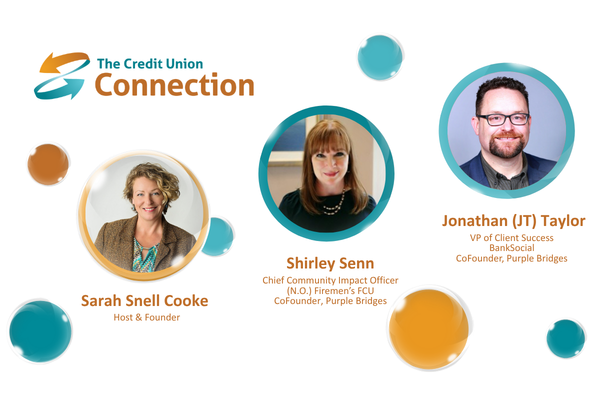
Want to learn how your credit union can join the fight? Catch the full conversation of this latest podcast hosted by Sarah Snell Cooke for The Credit Union Connection.
Sarah Snell Cooke: Hello and welcome everyone. I am Sarah Snell Cooke, your host here at The Credit Union Connection. I’m joined today by two lovely people. I’ve got Shirley Senn on my left, welcome, and, JT…
JT: Hello…
Sarah Snell Cooke: …Jonathan Taylor. In case anybody knows—not Jonathan Taylor Thomas—he is, yes, the stepbrother. Anyway, welcome to the show today. We’re talking about FI Safe, which is an initiative of Purple Bridges that you all founded. It’s a non-profit that helps credit unions better serve members who are survivors of domestic violence and human trafficking. And so there’s that, but y’all also have your day jobs. So JT, why don’t you kick us off? Tell us a little bit more about yourself.
JT: Absolutely. Thank you, Sarah, for having us on today. So JT, Jonathan Taylor, as you said. Current role is vice president of client success at Bank Social CUSO, and co-founder of FI Safe and Purple Bridges with the FI Safe initiative, and CU Spotlight with Shirley Senn. Thanks for having me.
Sarah Snell Cooke: Absolutely. Love the deep male voice. Gotta have that in the mix.
JT: There we go.
Sarah Snell Cooke: That in the mix here. Shirley, you’re up.
Shirley Senn: Thanks. So I’m currently the chief community impact officer at New Orleans Firemen’s Federal Credit Union, now Firemen’s Federal Credit Union. And as JT said, he and I, along with several other credit union colleagues, formed Purple Bridges a couple of years ago to house the FI Safe initiative, to bring together different stakeholders in helping, like you said, survivors come out of financial abuse and into financial empowerment.
And I think a part of it’s not just the tools, but it’s also being able to tell those stories, and so that was partly the reason for forming CU Spotlight, was to help elevate those types of voices. We have so many good, like yourself and others, that are bringing stories out about what the credit union movement is doing, and we just wanted to add another layer to that to capture some of these stories in the background.
So that’s why CU Spotlight, and then also CU On The Road came into existence, so we can take some of that storytelling actually on the road and also have an impact of going and visiting national parks along the way. So credit union and everything.
Sarah Snell Cooke: Yeah, absolutely. My husband and I are gonna be taking out the Credit Union Connection party bus real soon for…
JT: Oh, fun to meet our viewers cross-country. This could be a caravan situation. CU Caravan could be the overarching thing here.
Sarah Snell Cooke: I’m just upset my husband wouldn’t let me wrap it in turquoise and orange bubbles, but here we are.
JT: You’ll find the right combination of words, I’m sure of it, Sarah. You’ll talk him into it.
Sarah Snell Cooke: Absolutely. He has no choice. Anyway, so talk a little bit about, and JT, I’ll start with you, the impetus for this. Because you being the dude, now typically when people think about domestic violence and even human trafficking, it’s largely women. But how… what was the impetus for you here?
JT: Yeah, that’s a great question. A few years ago I was at Architecture CUSO, another CUSO, shout out to those guys, and was asked by a previous board member or CEO of a credit union if I’d be interested in applying as the CEO of CUSoL, which is a Ford Credit Union CUSO based in Albuquerque.
And as I was researching the CUSO and what they did, they had an initiative that was called CUSafe that they had just started, and it was kind of in its fledgling moments. But it was an initiative to connect the statewide domestic violence resource center in Albuquerque to two credit unions that were owners of the CUSoL CUSO, US Eagle Federal Credit Union, and Rio Grande.
Shout out to both of them. And it really, really resonated with me very strongly. My mom was a social worker, and so I had that in my blood, but also, I’m a girl dad. I have three daughters that are 29, 14, and 12. And my oldest daughter came up to live with me when she was 12. Her mother let her come, and I never questioned it at the time. I was just happy to have my daughter, only to find out years later that the reason behind her coming up was that she was fleeing from a domestic violence situation from a now-ex stepdad who was in the military. So that was the fire in my belly to start this work as a girl dad.
And so I accepted the job at CUSol and dove into this work. And we learned a lot in the initiative, what to do, what not to do as well. But that’s really what started it. And then as CUSol was phasing out, we looked at each other and said, “God, we’ve done so much here, we have to keep going with this.”
And after meeting Shirley at the Underground, shout out to them, at GAC—shout out, in the middle of St. Louis, yep. Yeah, thanks. Thank you Brandy and Susan for accidentally putting us together—we said, “Let’s rebrand this and let’s go as FI Safe.” And so that was two years ago, Shirley?
Shirley Senn: I think. Yeah, about two years ago.
JT: And so now, we have a program where credit unions can raise their hand to join the fight against domestic violence and human trafficking, but in a very specific way, by combating the financial abuse aspects of domestic violence and human trafficking, which is really where credit union superpowers are.
And not to do all the pieces, but hyper-focus on that. And we’ve created a program now that we are in the final stages of launching with St. Cloud Financial in St. Cloud, Minnesota. Shout out to Megan and Jed Meyer and that whole crew there, with a local resource center that they have called Anna Marie’s Alliance.
And so what we provide is the consulting, the training, the collaboration, and the coordination of the program between that local resource center and the credit union, as well as the technology, where we have a wonderful… We were just on a call with them right before we jumped on here.
Sarah Snell Cooke: Incredible, we have two incredible technology providers, one being Loop Solutions, and another one being SafeYou.
Speaker: Awesome. Can you tell us a little bit about those two tech organizations?
JT: Yeah. SafeYou, they’re both just amazing, and they’re women-founded fintechs, both of them. But one, SafeYou, based in Armenia, the country of Armenia, and Mariam Torosyan, her and three of her best female friends, created this app, in 2020, I think, Shirley, to combat the violence against women that they were seeing happen around them. And she has done an incredible—her and her team, Lilit and everybody, have done an incredible job of building out a safety app that also is a central hub for survivors to get, not only help them in the moment of attack, but also help them in the healing and moving forward with their lives.
Sarah Snell Cooke: So it’s a wonderful technology and they’re in, I think, eight countries at this point, including New Mexico, which we were…
Speaker: New Mexico, its own country.
JT: Right, and I guess in some ways you could say that. But yeah, we met Mariam. She was here on a grant to just research the United States, and she was in Albuquerque.
And the woman who helped create CU Safe at CUSol, our representative, Pamela Herndon, who is a board member at US Eagle, she reached out to me and said, “Hey, you’re gonna be in Albuquerque next week for your annual board meeting?” And I said, “Yep.” And she said, “You have to meet a woman while you’re here.”
Sarah Snell Cooke: She’s come up with this incredible technology.
JT: And it was just light years ahead of what we had envisioned at CUSol. And so yeah, we partnered with her and she was able to launch in New Mexico, which is the first state in the United States to launch SafeYou. So we’re very proud of that.
She’s gonna be coming this October for Domestic Violence Awareness Month, to do some fundraising with the goal of expanding New Mexico, but also other states on that side. And then on the Loop Solutions side, they’re a US-based company, and they’ve partnered with over 70 different domestic violence resource centers or of many different names, agencies, whoever, whatever word you wanna say, NGOs.
And they have some incredible momentum behind them as they’ve partnered with the Gabby Petito Foundation in Florida. For those who may have seen the Gabby Petito story on Netflix, she had been sadly murdered by her fiance during the pandemic. They were doing a video blog as they were traveling around the United States, and then she went missing, and come to find out, she had been murdered by her fiance.
Sarah Snell Cooke: Sorry, mind blanked. Yeah. But her stepdad and mother have created a foundation, and they’ve partnered now with Loop Solutions in order to try and put this clandestine technology that Cara Wasser has created in Loop Solutions into the hands of first responders so that people like Gabby, when she did call the police and they were there with her, they could have handed her this app that is disguised as a video game that…
Speaker: …no abuser can look at and access.
JT: Had she had that, they believe she could have potentially saved her own life utilizing the tool. So the goal is that through the Gabby Petito Foundation, there’s now a bill on the floor, or about to be on the floor, at the US government to help fund an initiative to enable this technology to be nationwide in the hands of first responders, but also to create kind of a centralized hub for people who need counselors, who need agents…
…to help them regardless of where they are in the country because there isn’t always a resource center right around the corner. And especially in rural areas, they really struggle with resources. It’s an exciting time to be part of a movement of technology and empathy.
And we’re very hopeful that we can help a big problem out there ’cause it’s one in three women and it’s one in four men that are struggling with domestic violence and human trafficking, and 98% of the time financial abuse is prevalent. So that’s basically every time.
So when you think about it, how many members do credit unions have? How many employees do they have? That’s statistically one in three women in your employment, one in three women in your membership. One in four men are struggling with this. And so it’s been an incredible journey. My eyes just continue to be opened, mostly in really sad and scary ways.
Sarah Snell Cooke: The need is there, and the good news is that our movement has some incredible skill sets that can help combat one of the thickest threads of control, which is the financial abuse side.
Speaker: Shirley, you got anything to add? ‘Cause JT just talked for a while.
JT: I know, sorry.
Shirley Senn: I think you just did our elevator pitch for us.
No, I think, when we think about, like you said, when we think about domestic abuse, I think we tend to put very tight reins around talking about it. And I think we tend to think that it doesn’t happen to us or that we don’t know people. And so if we don’t know people, and it’s out of sight, out of mind.
And yet, as JT so eloquently put those statistics out there, we can’t ignore them. They are literally around us, and the unfortunate side of this is that there are many resources, but it is so difficult to get to those resources to get the help, and that the resources that are out there are so heavily underfunded and understaffed.
And so there are many individuals that go, that are left literally out of that opportunity for creating not just empowerment for themselves, but for their children and their households, whatever that might look like, because this isn’t just affecting the survivor. It’s definitely multi-generational depending on what your household looks like.
One of the things that drew me to this particular thing was, one, we had a colleague, Linda White, who brought us together. She knew about JT’s co-involvement with CU Safe, and Linda and I had known each other for a while and had just reconnected. And she asked me if we could present at the Credit Union Women’s Leadership Alliance annual meeting.
And so that’s really how JT and I got integrated in this, during and after the underground GAC and so forth. But what was of particular draw to me was the fact that this project with SafeYou was going on in New Mexico, and that’s my home state. And I grew up in all of these types of stories that you were telling about in terms of especially the unique population diversity that’s in New Mexico—Native American, it’s heavily populated with immigrants coming from Mexico and Central America.
And both sides of this, of just the domestic violence as well as the human trafficking, were things that were just populated all around us, and yet very little was said about it. And so I knew that I wanted to make a difference in that side. This has been a pet project for me for almost three decades with other organizations I had been involved in.
But when you really think about this, we all know that if you are not financially stable, or even have a pathway out of financial instability, you just keep going around in those cycles of impoverishment and poverty. And that is exactly what an abuser wants to do—is to remove any opportunity for their victim to have any kind of financial security.
And so when you think about who is the natural answer for helping be a part of that, it’s credit unions—financial cooperatives. And so when, like JT was saying, sometimes it takes a little bit of time to ensure that these pathways are very stable. Because if we want to provide a solution, we want to ensure that we have the right technology, that we have the right people, we have the right pathways, the right training, everything, because all it takes is for one small thing to be a mishap, and we could be affecting thousands of lives.
Yeah, literally. And so there’s just a lot of responsibility being in this part of what we do, and I just felt like we needed to start somewhere. And so what FI Safe is doing in bringing to the forefront of the credit union movement… it’s like this syndrome my dad used to tell me about.
Sarah Snell Cooke: It’s like you never even think about driving a red Toyota or red Toyotas on the road until you own one, and all of a sudden you see red Toyotas everywhere.
Speaker: Yeah.
Shirley Senn: And it’s the same with this problem. It’s like it is literally kept under the covers until you start creating a safety net. Even if it’s behind closed doors kind of thing, people start to come out and feel safe talking to you about it, and it’s amazing and daunting how many people in our movement are going through this right now.
And the fact that they just need somebody to reach out to. And so I feel like, as a movement of not just providing financial stability, financial wellness doesn’t mean just finances. It is a complete wellbeing of someone, and that includes this part of their life. And having these tools, having these partners on board, having board members like yourself with Purple Bridges who advocate as well in the circles that you are in, just lets us get that message out deeper and farther and wider so that we can educate people on why credit unions need to be doing this and why…
And I’ll just state it, we so often when we think about something we’re going to do for the credit union, they have to… they say, “What is the return on the investment?” And I’m beginning to look at this from a different perspective after attending a survivor wealth summit last year.
Sarah Snell Cooke: And there was a young lady that stood up, and this question was going around because there were former credit union people, former bank employees in that audience. And she just looked around and she said, “Never should any survivor’s life be an ROI.”
Shirley Senn: And we’ve just got to think of it deeper than that.
Sarah Snell Cooke: We’re not just helping, but there’s an alignment of a lifelong commitment. If we’re gonna help someone, think about all the different touch points that individual has that we could also be helping. But also, it’s helping the credit union, it’s helping the member, and helping the community to know that there’s something open with open doors and open arms to help them change their lives.
Speaker: Right. It’s people helping people, damn it.
JT: In a really incredible purpose, for an example for that, right? It’s very rare that we as folks in the movement can help a member save and potentially save their life at the same time, number one. And number two, what’s the ROI on saving one of your employees?
What’s the ROI on saving one of your members now? When I think about the ROI question, I think about it on kinda two sides of the coin. Number one, how many of your loans that are going bad right now are going bad because somebody is suffering through a financial abuse situation?
How many of your accounts are overdrafting or just flat out defaulting because of that in your current membership? How many days of work is being missed right now, or sick days are being used because somebody is going through an abuse situation, financial or otherwise?
I mean, we recently, after the announcement of St. Cloud, were contacted by a credit union employee who was going through it themselves, and were literally, and still are homeless right now, who could not afford the legal fees to fight her abuser, and now she does not have her children but for four days a month while she’s trying to get herself situated.
And yet, she wanted to bring us in to connect into the credit union to create a path to help others in the membership. But she’s too scared to come forward to let her employer know that she’s going through this. And of course, we’re sitting there going, “Oh, God, how can we just…”
Sarah Snell Cooke: They’ll help you. They can help you, if we can…
JT: So when we first started building this, we used the metaphor of the bridge, with two pillars that are keeping that bridge up. One is the resource center or the agency, if you will, and the other is the credit union. And we were building a one-way bridge from people on the outside who need help in the community over to the credit union to get them help.
That’s really what we were focusing on at the time because I hadn’t realized this truth, that this was already in the credit union. This had already infiltrated the credit union space. And then the credit union started coming to me saying, “Okay, that’s great. We’ve got it this way. Can we also have it go back the other way so that if we have an employee or we have a member, we can get them the help they need at the resource center? Because we can only help so much as a credit union, right? We can address the financial abuse aspects, but what about shelter? What about daycare? What about legal? What about clothing? What about food? What about all these other things?”
That’s where that partnership and that connection within the program between a resource center and the credit union just… it really is the best model that we’ve found so far. The ROI is, what’s the ROI on helping your own employees and your own members, number one?
Sarah Snell Cooke: What’s the ROI on potentially saving people from fraud, saving the credit union from fraud? ‘Cause that’s really what we’re talking about. This is…
JT: Financial abuse is fraud. And then on the other side, what’s the lifelong loyalty that’s created from a member who you do help, that you give them that chance to be able to move on with their life? What is that worth over the course of 30 years? And what about those folks that have gotten out that are successful and they’re looking for a financial institution to park their money with? People vote with their dollars these days.
Sarah Snell Cooke: And I can tell you, Shirley and I have been approached by very successful people that have said, “If I would’ve had this, it would’ve made my life so much easier. And who’s doing this? Because I wanna support them.” There’s a lot of members in your community that will support your organization because you’re doing something like this.
Speaker: For sure. And talk a little bit more, if you will, Shirley, about the different situations, ’cause I don’t know that everybody understands what financial abuse aspect of it means. There’s a lot of facets to that, I think.
Shirley Senn: Oh, gosh. Yeah. As JT said, the easiest way to start as a baseline is to think about what we deal with elder fraud—when you’ve got individuals that maybe it’s a caregiver, a bad caregiver that has taken responsibility for power of attorney and starts withdrawing money or funneling money or laundering money through accounts. It’s things of that nature.
But when we think about what’s going on in this world of human trafficking or survivors of domestic abuse, it’s literally taking away financial dignity. You are taking control of everything. It’s not just about bank accounts, it’s about your job.
Sarah Snell Cooke: It’s about living… if you have a job.
Shirley Senn: And if you do, a lot of times it’s getting a check and the abuser is going with the survivor to the institution to make sure they deposit it, and then turning right around and making them withdraw the funds. It’s things of ruining their credit, deliberately ruining their credit so they know they can’t go anywhere else.
And this isn’t just about ruining the ability for you to go out and buy a car or to get a credit card. This is literally ruining every aspect of household stability. Think about how when we wanna go and apply for not just a mortgage, but just simply to rent someplace… they’re checking your credit.
And if they see your credit is bad, or if they even see that you are married or still with an abuser and that… there’s just so many levels of that. It’s affecting your ability to have housing. We’ve had a story here recently from a young lady that is working and is homeless because while she was still going through her divorce, she was still married, and her abuser had a legal record.
He had been jailed. And because that was still on her record and in her credit profile, they did not want anybody associated in their housing complex that still had ties to an abuser. And that’s financial. It’s just those little types of things that they just take control of everything.
They take control of the phone, how you’re gonna get money from an ATM. And so when you remove all freedoms from any type—cause that’s how we pay for things, that’s how we transact business—is through either digital assets or monetary transactions with cash. And I think the statistics say that it takes seven times for a victim to come back before they’re finally free because it’s all in that finance side.
They cannot survive out there on their own, and like we talked about, there are just not enough resources for them. But if we think about where credit unions can step in, and a lot of us do character-based lending, we’re willing to look at non-traditional ways of underwriting a loan, think about this—if let’s say you do have an employee that has come to you and is suffering from domestic abuse, is going through this right now, and needs help, there are so many things a credit union can do.
Let’s just, as an example, if you write a letter for something that shows character, if they need a first and last month’s rent and a deposit, and their credit is ruined, why not give them a loan for those funding and also help them rebuild their credit? There’s just little things that we could be doing, not just for our external members, but internal as well.
So that’s why this is so important to me, because to see those rights and those opportunities being taken away and held captive, is not just wrong, but again, it is costing people their lives because they do not have a way to get free.
JT: Yeah. It’s so interesting, Shirley. One case that we dealt with down in Albuquerque, we were able to get a car loan, ’cause that’s one of the big needs, of course—is transportation. And the thing that sunk the deal was the auto insurance, because the auto insurance was based on the credit. And we literally… the cost of the auto insurance was as much as the monthly payment for the car. And yeah, it is tied to everything.
The good news for credit unions on this, I think, is that, number one, you’re perfectly positioned to help. Number two, you’re already doing this work. You’re just doing it in a different way. Really, when we boil it down, it’s about financial abuse, and as Shirley said, you’ve already joined that fight with elder abuse.
Really, what we’re trying to get credit unions to do, and we’re succeeding at now, is getting them to understand that all they need to do is broaden the work that they’re doing to combat financial abuse and elder abuse to another segment, and it’s really amazing when we sit down with a credit union, the very first thing we do is we go, “Okay, what are you already doing for crisis lending? What are you already doing with elder abuse? What are you already doing?”
And St. Cloud can attest to this, they were relieved because they’re like, “Oh, we do this loan for if a house burns down or…” You’re like, “Great. Talk to me about that loan. How can…” And really it’s a three-degree shift and a repackaging of a lot of the work that credit unions are already doing, and just doing it in a different way, recoding a few things so you can track. But that’s a big, I think, relief for credit unions as they’re looking at doing this, that they’re like, “Okay, number one, we don’t have to recreate the wheel. Number two, we’re already doing this, just in a different way.”
Shirley Senn: And sadly, number three, it’s already inside our credit union, so we’ve gotta do something, because doing nothing is only creating loss for the credit union and more pain for our members and our employees.
Sarah Snell Cooke: Yeah, and I think too, I personally have a strong sense of justice and injustice, which is a large reason why I joined the board there, and happy to do it and promote and work with you all. So I should have probably disclosed that, but this isn’t real journalism anymore. But you were talking about St. Cloud and some of these other credit union employees you’re referring to. Shirley, let’s start with you. What has been the response from credit unions and other credit union organizations?
Shirley Senn: I think it’s been a little slow at first ’cause I think people were like, “This goes on in our industry? This goes on in our movement? This can’t happen.” And the reality is it is, it has, it will, and it will continue to be there. But, as we have provided a safe space for people to talk to us, I am seeing more and more opportunities for people to feel comfortable and actually to tell their stories.
Because of just exactly what JT was talking about, this is as broad if not bigger than elder abuse. And we want to be leading the charge on eradicating that financial abuse. And we get a lot of, “Hey, we love the work you’re doing, but…” And I want it to be, “Hey, I love the work you’re doing, and how can I help?”
And that’s where we’re slowly seeing the cruise ship turning in that respect because I think people understand, again, just going back to the daily business, is that when we’re thinking about financial wellbeing in particular, it’s not just about teaching them how to do this, sitting down there, do modules one through seven, and then I hope you have a good life.
But we now truly understand that it has to be a change of behavior. And so understanding that also means that we, as credit union employees and advocates, have to also change how we provide the services and the assistance and so forth. And the willingness to be able to do this has been remarkable, and the credit unions… a shout-out to Orsa Financial, for example. They have their Choose the Bear program and have made a major stand on that. And I think as we start to slowly see them, St. Cloud, other credit unions come into the forefront to say, “We support this, it’s the right thing to do,” that we’re starting to see that trajectory really pick up.
JT: And I’ve also seen some really creative angles from credit unions as they’re looking to do something like this. Number one, it resonates big time with the employees and really motivates them to get behind an initiative within the credit union, so we see a lot of that.
But we’ve also seen very creative ways of, okay, how can we also do well while doing good in these situations? And we had a credit union recently say, “Hey, we would like to take an initiative like this by funding the technology that the resource center can leverage and utilize,” which is part of our model, “and also bank those nonprofits, bank those resource centers, make them business accounts, make them part of our SEG, make them part of the credit union so that they can, as they get their funding, as they get the resources that they need to run their day-to-day, they can flow that through the credit union. That brings in more liquidity. That’s good for everybody.”
And I’m like, “Brilliant. That is what I’m talking about.” There are ways that we can do this work, get creative, and also help impact the bottom line for the credit union.
Sarah Snell Cooke: Yeah, for sure. And, you all also offer, you mentioned in passing, trainings and sessions and briefings for credit unions and related organizations. Talk a little bit about those as well.
Shirley Senn: Yeah, again, I put kudos out there to all of what the credit union’s doing to provide a basic level of financial education. But as we start to think about what’s unique about different niches that we work with, a lot of them are suffering different levels of trauma. And so part of the training here goes to how do we help bank, and a lot of times underbanked or unbanked, individuals in context of what they’re going through, and that’s where that empathy really comes into play.
But it’s little things like this. We obviously have regulations and guidelines for opening accounts, et cetera. And an easy one to think about is when you’re opening an account, know your customer. Most of the time we’re required to have one to two forms of ID. And let’s just take the situation where maybe we literally have someone, and this is a very realistic thing definitely in the human trafficking space, that they’re being brought over here with absolutely no identification. Or we have abusers that, again, have taken away and a survivor has gotten away and having to restart. They don’t have an ID to come in, and they’re having to open an account, for example. Maybe they got a job and they need direct deposit, and they need to open an account, and you are just trying to help, but you say, “Hey, love to help you, but we need two forms of ID,” and they don’t have it.
They’re probably not going to come back. But what if, like Jonathan said, we have so many tools at our disposal, what if we were to tap into biometrics, for example? ‘Cause if that person had a driver’s license at one time, that’s still in the database. So part of the training is just rethinking how we can help, and how can we help in a way that is in alignment with their situation, which takes an additional level of training in what we like to term compassionate banking.
So it’s not just about the financial counseling to the individual, the end user, but it’s also working with the employees of the credit union to help them identify potential survivors, but also to help them in alignment, without feeling that they’re running into any compliance issues. And then on the other side is knowing when to work with your resource centers and other advocates to know when exactly is the right time for financial abuse and empowerment to become a play in that safety plan.
JT: Yeah. That’s perfect, Shirley. Swim lanes are paramount, and that’s definitely something that I learned early on in doing this work, is that with a willingness to help, you wanna make sure that you help and not overstep your role. And so that’s a big part of the training as well, is just the folks in the credit unions understanding where does it start and where does it stop, because we don’t want the resource center to take on fiduciary responsibility and pre-underwrite and do things like that.
Just like we don’t want folks at the credit union who don’t have certifications in counseling, who don’t have these different certifications, to overstep their role. And part of the training is just understanding where the NGO or the resource center, the agency starts and stops, where does the credit union start and stop in this work. Because the credit union really from a resource center and agency standpoint is another spoke on the wheel to help solve one of the many problems that a survivor has as they’re trying to break away, or they’ve broken away and they’re trying to now move on with their lives and survive.
Sarah Snell Cooke: Yeah, absolutely. So I always allow my guests final thoughts. Unfortunately, we’re running up against time here, which, I could talk about this probably all day, or at least JT could. But I’m just giving you a hard time, JT.
JT: I can, Shirley… and I will.
Sarah Snell Cooke: Shirley, I’ll allow you to start with final thoughts. What would you like to leave the credit union audience with today?
Shirley Senn: Yeah. I would just say that there’s been so many things that credit unions have been pioneers on, giving women their first loans, remote deposit capture, and these were all things that in their own times and respective areas were things that were being turned away by mainstream financial institutions.
And credit unions and the credit union movement saw the need and the right for those things to be happening, the innovation. And so I would encourage us in this respect as well, that when we’re thinking about literally 33% of the population being in one of these statistical communities, it’s somebody that you know, and it’s somebody, could be a family member, could be a neighbor.
Sarah Snell Cooke: But you literally could be the lifeline for helping somebody save their life and put them on a road to financial empowerment, and I don’t know that there’s any better ROI than knowing that you saved somebody’s life.
100%. All right, JT. Oh, let’s close it out.
JT: How do I follow that? Similar to what Shirley just said, we have to act. This is something that is getting worse. It got terrible during the pandemic, and those numbers have not gone back, and nobody knows why, because the data is just not there. And we have the ability to help save our staff, our own people, to help save our members, and also make an impact with the community.
It is not enough to stroke a check, okay? That’s a handout, not a hand up. And it’s time for the credit unions to really get busy with action on the people helping people with this pandemic. You guys have done a great job in elder abuse, and now we just gotta widen that out to a much larger audience of your current membership.
Sarah Snell Cooke: All righty. And I said that was the last thing, but Shirley, tell us where people can find out more.
Shirley Senn: They can go to our website at www.FISafe.org. My email is shirley@FISafe.org, and JT’s is jonathan@FISafe.org. Or look for us on LinkedIn. We also have a LinkedIn page for FISafe as well. And I’m happy to connect anybody as well.
Sarah Snell Cooke: Thank you so much for your time today. Yes.
JT: Thank you. Appreciate it. Thank you. Bye, guys.