

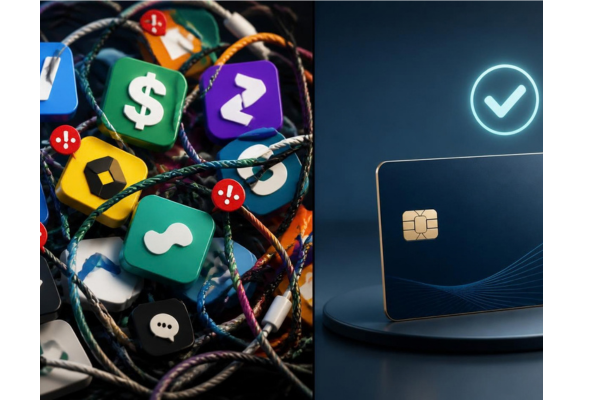
Here’s a frustrating truth about sending money to friends today: you need to make sure they’re using the exact same app as you.
Venmo? Cash App? Zelle? It’s like trying to coordinate streaming services for a watch party—except with your actual money.
Moov Financial is taking a different approach. They just launched Moov Money, a person-to-person payment solution built on a simple premise: almost everyone already has a debit card, so why not use that?
The Debit Card You Already Have Is Now Your Payment Address
Working with Visa and Mastercard, Moov Money lets people send and receive money in real-time using their existing debit cards—no new apps to download, no new accounts to create, no wondering if your friend is on the right platform. The payment goes straight to the account linked to any eligible Mastercard or Visa debit card.
The numbers back up why this matters. According to the Federal Reserve Bank of Atlanta’s 2025 Survey and Diary of Consumer Payment Choice, 90.5% of U.S. consumers carry a debit card. Meanwhile, no single P2P provider today reaches more than 34.6% of consumers. That’s a pretty significant gap.
“Moving money shouldn’t depend on whether two people use the same app,” said Wade Arnold, CEO of Moov. “Moov Money breaks these restraints, enabling anyone with a debit card to securely pay and get paid.”
How It Actually Works
The technology runs on Mastercard Move and Visa Direct—the card networks’ existing infrastructure for moving money quickly. Moov provides the layer that connects these networks to your bank’s digital experience, handling everything from linking a phone number to a payment destination to verifying identities and catching fraud.
Justin Zhao, Head of Visa Direct for North America, emphasized the security angle: “Through our work with Moov, financial institutions can now use trusted Visa credentials and infrastructure to help consumers send and receive money with greater confidence and ease.”
Security That Actually Addresses Modern Fraud
If you’ve been following the news, you know P2P payment scams are a real problem. Moov Money tackles this with a multi-layered approach that includes device intelligence, phone-based identity verification, network-level card validation, passkey authentication, real-time monitoring, and AI-powered fraud detection.
Plus, Moov handles disputes, fraud monitoring, and tier-one support for participating financial institutions. That means banks and credit unions don’t need to build out massive support operations just to offer P2P payments.
Banks Can Keep Customer Relationships (Finally)
Here’s something that keeps community banks and credit unions up at night: when customers use third-party payment apps, those transactions happen outside the bank’s ecosystem. The relationship moves elsewhere, one Venmo payment at a time.
Moov Money integrates directly into existing digital banking platforms, so the experience stays under the financial institution’s brand. Jack Henry’s Banno Digital Platform is first in line, giving over 1,000 banks and credit unions immediate access to the solution.
“Community banks and credit unions are built on service, relationships, and trust,” said Jack Henry Chief Technology Officer Ben Metz. “Integrating Moov Money into the Banno Digital Platform enables financial institutions to deliver a modern, fast, and secure P2P payment experience directly under their own trusted brand.”
Mike Kresse, EVP of Commercial and New Payments Flows at Mastercard North America, summed up the broader vision: “The future of person-to-person payments is interoperability. Tapping into the trust and reach of Mastercard Move, together we’re helping financial institutions unlock that future so that the end-user can focus on what matters—seamlessly getting money into hands, when and where it’s needed most.”
Who Can Use It and When
Moov Money is available now for banks, credit unions, neobanks, and brokerages for domestic person-to-person payments. Financial institutions can integrate it through their existing digital banking experience or work directly with Moov. Recipients with eligible cards in Mastercard Credential Services or leading mobile wallets can even use tokenized card credentials, which means they don’t have to manually type in their card number every time.
It’s a practical solution to a problem that’s been oddly complicated for too long. Moving money between people should be as simple as having a debit card—and now, apparently, it can be.