

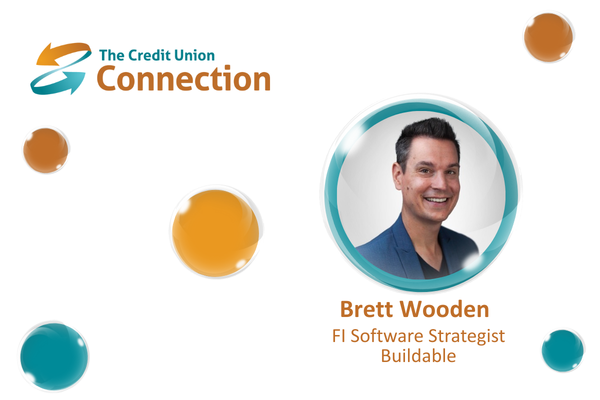
Brett Wooden, financial institution software strategist, Buildable
AI has changed how we think about building software. What used to take months can now be prototyped in days. Interfaces, workflows, even entire applications can be generated with a few well-structured prompts. For credit unions looking to move faster, serve members better and compete with fintechs, that’s incredibly appealing.
But speed isn’t the only variable that matters.
As more organizations explore AI-assisted development, the real question becomes less “can we build this faster” and more “what are we actually building, and how long will it last?”
Another layer to that question is often overlooked, especially when speed becomes the focus. “Do people actually want it?”
Human-centered design becomes critical. AI can help you generate ideas, features, and even full user experiences, but it does not validate whether those solutions solve a real problem for your members or employees. It can produce something that looks right without ever confirming that it feels right in practice. In many ways, AI can accelerate us past the most important step, which is understanding the human on the other side of the solution.
Credit unions have always had a unique advantage here. Relationships, trust and a deep understanding of their members define them. That same mindset must carry into how software is designed and developed. Before building anything, time must be spent asking questions, observing behaviors and validating needs.
The question shifts from whether we can build something quickly to why we should build it at all.
Human-Centered Design
When human-centered design leads the process, AI becomes a powerful amplifier rather than a shortcut. It helps bring validated ideas to life faster, instead of creating solutions in search of a problem. That distinction can be the difference between software that gets used and software that gets ignored.
AI is exceptional at prototyping. If your goal is to validate an idea, create a proof of concept or demonstrate a future-state experience to your leadership team, AI can accelerate that process dramatically. It lowers the barrier to entry and allows teams to explore ideas that may have previously been too expensive or time-consuming to pursue.
Similar to writing a novel, you could ask AI to write the entire story for you, and it would likely come back quickly with something that looks complete. But if you have never been to Japan and want to write a story set in Tokyo, there is a difference between asking AI to write the story and asking it what Tokyo feels like. The second approach gives you context, texture and insight, but you still own the story. The first may be faster, but it often lacks depth and authenticity.
That same dynamic shows up in software.
Prototypes are not production systems.
The code generated through AI tools is often optimized for speed, not structure. It may work, but it doesn’t always follow best practices for scalability, security, or maintainability. For a credit union where systems must be reliable, compliant, and secure, that gap matters.
Is Your Credit Union in Stack Debt?
One of the less talked about risks in AI-generated development is what I would call “stack debt.” Traditional technical debt is about shortcuts in code. Stack debt goes deeper. It is when the foundational decisions, such as frameworks, integrations and architecture are made quickly without fully understanding long-term implications.
Think about it like building a house. AI can help you frame the walls quickly, maybe even get a roof on faster than ever before. But if the foundation was poured without the right planning, everything built on top of it becomes harder to maintain, fix or extend. The speed at the beginning can create constraints later that are much more expensive to undo.
AI can recommend tools and stitch together solutions, but it does not carry the accountability of maintaining that ecosystem over time.
Credit unions need systems that integrate with cores, vendors and evolving member expectations. Choosing the wrong stack early can create friction later, especially when you need to extend functionality, onboard new vendors or meet regulatory requirements. There is also a growing trend of relying heavily on AI engineers or prompt engineers to drive development. This can be powerful in the short term, but it introduces a new kind of dependency. If your system is largely built through AI-assisted workflows without clear architectural ownership, you may find yourself increasing long-term maintenance complexity.
In other words, you are not just inheriting code. You are inheriting the process that created it. And if that process is not well documented or grounded in sound engineering principles, future teams may struggle to support or evolve the system.
The human-led development approach plays a critical role.
AI Is a Tool
AI should be a tool, not the architect. Experienced engineers and product leaders bring context that AI simply does not have. They understand your members, your internal operations, your regulatory environment and your long-term strategy. They make intentional decisions about tradeoffs, not just fast ones. It is the difference between using a calculator and understanding math. The calculator gets you the answer quickly, but if you do not understand how the equation works, you are limited when something changes. The same is true with AI in development. When humans lead and AI supports, you get the best of both worlds with speed and sustainability.
At the end of the day, credit unions are not just building software. They are building infrastructure that supports member relationships, operational efficiency, and long-term growth. Systems built with intentional architecture tend to last longer and are easier to maintain, extend and hand off as teams evolve.
That last point is critical. Too often, organizations become dependent on the person who built the system rather than the system itself. Whether it is an internal developer, a vendor or an AI-driven process, if the rationale for decisions and how the system works is not clearly documented and understood, you create risk. The goal should not be to build something that only one person or one tool understands; it should be to build something that your organization can own.
AI is an incredible accelerator, and it absolutely has a place in modern software development. But for credit unions, the decision is not just about speed. It is about sustainability, ownership, and long-term value. The most effective approach is not “yes AI” or “no AI.” It is knowing when to use it and when to lead beyond it.
If you are exploring how AI fits into your software strategy, now is the time to ask the right questions. What problem are we solving? Do we actually need this? Are we building something we can own and sustain long term?
If you are thinking through these tradeoffs or looking to move from ideas to execution, Buildable can help. You can reach me at bwooden@buildableworks.com for the opportunity to connect and share what we are seeing across the credit union and fintech space.
Related Articles:
Why We Are Building a Credit Union Branch on Roblox
Meet Your Next Member. They Are Playing Roblox Right Now