

“Five months. That’s all it took. And the first question everyone asked was: how?”
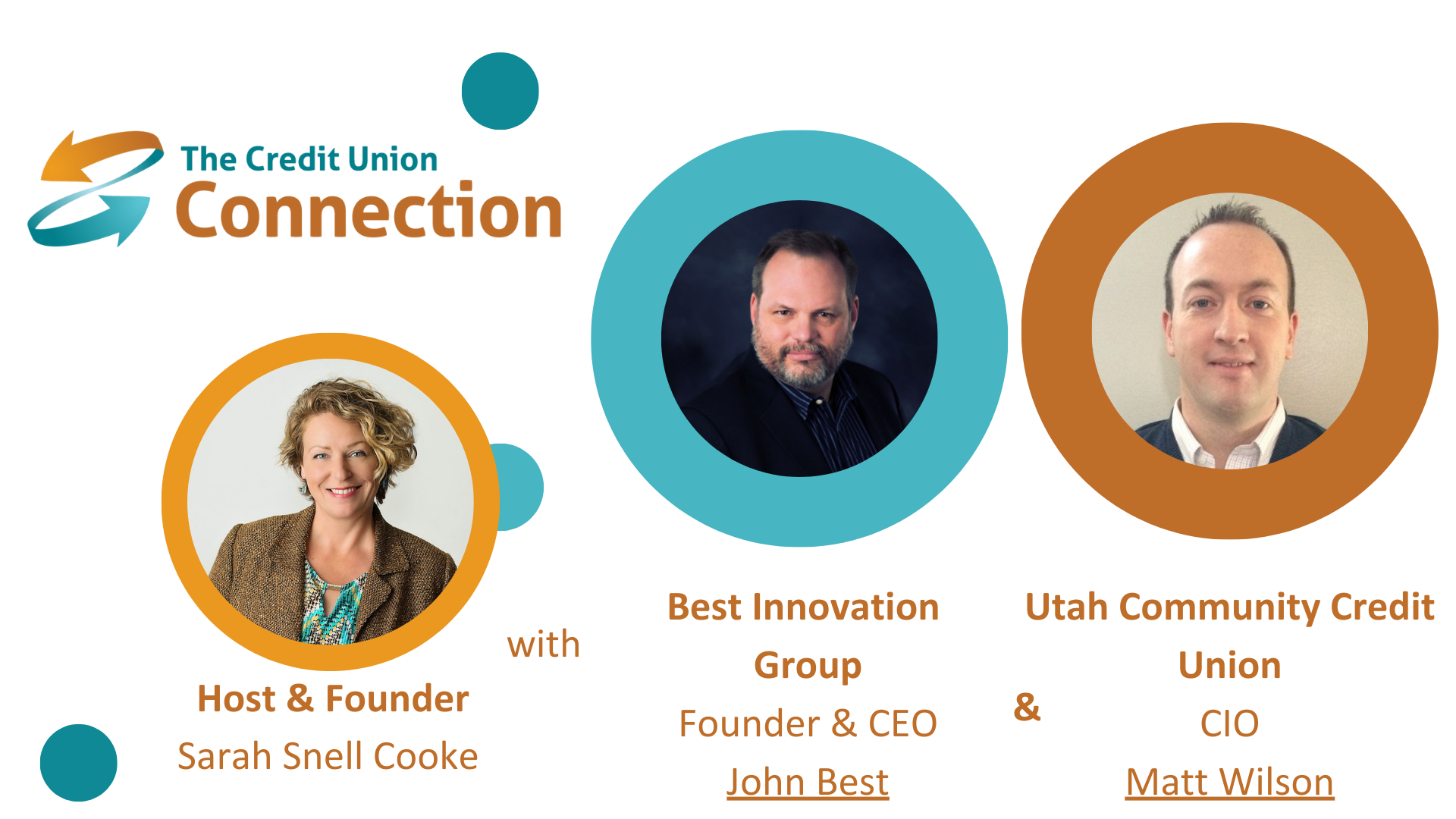
When Sarah Snell Cooke, founder/CEO of The Credit Union Connection, sat down with John Best, founder of Best Innovation Group, and Utah Community Credit Union CIO Matt Wilson, the conversation quickly moved from introductions to the jaw-dropping pace of the technology conversion during a merger that typically takes twice as long. The merger-conversion of Utah Community Credit Union and TransWest Credit Union wasn’t just fast; it was unusually smooth, with technology and people working in lockstep, according to Matt and John.
But as John revealed, the real story wasn’t just about speed. It was about creativity and trusting something relatively new to credit unions: embrace AI.
What unfolds in the conversation is less a “how-to” playbook and more a glimpse behind the curtain of what happens when a credit union’s culture meshes with innovation. The AI didn’t just work; it accelerated processes in ways that freed teams to focus on higher-level challenges.
Matt’s perspective brings another dimension. Having joined UCCU just as the merger began, he inherited both the opportunity and the pressure. His reflections highlight how much of the success hinged on people. The teams on both sides were willing to adapt and even joke their way through the stress of a core conversion.
There’s rarely a moment where technology, teamwork and calculated risk-taking converge so neatly. Give our interview a look see!
NOTE: The following transcript was created by our robot overlords. It could have a boo-boo here and there.
Sarah Cooke
All righty, I’m gonna go Hello and welcome everybody. I am Sarah Snell cook your host here at The Credit Union Connection. I’m here today with two fabulous gentlemen. On my left is Matt Wilson. He is the CIO at Utah Community Credit Union. Welcome. Matt,
Matt Wilson
Thank you. Great to be here.
Sarah Cooke
Cool, very cool to have you as well. And so, John best, you’re a repeat offender. John best is the founder of Best Innovation Group. Welcome, Hey.
John Best
Good to be here. Sarah, nice to talk again. Yeah,
Sarah Cooke
Absolutely. So I’m going to give you guys just a half a second here to better introduce yourselves and your organizations. Matt, why don’t you go first?
Matt Wilson
Yeah, so I am Matt Wilson with Utah Community Credit Union. We are a three and a half billion dollar credit union in Utah, based out of Provo Utah. We serve the community here and in many said groups around the state, but I’ve been around since about 70 years now.
Sarah Cooke
Very nice. Always great to hear the legacy credit unions, and they’re still thriving and relevant, right? John, I don’t know. I think everybody knows you, but go ahead,
John Best
That’s not true. My name is John Best, and I’ve been working in credit unions my entire life. We started big in 2014 with the purpose of sort of helping credit unions continue to grow and look at innovation. And here we are still doing innovating things 10 years later. So I’m very excited.
Sarah Cooke
Yeah, 10 years making it, 10 years in a business is awesome. Yeah,
John Best
I am, you know, I remember someone who won’t be named, said, You’ll be back. And so,
Sarah Cooke
yeah, you didn’t have spite. I know. Yeah, I’m not
John Best
going back, even if I have to live in a box under the overpass.
Sarah Cooke
Exactly. I’m eight years in, so not too far,
John Best
Right? I remember when you went, Yeah,
Sarah Cooke
Yeah. I’ve been around credit unions for 26 years now. I don’t know when I got that old that I needed these damn things, but So John, I’m going to start with you. One of the toughest parts of a merger is the technology. And so that’s one of the things we’re going to talk about, is the Utah Community Credit Union and trans West Credit Union merger that occurred this year. But first start off in general, with technology. How can credit unions better prepare when they’re in this merger situation?
John Best
Yeah, so, you know, it’s funny, because having done so many of these over the years, and I’ve done them in every way you can think of banks creating the credit union just a branch here, boutique mergers, which were really interesting, where we kept the branding of the original credit union intact. And so it was like a powered by this, you know, this credit union, but yet the original naming and branding stayed in place. I think the biggest thing is, is to have your own house in order with regards to products, services and understanding sort of what your strengths are, and also with your people. I think that’s, that’s the other side of it, because, you know, the technology is a difficult portion of it, but the people part of it is just as important and just as difficult, and they really kind of go hand in hand, because it’s a tremendous effort. It’s like a conversion, really in a short time. And it can be, you know, it can be stressful, but I think having your house in order, particularly around your products and services, your own achievement, your own card services, all those things really having a solid plan, like, you know, hey, we’re not going to be introducing some new card and doing a conversion right after we do this or that. There’s a good schedule and understanding what you’re where this fits into your model and what you’re going to do in your business.
Sarah Cooke
Yeah, project management is huge. Not strong suit, but I understand how you do this because of that, Matt, so how do you think crannies can better prepare from your perspective, and what did you learn during the process? Oh,
Matt Wilson
Wow, I learned. I learned quite a bit, and I was fortunate enough to come in after this had all been decided. So I was started with Utah community just at the beginning of the year, just as we started this whole, whole conversion. And it was great. And to John’s point, having a team in place that just is solid and knows exactly what they’re doing, from cards to core to account products and all that kind of stuff, it was, it was a game changer. There’s no way we could have done it in the time period that we did without a solid team in place, not just on the Utah community side, but on the incoming trans west side as well. They needed to know was on their side, so that we could easily convert and map product to product and know what we’re doing with each member and. Institution. So yeah, the team, the team needed to be focused, and the team needed to know what, what was their responsibilities. And I think that’s where we started off on really good foot,
Sarah Cooke
Yeah, yeah, organizing, preparing got to be the first thing in every kind of project to do. So you guys completed this core conversion in just five months. And I’m going to start with John first. But how? I know everybody’s like, what the hell? How?
John Best
Um, well, okay, I’m going to go back to Matt’s point. How is the it was the amazing team at UCC. I got to give props to Christy and all the folks there that were just amazing. So we can come in, I like to say big is this tool where we’re like the old base commercials, remember those? We don’t make x we just make x better. So we are the kind of group. We’re not coming in to help you figure out the board seats or anything like that. We’re purely focused on, how do we get the transition these assets from one side to the other in the most efficient and effective way that benefits both sides? And to Matt’s point, having a great team was the beginning point. The second part was we had just come off a fantastic a fantastic merger before with United credit union, who also had a fantastic team, and we had just gone through that process end to end. And it was a little longer, but not much, you know, so we’re shortening it as we go along. But the other side of it was finding these straightaways right, finding these opportunities where we could put some new tools in place, ie, AI, like we talked about, not just for the, you know, for the products, which was a big part of it, but also even some of the custom programming that had to be done. And we couldn’t do that without the knowledge set, you know, from Utah and from trans West, if we hadn’t had both of those. You know, your own, the AI is only as good as the questions you asked. It’s like, it’s like a shovel and a backhoe. You might think you can dig a hole faster with a backhoe, but not if you don’t know how to use it. And so what they did was they gave us the effort, not only that, but the creativity. And they were really focused in on being open to these new ideas and how we do things and getting these things done, and the faith and trust that they had. So that was, to me, that was the biggest part. But, you know, helping them to understand the art of the possible, I think, was also a big part of it. I think because he had such a good team, and the way we do things is we’re not a black box. We don’t go off somewhere and come back and go, here’s Here you go. We turn on the screens and say, this is way we’re thinking. It’ll go when you think, and get that input. And I think that fostered trust and teamwork, which was a big part of it. But finding those straightaways and having them pointed out, where once Matt’s staff understood the art of the possible, the Cades, the Christie’s of the world, then they could go, what you did with that? Could we do that with this? And that’s where it took off. And so that was that was really extremely important to the process.
Sarah Cooke
Yeah, that’s interesting. I mean, I think it’s great that, that the team started feeling like they owned the project. It sounds like, because they’re asking, well, and getting creative too, asking, well, if ABC works here, then can it work there? That’s great. I mean, Matt, do you have anything you want to add to what John, John was just talking about?
Matt Wilson
It really is. It’s that cohesiveness together, right? And I will say that while we had great teams on the two credit unions coming together, there’s no way we could have done this without, without big either. I mean, just the time frame alone, right? We had, we had a dedicated team to it, right? Everybody kind of didn’t drop everything else. We still had business as usual. We’re still fulfilling the responsibilities each of us had here. But then we also added to it, this conversion. Well, we offset that with big and their group and the great team they have. So all three of those together, just we were able to knock it out of the park. And I couldn’t be happier. We couldn’t be happier with the end results.
John Best
You know, one other thing Matt, I was thinking was, and this was something we learned from United as well, was really taking advantage of the state of the art Tech with regards to communication. You know, we heavily use teams, you know, in the past, when you can remember, and Sarah, you’ve been around for this sort of thing, but it used to be okay. Well, on this meeting, you know, the emails will go and we’ll talk about it, but we really can’t move this or do that. But we, we realized that creating that interaction where, at any point, you know, we could grab a knowledge expert from either trans west or Utah, and ask a question or two. That’s what really greases the skids a lot, especially in the AI side, when you’re when you’re saying, Okay, I’ve got this process going. It’s gonna, it’s gonna go. Through and finish this. But while I’m starting that, let me get started. It’s like a cooking show, right? You know, we’re at the end. You know, you’re putting a bunch of stuff in the oven, but you’re also talking to the audience as you go and trying to pull it together. And just having that, that communication, I thought, was really important, not just from the staff, which was wonderful, but even into lower levels of the staff. They were open, you know, hey, let’s go grab this person. Next thing you know, they’re in the chat, and this is a person who really understands this small element of something that, because what happens is, is that a merger is also the art of the obscure, like, how often do you really dig into trusts, you know, like a trust account, and the way it’s built in the and, and that whole portion, you see them, but they’re not frequent. But then you go to convert 40 or 50 of them that have compiled over the years. And you know that expertise on the other on both sides, is really important, because you know you’re digging deeply into all the aspects and elements of how a financial institutions run, and every financial tool related to that, from credit reports down to how accounts are open, down the document imaging, down to even, hey, how your ATMs get filled with money. I mean, it is, in the end, everything and that’s an important part of it. And we’ve actually, over the years, been amassing a lot of details around that in terms of documentation. And that was another area where suddenly AI came into play, at least on my side, where I went, you know, used to be they grabbed me on a call, and I just sort of rattled this stuff off. I’m getting old, so I’m starting to forget things. And I went one day, I went, I’m going to grab every one of these documents and train an AI on it. And I sat down and did it, and it’s paid big dividends, because what it helps is thinking through all of the what ifs. But then you get the people like, what you know Utah have, where they’re able to go, oh, wait, when we’re in standing, it’s going to be this, and there’s going to be these floating transactions afterwards. And, you know, they got someone really smart, who knows, you know, Jason or whoever, to do this or do that. That adds even more, you know, even more expertise to the to the database, in the sense that, oh, okay, we can plan for that, whereas I think oftentimes those are sort of grenades you find afterwards, and you know, you’re never going to get all the way through. And you know, at the done, go we’re done. Everybody, go home. That’s just not it’s just too many variables. It’s but the closer you can get to that, the more counts that you keep around when they move over, which I really love, that Utah was so open in their communication with us and the incoming members, and really cared about the other credit union, you could feel that those are the types of mergers we really enjoy.
Sarah Cooke
Yeah, oh, wow, communication is important. How about that? Tell my husband,
Matt Wilson
And I think that’s a good point, John, is, you know, sometimes we get used to the day to day interactions and the communication platforms we use and the technology, but really the friction that we removed right, the secure repository for files, and file sharing and being able to bring on an expert into a chat session real quick. I mean, those things really did help accelerate
John Best
It takes something that’s like three days and moves it to an hour or less,
Matt Wilson
Rght? And we were able to respond quickly and move as quickly as needed, as we had those topics come up and those discussion points come up, like you said, so
John Best
And by the way, just it’s, the tech is great. But then you have the people who are willing to do the heck poor Christy God, God knows we’d be Hey, you think she’d answer, let’s not do it. Well, we really need to know. Okay, let’s do it. And maybe Kay, Christie, so many of them that would even the folks from trans West, they were just amazing. And I think when you streamline that communication, and then on top of that, you’re able to, you’re able to really gather this information, because, you know, you get a much more contextualized thing happening in chat, because there’s screenshots, there’s all this other stuff that’s useful to the engagement that really helps you to grow it. So I completely agree. I think that was a driving force behind this, was, how do you build a team? Put it this way, if you want to go to the Super Bowl, you’re going to need a good front line and a lot of good blocking and tackling, and that’s what we brought, you know, that’s what they brought to the table with us, and we were able to just sort of run right behind them and find the holes, you know? And that’s, that’s what we look for, because we don’t, you know, we’re not a huge company. Big is only 12 people, and we’ve done three of these in the last 18 months, and we’re on track to do four more. And that’s a lot for our size. Because if you go to any of the big players right now, they’ll go, Sure, we can do that in 2028 and unfortunately, the industry is compressing faster than that, and not everybody has the resources and the capability of doing this. So yeah, I think. That’s a tremendous opportunity. The other thing is, I want to praise and I didn’t do this. Matt, the reason all that happened is because your infrastructure team was so fantastic. That’s usually an area where I do spend a lot of time, sometimes with particularly the smaller credit unions. They’re being merged in the merger if you will. If that’s the correct term, Sarah, you would know better than I. But you know, helping them with their office, 365, and their teams and all that, but, man, both Utah and united, they just both had fantastic infrastructure teams that just took all of that off the table. Wasn’t hard getting in the VPN stuff that normally is really difficult for a vendor. And we didn’t feel like vendors. We felt like partners, so we felt part of the team, and that’s what we try to foster. It big as well, because there’s no other way to do it,
Matt Wilson
Right? Yes, yeah. Go ahead, Matt. I was just gonna say great teams all around I again, inherited them all, and they, they’re, they are fantastic,
Sarah Cooke
Yeah, right
John Best
behind him, either in that blur with any kind of weapons or anything. I’ve seen him without the blur. It’s just him. They’re not threatening him at all. He’s not forced to say any of that. So
Sarah Cooke
Now, at the what I’m also hearing you say, though, is you also end up with better, not just faster, but better results, because you’re getting the people involved who are closer and closer to the member, right? I mean, that’s what I’m I think is going on now. You have any comments on that?
John Best
Yeah, I think that, you know, one of the things you were unfolding, imagine you packed a suitcase 20 years ago, and now you’ve got unpack it, and you’re moving to the new house, and, you know, you open it up and go, Well, what were these for? And why did I have it done this way, and what was this, and what was that? And, you know, that’s hard with, like I said, you’re touching things that just have been sort of collecting as as rote, you know, finance, or financial tools and accounts for years, and understanding how they came together. Because there’s a at some point, you know, what happens with mergers if you don’t have the staff like we have and they have, and what we did is you get to this titanic point where, hey, the lifeboats are there. Let’s just start shoving people on them, you know? And you start to clear the decks, and a lot of things can get left behind, and that’s where the member satisfaction goes down. And then what’s the point of the merger if you don’t retain, you know, the benefit of, you know, growing the CRO the co op and creating new opportunities for both them and the incoming credit union, it’s so being able to be to have this other stuff kind of off the table and not be behind the eight ball allows for more time to unravel these more complex things that truly exist. There are 10% of the they’re 10% of the accounts, but they’re 50% of the work, you know? And that’s, I think that’s the that’s the magic sauce, right there, secret sauce. Magic sauce is a different thing. You can only get that Colorado, I think, and Utah’s not Colorado so
Matt Wilson
Well. It is key, and members are behind the whole thing, right? That’s the whole purpose of it. And I think the incoming credit union trans West, they knew that. The board knew that we want, they wanted to take care of their members, and part of that was the purpose of the merger, and so we wanted to bring them into the Utah community family as seamless and painless as possible. And no, no merger knows, no system. Conversion is perfect, but the feedback, the member experience, we feel like we did. We did pretty good. There’s always room for improvement, of course, but for the most part, I think the members have been fairly, fairly happy and satisfied. So yeah, because
Sarah Cooke
That’s like you said, that’s the whole point anyway, right? And so one of the things that you brought up John a second ago was your use of AI explain a little bit about how you used it to, I guess, program this project.
John Best
So first of all, you know, everybody freaks out, I’m not taking all the cranes and memory data and jamming it into chat GPT and saying, let’s go. It’s not that at all. What we discovered is, is that there’s a lot of things that local AI, so products like there, I don’t know if people know this, but you can get a very powerful AI to run locally on. You know, I have this little Mac air here that can run an AI even when it’s not plugged into the Internet. It’s more than capable, and it can answer it could tell you about string theory. It could tell you a lot of stuff. Here’s the thing, though, I don’t need for a merger it to know about string theory. You know, that’s not it’s capable purpose. I just need an AI that’s smart enough to understand financial services and systems. So the process that I started to look at where we really. Put a lot of time into it was twofold. One was the first part of it was mapping products. How do we go through and if put this way, you start with both sides products. First step is even get them just quantified. Like, okay, what are the characteristics of this account? Particularly in this case where we had two separate types of systems, you had DNA and XP two, two very different systems that have very different types of account structures. So first step is, okay, I got to get this big pile of accounts, and I sort of have to find some common ground with what the slots that are available over here. And so that’s actually a lot of work for someone to sit down and do, and it takes an expert. But what I kind of said was, hey, I could kind of envision a process, and I tried to do this years ago. You know me, I’m always trying. I tried to do this, like in 2018 with some AI, and it just didn’t work, because it really got down to being machine learning, which is a different it’s still AI with a different process, and it was just too complex for me to get through that. It was diminishing returns in terms of the time it would take me and the amount of time it would take to do it manually. That’s always the game. And the merger is, could we type all those in, or can we do it programmatically? And what people don’t understand is one account versus 500 programmatically is kind of the same if you’re accommodating for all the different things that can happen. So step one was, hey, I can use AI to just quantify these things and start to get them closer together, to say, hey, these kinds of accounts go over here. Maybe not one to one yet, but I know that I can sort of get these together. And instead of taking a week or two to do that, I can get myself there in a day or two. Okay, next step is all right now that I’ve got them sort of sorted, and I know that these go here, these go here, and these go here, because, remember, you’re talking about two the separate systems that that, you know, there’s all these different flavors and features in DNA versus XP two. And that’s also where our expertise comes in. Having grown up in this world where we wrote home banking, you know, before we in another life, everybody at Big had done that sort of thing for all these different cores. So we know most of these cores pretty well. So finding our way through that process to get everything kind of laid out where, okay, products, we know where all the products are going to go and what the and what the services, or where the which ones are going to get mapped into which that’s step one, and using AI to just, you know, if I can get you to 70% closer, and you start from 70% that’s a big dividend. You’re getting a big payout from that, rather than starting at zero in terms of time. And here’s the thing that’s the bottleneck. Right before you can start putting fingers on keyboard to say, we’re going to start writing the transformation of these files over here, you got to know how it all maps. And if that takes three or four weeks or a month to get it right, that’s all the time you lose before you start putting fingers on keyboard. You know to start mapping this, because it’s not like you can finish certificates and just get going. You have to start off with the accounts, the account structure, the types of accounts, the socials, the emails, where are your emails? I don’t know. Half of them are on home banking. Half of them are here. Half of them are there. There’s a lot of that. So using AI to just crunch that down, no member data. This is just where everything is. Let me do my best to try to figure out and map all this to for these accounts to get everything going. So that step was really helpful. That’s where I started. The next step was, okay, I got this close. Let me see if I can get further. Let me see if I can take the characteristics of these accounts. These are my available opportunities, and these are the things I got to sort into it and see if the AI can do a good comparison on them to tell me what’s the likelihood that this, you know, of all these accounts, what’s the likelihood that this one will work with this one? And so at the end of the day, we were able to produce these reports. They weren’t perfect. They’re getting better every time. But they weren’t perfect because the prompts weren’t perfect. But again, if you start off at 70% you’re way ahead of the game, especially if you have talent like what Matt has on this team. Because not only did they look at it and go, oh good, I’m halfway there, but they came back and said, Hey, could you after? Because we share what we did, they go, could you add this to it that probably get it to do this way? I was like, oh, okay, so we make those changes. So that was one big piece of it. And then the next piece was the programming. We all know that this thing, these things, are doing really well at coding. It’s, it’s the big surprise of AI is that it’s not going to take your meat packing job, it’s going to take the coders job, right? But that’s not really true either, because what’s happened is it’s just one coder is now 10 quarter quarters, but Matt’s expectation from one coder now has gone up as well. So it’s all it’s all kind of the same. You know, the boats all wound up leveling out at the end, but being able to to being able to take those characteristics and those mappings. And we actually developed a system internally that we started saying, look, here’s all the commonalities. We use Coex. You may remember that coofx is something we wrote, many, many, or we write we were involved in being part of when I used to be in the cranium space and developing. And basically it’s a standard that it maps, that. The attempts, a lot of work was put into it, attempts to create a normalization of the credit union, the standard credit union data structure. So by using that, we now have this middle ground where we can the AI has some definition, and that’s really important. So now we can say, okay, here are all the fields I got coming from here, and what they look like based on what I know. And here are all the fields that are coming from here based on what I know. Let’s if I give them the CFX, then I can take it to anything on the other side. So that was kind of the mentality. I don’t know if any of that makes sense, or
Sarah Cooke
If anybody yes, there’s a lot of notes
John Best
Involved, if you didn’t notice. And yeah, yeah, we used a lot of these. This was just a lot of that, you know. But no, it was, I knew the fear is member data, right? That’s everybody’s fear and but I didn’t care. I knew that was pumping a bunch of member data into it’s not going to be helpful. What we needed to do was figure out how to write the code efficiently to do the extracts and be able to push them into the system and do it much faster than we normally do. But step one is you can’t even begin to code until you know what goes where, so you can see how that compressed everything down. That’s my answer. And we couldn’t have done all that without the incredible talent of, I want to go back and give united their props too. You know, we just started working on I, you know, I took that merger job going, Okay, I’ll do it, but only if you let me use the AI. And the United said, Heck yeah. And I went, Oh, really, okay. And then I went, told the same thing to Utah, and they said, Heck yeah. And I went, Wow, that’s two for two. Okay, normally, when I gave my my crazy ideas, they go, Oh, we’ll get back to you. And, you know, we don’t hear from them. So, so, yeah, that’s how it evolved. Yeah,
Sarah Cooke
Matt, I know you kind of walked into the middle of this whole conversation as far as, like, the merger and the tech conversions and stuff, um, what did you all have concerns about involving AI? I mean, heck, yeah, you can use it. But, I mean, there’s gotta be questions, if not from you and the people in your team who really better understand it, at least from a CEO or CFO or somebody like that.
Matt Wilson
Yeah, there’s, there’s always questions, right? When you’re when you’re doing something new. But fortunately, our CEO was the former CIO, so we had a great background, understood things, and was in the process. He’s one that selected big as well, so he knew all those things and had a great understanding and really look forward. You can’t move quickly if you’re not willing to take some risk on new technology and new ways of doing things. And that was one of them, and it worked in our favor on this one, for sure,
Matt Wilson
Great. I actually think we could go faster on the next one. And I think,
Matt Wilson
Well, we joke about that, you know, can we get it from five months to three months and we get some crazy stares at that point. But
Sarah Cooke
Then you might actually have somebody with the letter opener behind you
John Best
That’s, that’s every day for me, so I even used to that.
Matt Wilson
But yeah, it was, it was phenomenal how it all turned out, and always looking back. Yeah, everything was answered and Done, done well for us. So it mitigated those questions and those risks that we had. But yeah, it was good
John Best
From our perspective, is, man, we, you know, I don’t say enough about my team. You know, the guys I’ve been working with, I’ve been working with for 30 years. You know, they’ve all been with we started out as, you know, there’s a TJ Maxx up the road where I met two of them. The third one’s been with us for 20 years, but we’re keeping an eye on him. But those guys, they just their database nuts, and they’re open to new ideas. And so having that, and sort of the culture that we have at big and the innovation, and then someone like Justin, who was great, where the thing about big is we’re not a black box. We’re not we’re not coming in and going, Okay, we have this process. We can’t tell you about it, but this is what we’re going to do. Give us your data. We’re kind of our opinion is we’re part of your team. We have an idea. This is how we think we could pull it off. What do you guys think? And we work together on it. And those tools continue to evolve, but and then I work on them in the downtime too, because I just love those puzzles. I’ll give you an example. This was one I was telling Matt about earlier, and you I just talked to a crayon today, and I showed him a little bit about how we went about this process that I just explained to you. He said, Where were you? Because he just had a merger that failed, like they got all the way through. It was all approved, but the crane voted it down. And the reason it got voted down was they couldn’t find a way to make everybody whole with all the benefits and all of that. And he said there was just this incredibly complex spreadsheet of, here’s their benefits, here’s our benefit. Sound familiar, and this and that. And I thought, Oh, I probably could figure that out. Like it sounds like another puzzle, but I don’t want to. Out the puzzle. I just like figuring out the figuring out how to figure out the puzzle. So I was like, I wish I’d seen that. So that’s another round. Matt, you know, I was thinking about that, like, that’s another area where I think it could be applied. Because it’s fantastic. It’s sort of figuring out those sorts of benefits. And a lot of effort is being put in recently to create these models that really do understand benefits HR, because that’s the first place a lot of people have went in terms of deploying AI is deploying these agents and services that help the employees understand their benefits, maybe fill out forms, tell them how PTO works, those sorts of things. And you’re seeing the big players like Workday all get involved in that. So I think there’s some opportunity in just even further up the stream than when we get involved in during the process of like, Hey, we’re thinking about this. Let’s figure out what it looks like. I think there’s even some more opportunity to engage,
Sarah Cooke
Yeah, and that was actually Matt. I wanted to go to you and ask about, how did you prepare your team and your members? And I guess that’s two different questions for any potential hiccups that might come along. You know, the how the MSR, who has a member ranting at them on the phone or whatever, you know, how did the credit union prep your team and as well as the members?
Matt Wilson
Yeah, there was a lot. Again, it goes back to the team structure, right? Making sure we’ve got good people and we have great people here. But training was involved from the very beginning, right? So we were able to inform our employees, Hey, these are the things that are happening. They’re learning systems so that they both the new system and the old systems, and being able to understand where the new members are coming from, right, what their experience has been, so they could help answer the questions when it comes to day one with Utah community. And so they were, they were involved up front and helped with that. There were communications on a weekly basis. We had, we had huddles with all the groups together. Hey, these are the pain points we’re seeing. These are the potential gotchas. We walked through those. Talk through those. People would pick up on their responsibilities and hey, we’ll put some training together for that. We’ll discuss what, what are the options that we can do? How can we handle this? How can we communicate it, and then communicating to existing members was, was one thing, and fairly minimal and simple, but communication to the incoming members was, was critical, right? I don’t know if you can ever do too much communication. Maybe you can but, but there’s always there was always something, and as fast as we were going, there was always something else to be communicating about. So we had to be be able to consolidate it and put it into consumable pieces for them. But I think overall, just having that team together, having those weekly huddles and discussion points helped us internally be able to make those external communications easier and better.
Sarah Cooke
Alrighty gentlemen. Well, we have run well over time, which is totally fine, because this has been a very interesting discussion. I always give my guests the final thoughts to close out, and I’m going to go to John first, Matt, so you can close us out entirely. John, any final thoughts you wanna leave our credit union audience with?
John Best
Yeah, I think the two things is just the first one is explore and train, create a culture of being inquisitive, and get, get your staff involved, even if it’s just with Microsoft copilot. I saw a gray in the other day that was running a cool little thing that where they had everybody having it create pictures, whoever could come up with the coolest trade union mascot or something. Just any kind of use of the AI is going to be helpful for everybody understanding what the art of the possible is, I think that’s really important. And then the second one is, I do think that cranes are going to have to start thinking about from an organ, an org structure, AI, for one thing, and for another, mergers, M and A I can remember a time when there used to be some cranes that had a formalized M and A structure, but I think that a lot of growth in seeing the success of Utah, I think there’s going to be a lot more of this, and so we’ve got to continue to figure out, because I’d like to see these credit unions, really, you know, I think, you know, I don’t want to keep losing credit unions, and the best way to do that is to for them to find partners like Utah that that want to keep the culture and the credit union philosophy intact
Sarah Cooke
They’re already and that send us home.
Matt Wilson
Yeah, I would agree with that, too. There’s, there’s a lot going on in the credit union industry, in the financial industry, right? And there’s a lot of regulations and other things that are troubling and hard to keep up with. And, you know, there may be a consolidation. Is more consolidations going forward, in the future. And to John’s point, let’s don’t, don’t be afraid of it, right? That put some put some teams together, and things are possible, and, and, and then you get credit unions. We love the credit union philosophy, and that’s what we live for. We want to serve the members. We want to help the members, and we want to make it best for them. And I think that’s how we continue on with that credit union philosophy, as John was talking about, but technology is awesome as well. Utilize it, embrace it and move forward with it, and life will be better and easier for everybody.
Sarah Cooke
Excellent. Thank you guys so much. I appreciate it. Have a great rest of your days. Thank you.