

“This opportunity allows me to leverage my expertise and passion for technology to help credit unions overcome their challenges and thrive in the modern financial landscape.”
Mitchell, Stankovic and Associates (MSA) is excited to announce that George Estrada, founder of Orion, and fractional CTIO of Rize Credit Union has joined the Credit Union Shared Services (CUSS™) model as a fractional Chief of Technology and Innovation (CTIO).
“After Money20/20 in 2023, I was referred to George Estrada with Amazon Web Services and learned about AWS credit union sector and his commitment to cooperative principles,” noted Susan Mitchell, CEO of MSA. “George was thrilled to participate in The Underground, and when we identified gaps, AWS became part of the credit union working groups to develop solutions.” (WATCH THE VIDEO FOR INSIGHTS STRAIGHT FROM GEORGE & KEEP READING BELOW!)
For more thought leadership from George and many other industry leaders, register for the Mitchell Stankovic Underground today!
Underground thought leaders tackled big issues as volunteers within working groups, and MSA developed white papers on Leadership Digital IQ and GenAI for Credit Unions. When it became obvious that small to medium credit unions had major issues impacting sustainability, we did research and identified four pain points: Leadership Succession, Back Office Efficiency, Legacy Technology, and Lack of Retirement Plans. This research was documented in a white paper, Credit Union Shared Services (CUSS™), and MSA decided to act, creating the CUSS model.
Authentic leadership succession requires bench strength and skill sets beyond what is practical for small credit unions. Mergers have accelerated because of this gap, but passing the baton to an identified successor won’t solve the issue. Frankly, the pay scale is low, the complexity of risk is high, and the future unclear. So, a fractional service is launching that will scale and serve small/medium credit unions. It will start with sharing resources, offering banking as a service, and having access to fractional leaders with intellectual capital previously out of reach for many credit unions in the movement.
Jennifer Oliver, CEO of Rize Credit Union, has long been a believer in BaaS and fractional leadership. We can look at her past consultancy with NCUA that brought Municipal Credit Union out of conservatorship to see her impact. Jennifer and Sue share a passion for small credit unions and often collaborate on new ideas. “We determined that credit unions of all sizes need access to technology talent,” commented Jennifer. “The job description must include strategic vision, experience beyond financial services, and an ability to create a road map that will position credit unions to modernize and grow.” Finding this level of CTO is tough, especially within the credit union current compensation structure.
During conversations with Estrada, then at AWS, Susan realized he had a strong desire to start a firm and work with credit unions. This discussion evolved into a unique solution – he was offered a fractional CTIO position at Rize Credit Union, a CTIO consultancy within CUSS™, and he founded his own firm, Orion. Each opportunity is a win. Rize has top-level executive talent, George fulfills his desire to help the credit union movement, and MSA has concrete proof of concept for the fractional leadership pillar of the CUSS model.
“I am thrilled to join Mitchell, Stankovic’s CUSS model and contribute to the growth and innovation of credit unions,” said George Estrada. “This opportunity allows me to leverage my expertise and passion for technology to help credit unions overcome their challenges and thrive in the modern financial landscape.”
For more information, please contact: Mitchell, Stankovic and Associates, Zach Christensen at Zach@mitchellstankovic.com
NOTE: The following transcript is automated with AI. No, it didn’t replace someone’s job.
Sarah Cooke
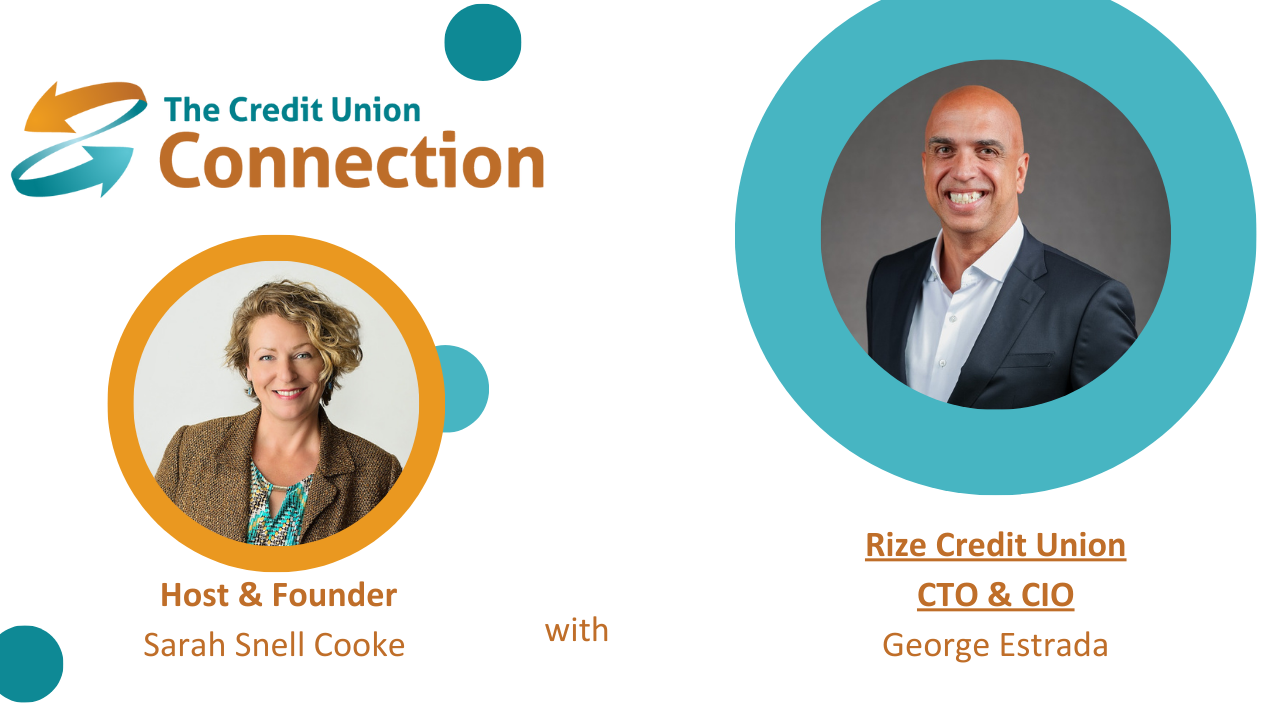
Hello and welcome everybody. My name is Sarah Snell Cooke. I am, of course, your host at The Credit Union Connection today. On here, I am joined today by George Estrada, welcome. Thank you. Good morning. Good morning. George is here as, not only the CTO, or excuse me, CTO or CIO?
George Estrada
Chief Technology Innovation Officer
Sarah Cooke
at Rize Credit Union, as well as from Orion, which is his consulting and doing Firm, recently started. So George, why don’t you tell us a little bit more about yourself and the company and what you’re doing, sure. Thank you.
George Estrada
George Estrada, I’ve recently finished a tenure five years over at Amazon Web Services. And prior to that, I was a CTO for a managed service provider and a CIO for a think tank before that, so I’ve been in the leadership role in tech for over 20 years. And, you know, I, you know, while at AWS, I focused on helping build the credit union team, and that’s how I met Sue Mitchell and the Underground and Mitchell Stankovic. And look, there was a lot about this industry that just, you know, attracted me, you know, the need for a lot of modernization, the mission, the mission, in and of itself, was, has been very, very targeted. And you know, it’s one of those things that when you’re doing technology, if you have a mission, and you know, what those outcomes that you’re trying to drive can be very inspirational, right? So one of the things that I did as I left was I started my own consulting group, Orion digital services, and I will be working with Mitchell Stankovic and the Underground with this model, the CUSS model, that that the Underground put together, and this is a shared services model to help credit unions of all sizes, but really focus on the mid size and the smaller credit unions where, you know, fractional services, especially as defined by Mitchell Stankovic, can really deliver some real value across the board for organizations. So very excited this new chapter in my life, and I’m looking forward to bringing a lot of that experience to the fold here.
Sarah Cooke
Yeah, yeah, you mentioned the CUSS model that came out of the Underground. Can you talk a little bit more about that and your role in there?
George Estrada
Yeah, well, you know, look, I think that one of the things that we were talking when, when we started discussing the CUSS model, is, what are, what are the real pain points that credit unions have? And sometimes, you know, it could be something like, you know, they’re all you have, like, five or six credit unions in one particular region, all duplicating the same efforts, right? So they may have Office 365, for example, as their platform, mail platform, email platform, and they have very little use of all the powerful and security features, because they only have one person per credit union that really has a limited amount of time to do that. So what if they could share resources to do that? They could share the resource to manage all their environments at the same time, you know? And usually you would say, Well, that’s what managed services are like, and they are but how about a strategy, right? You know, because you could have five different MSP all managing very differently. But if you had, you know, some fractional services, whether it’s a CISO chief information security officer, or CTO or CEO or COO, any one of those leadership roles, they could shape the strategy for those that collective of credit unions, and then you have a more effective use of these tools, right? So that is something that model really started. And it’s not limited just to technology, right? It could be around vendor management, it could be around purchasing, or it could be around back office. Back Office is the most repetitive you have accounting, you have human resources, so you get the drift there. But you know, and folks can argue, well, you could do that already, kinda right, but with the CUSS model, what you’re doing, you’re bringing the values that I was talking about earlier, of credit unions to the fold. So it’s so you’re getting these services with the mindset of the credit union mission.
Sarah Cooke
Which is so important, and unfortunately, you know the back office type operations you’re talking about are so unsexy. Always want to hear about, how do we do new land? Ending and stuff, but really the efficient, the efficiencies and the value that come out of cleaning up that back office, having it more streamlined. Not only, you know, in a credit unions and a dozen or more credit union there’s a lot of efficiencies to be gained there, and so I think it’s a great opportunity. And really that’s what crannies are supposed to be doing, is returning the best value. Returning the best value to their members.
George Estrada
Yeah, and sorry to interrupt, but it’d be, you know, because I want to highlight one point there, right? So if you went to a traditional fractional strategy with different consultants all over the place, they’re going to bring, for the most part, the mentality of like, yeah, we’re going to combine these back office roles right with the idea that we’re going to go for efficiencies, and usually that’s tied with a very narrow scope of getting rid of people. Okay? I, you know, I’m not a big fan of like tying efficiency with or equating efficiency to getting rid of people, I think efficiency, when you manage it properly, take advantage of the efficiencies. Meaning, okay, so I don’t need 10 people to do this. I can use it do five. But what can those five team members do for our members? Deliver more value, maybe recalibrate their roles so that they have more front time, air time with members, right? So that’s the difference. That’s what we’re driving at, is that, yeah, they’re going to be efficiencies. They’re going to be we’re going to eliminate redundancies where you need to. But it’s not because we want to just get rid of people. We want to focus them in areas where they can deliver true value to the members.
Sarah Cooke
Yeah, and that’s so important for credit unions, because, you know, they want to always treat their members, right? Well, their employees are their members too. We need to keep that in mind and but it’s interesting, because even coming from a huge company like AWS, you’re very much in favor of working with these small and mid sized credits, which are even small and mid they’re small for the overall corporate world. And so like, how does that? How did your background help you to move into this type of position.
George Estrada
So I have been very fortunate in my career. I started with the think tank in DC, and we were very scrappy. We didn’t have a lot of money. We had to be very creative with how we moved around. I had a great team of developers. We were very active, so we learned to do more with less, and when I went to the MSP is very similar. We had a broad range of customers, whether they were some of them were defense contractors. Some of them were contractors for the intelligence community. Some of them were nonprofits. So we had to figure out and be creative on how to maximize our resources. So why? How does, you know, like, what Amazon brings to the table, and I’ve been a big fan of Amazon since 2009 is that they bring and drive choice, you know? And it gets overlooked a lot. Folks think it’s Oh, it’s big Amazon. It’s like, no, no. They drive choice. They have, you know, they got Netflix is one of their biggest customers. They have Amazon Prime. They compete with them. They give their customers choices. So coming to the back to the credit union and working with them for the last five years in that capacity, and now in my new role is I’m driving to get choices. And credit unions have been very limited in a closed ecosystem, okay? That has been very forcing them to make choices that they really weren’t in their best interest or the interests of the of the members, right? So I think I’m very well prepared to be scrappy. I’m very well prepared to force choices right mind choices. I don’t want to be told what tool to use just because, because right so that I’m not going to take that as an answer. We have options. And you know, we, we should be demanding more. You know, it’s like we, they, should, folks should be valuing our business. And I think that’s one thing that I’ve noticed over and over again. It’s people taking credit unions for granted and the business that they bring.
Sarah Cooke
Yeah, yeah. And collectively, they’re a whole lot, you know, stronger, you know, bigger to do that?
George Estrada
Yes. And they do that very well, right? That was one of the first things I learned in the Underground. I couldn’t believe it, you know, you know, there’s, you know, there were some, you know, I met some vendors in the process that were kind of cynical, right? They’re like, Oh, credit unions will never do this. Credit unions will never do that. They don’t understand that. And I found out very demeaning and disrespectful and. But then when I go to the Underground and I start meeting folks, and these folks are very smart. They hold their cards very close to them, because they have, they have to respect the interests of their members. But then when you get to know them and you get to trust you, and you get to trust them, the doors open up. And guess what happens? Right? That Collective is very strong, right? So you gotta, it’s like you gotta earn your trust with one and then that’ll open the door for the next one and so on. But I think that now you know, what I like to do is help inspire the movement to use that trust and that collective to demand better services, better products. Don’t take what they want to give you. Take what you need.
Sarah Cooke
Yeah, cuz one of the things that you know, the younger members don’t have the technology the customer member facing technology that they want. And so they aren’t only, I think it was 4% 6% something like that. Are members of credit unions and but when you are in this closed system where you have very little choice, if any of what mobile carrier you use, what whatever the product is or service that you’re offering your members, a lot of that is determined to buy the vendors, and that’s just, that’s Just awful thinking and cuff like that, for sure. And so, yeah, I think this is a great opportunity for small, midsize craniums. I mean, they’re merging every day, it seems like. And to save some of the ones that really should be, you know, that are strong financially, that you know, don’t have this one thing or that thing that are actually very important. And so, you know, one of the main reasons you see the mergers is because of better you’ll be able to accept, receive better services. And so, yeah, to stop the ones that are unnecessary, I think is a large part of what the underground is going forward with this particular product, too.
George Estrada
Oh yeah, and they’ve been the underground has been amazing. If you haven’t been there, make sure you go right. These events are very poignant, targeted, and they challenge the common thought, right? It’s, it’s like, okay, why did we do this? You know, it’s like, you know, we, I remember, Sue was the first one to challenge, you know, the whole idea, of course, right? When I better, and she was like, Well, why aren’t we talking, why aren’t we talking to cloud native, core providers? And people are like, No, why would we? It’s like they’re not ready. Who says that they’re not ready, right? Why not bring them here? And she brought them, she brought them to the underground. She challenged them, she asked him questions. And guess what? What that started doing? It started getting CEOs comfortable with the idea of talking about modern cores and so and you still get the cynics that push back and say, Oh, those cores will never be ready. They will be ready. One day, they will be ready. And if you haven’t started discussing it, if you haven’t started asking the questions, you’re going to get caught out there, because there’s some real big ones coming from Latin America and Europe. And that conversation started with Sue when everybody else said, We shouldn’t be having that conversation.
Sarah Cooke
Yeah, we, we just added a client that’s from Australia, that’s a core, you know, it’s just, what do you know, they’re going to come in if, if our, our current cords that are available here in the US, don’t get some stuff straightened out. And so like you’re going to be on a panel at the underground, excuse me, and your panel is called architects of tension. Can you talk a little bit more in depth about that one, and also some of the other content that you’re looking forward to it that are that’s coming at the underground on October 25
George Estrada
Yeah, look, I think that’s gonna be a fun panel, because we’re going to be talking about everything from web 3.0 which everybody forgot about because of the AI craze. Ai, you know, the whole idea of trust for verify, right? And how to invest smart in tech. But, you know, look, the title architect, architects attention is that there should be tension in leadership, okay? And everybody tends to think that that’s negative, and it’s like it isn’t right. You know, my job as a technologist is to challenge the conventional thinking. Okay? My job is to identify not just the bleeding edge technology, but how about the technology has been around that does a really good job. We’re just not using it effectively. And what I mean by that is like, yeah, look, even with some of the existing cores out there, they have good technologies that people aren’t using. They move to. Another shiny object, and then they’re doing they’re using the technology 30 to 40% less effectively than if they focus on, okay, can, can we do this? You know, give you an example. A spreadsheet is a very powerful tool. It still is, you know, for good calculations. I mean, that’s it. It’s effective. And sometimes that’s all you need to manage a project. Do you need, you know, smart sheets? Do you need a big, you know, project planning tool? I don’t know if you have the resources. It’s if it’s that big an endeavor, but if it’s something that’s going to take three weeks to do, you could probably run it off a spreadsheet. I would argue you could run it off a notepad, right? So, so why do you have to have that tension? Because you have to challenge and maximize the value of the technology and the investments you’ve made, and balance that with the new opportunities and new technologies are bringing in. Okay? And so you gotta challenge. You gotta push and say, Okay, we I know that, you know, Sarah, I know that you’ve been doing this, and you’re comfortable with this technology, and it’s reliable, but what’s the roadmap in three years? Will this technology keep pace with our members? Right? So that’s where you really pull and get that tension going, for sure.
Sarah Cooke
And so I know we’ve got some in addition to yourself, there are other stars that are going to be there, like Steve Bohannon moderating yours. What about, like, some other kind of controversial topics that you think you are hoping will come up during the underground?
George Estrada
I mean, I think the topic of ecosystem is going to definitely come up, right? And the ecosystem we have, and, and is it a, you know, is it a functional ecosystem, right? You know, it’s funny, because everybody uses the word very loosely, you know, because it picked up, I think in the 80s or 90s, you know, I was like, oh, you know, the rainforest ecosystem, you know, but ecosystems go south too, right? There could be an imbalance.
George Estrada
You bring a predatory creature, for example, it’s something that you bring a Python into the Everglades, and it throws off the balance and ecosystem, right? The predatory species, you know? So is that happening in our ecosystem? Do we have some, some predatory species that that have taken root and we need to watch out for? I mean, that’s real, okay? I think this the CEOs takeovers. It’s going to be phenomenal. The lineup that Mitchell Stanknovic Just put together is going to be great. I encourage everyone to go. These are the folks that are really leading our industry, at the top end of it, right? So it’ll be interesting to hear them talk about some of the issues the CUSS model, you know, really discussing in detail the last underground in GAC. It was introduced in detail. But now we’re really going to be executing right? So we’re going to really be talking about not only the role that I and Orion digital services will be playing, but the role that other colleagues and other services, the work that we’ve been putting and identifying and vetting a lot of these vendors that really are going to be more partners, right? Because that’s what Mitchell Stankovic and cuss has been doing, is vetting people that are going to be more than vendors are going to be right. So we’re going to have discussed the CUSS model in detail, and, you know, and then also talk about a lot of the changes at the NCUA, and what it means with all the regulatory moving around and how do we navigate? And hopefully, how do we use technology to help us navigate?
Sarah Cooke
Yeah, and especially NCUA, the current chairman, slash only. Only board member is really tech heavy, really into tech. So, I mean, it could be a good sign, could be a bad thing. We don’t know, but yeah, so that’s gonna be super interesting. How that ties in with the other topics as well. And so now, how did you end up? I mean, I guess you met Sue somewhere along the lines, and you ended up she, she did that arm twisting that you don’t even know she’s twisting. She doesn’t. She’s good at that. So how did you originally get involved?
George Estrada
So I was introduced to her by a good industry friend, and, you know, he said, Look, you need to talk to her. He, he saw what I was trying to do with credit unions at AWS. And, you know, it’s, it was very hard to break in. You know, I was going to conferences, I was meeting with CEOs and, you know, making myself available. But it was very hard. And then I met with Sue, spent a lot of time with her. She. He taught me a lot of about the credit union industry that I wasn’t aware of, and then I started participating in the underground. I wasn’t, you know, and it wasn’t quid pro quo, you know, I would go, I would give the message of what Amazon wanted to do and how we wanted to help the industry. But it wasn’t like, do us and don’t do them, and it was none of that, and I got some, a lot of a lot of air time, speaking and really engaging and making good friendships that have lasted over the years. So that opened the door for us at Amazon and the underground and Mitchell Stankovic to really start tackling some topics. So one of the I’ll give you one of the best initiatives we did when, when chat GPT hit the scene, everybody was all over the place. And, you know, so what I did was I went to sue, and I said, Sue. Look, AWS is more than willing to provide some of our top thought leaders, okay, in the space to meet with credit unions and help them answer questions. So Mitchell Stankovic said, Hey, how about if we put together and collaborate on a white paper on January and So Sue was able to gather CEOs, board members, some CIOs and CTOs from the credit union industry. And over the course of four months, myself and a couple of senior leaders in the AI space who were literally trotting around the globe talking about generative AI met with them over the course of four months, two hour increments, answering all their questions. They were coming with every question that they had. And then Mitchell Stankovic, this cohort of credit union leaders put together the generative AI white paper. I’m pretty sure that’s still available on the Mitchell Stankovic site, but that was that was an amazing experience of collaboration, right? Amazon. I thought AWS put their best foot forward by providing resources that could answer executive questions that they needed, and this is something that, quite frankly, a lot of other industries weren’t getting because they weren’t asking Okay, and Mitchell Stankovic became a very key channel for that. But I think that what that white paper did was help address for a lot of leaders in the credit union space how to think about generative AI, because it was still evolving, and it still is evolving, right? So, yeah, I think that, you know, meeting her and following her lead and her mentorship really opened the doors and opened my eyes on the potential that this industry has. And I do think that there’s a lot of potential. And while there’s still a lot of folks that think and are calling out, oh, the end is an eye. I think we’re just getting started. We have, you know, like my CEO, Jennifer Oliver, is quite the visionary, and she’s quite the entrepreneur, and she’s not afraid to take chances and ask the right questions and push hard and create that tension. There are others like her in the industry, and you know where they show up, they show up at the underground, right? So that’s that I think, that we are, I’m hoping, and I trust, that the reason Orion digital services is going to play a big role, along with Mitchell Stankovic and the underground and other leaders to do a renaissance of the credit union industry, and I think we’re going to do there. And those that don’t believe it, that’s fine. They could sit by the sidelines and watch us.
Sarah Cooke
Yeah, absolutely love that attitude. So yeah. I mean, there’s so much to come out of it. Why do you think people need to be there on October 25 what is the most important thing you think for credit union executives and board members?
George Estrada
Well, I think first and foremost is to get the way, to get a really good walkthrough on how we’re going to execute cus and how we are executing cuts. It’s happening right? So now you see the mechanics. I see how this works, and you’re going to see how it scales. That’s number one, and you’re going to have us there. Just think of this myself. Jennifer Oliver, you’re going to have us all there to answer those questions with real, live examples. Number two, I think that we are at a pivotal moment in the industry. And I know everybody always says that, but I you know, I don’t think people quite get it. There’s a big presence of credit unions led by Mitchell Stankovic in 2020, a few days after that, right? Yep. And that’s gonna be huge. I’m also a speaker that week, and Sue and her team have put an amazing program along with the money 2020 folks. And you know what that means? It’s like you gotta be there, because we are no longer afraid to collaborate and work with fintechs. And it goes back to the ecosystem mentality, right? Let’s find the invader species, get them out of the ecosystem and replenish them with species that are more friendly to the system, and build that so, yeah, I think that’s the biggest wise the house and wise for cuss, the CEO takeover of the stage, you know. And ask these CEOs these questions, what’s their vision for the industry? What is the vision for AI in the industry, for cryptocurrency, now that the genius Act has been passed, how are they looking at it? And you’re not going to get the opportunity to ask these individuals the way you will at the underground. So I think it’s very important, and we’re going to see the acceleration of a lot of change in our industry over the coming years.
Sarah Cooke
Yeah, I hope so, and for the better. And to put it this right before Money 2020 is such a great idea to then kind of guide everybody over to Money 2020 and the fact that they have a credit union track this year is amazing.
George Estrada
I would add one thing. You know, there’s this quote. I don’t remember the book, but it was very interesting, right? And because one character tells the other if you’re asking the wrong question, I never have to worry about you getting the right answer. Okay, right? It’s very dark. It’s cynical, right? I say that because part of what people are going to get at the underground is, what are the questions you should be asking of the fintechs, what are the questions you should be asking of yourself? What are the questions you should be asking of the NCUA, right? Get equipped with that that way they have to worry that you’re going to get the right answers. Mm, hmm, that’s a real big value proposition. I think that that you you’re just not going to you’re going to miss out if you’re not there.
Sarah Cooke
Yeah, yeah, for sure. And now I could go on forever, but as we wrap up, I’m going to give you the opportunity, as I always do, for my guests to provide your final thoughts. What would you like to leave our credit union audience with?
George Estrada
That the future is bright. It’s as simple as that. There’s a lot of look. There’s a lot of folks that that feel like, oh, the idea of cooperatives is, it’s an ancient thought. I don’t believe that there are those that somehow think it’s not consistent with free markets. Again, you’re wrong, right? I think that this is the power of free markets, and I think that we are technology is going to is changing it so that the barrier of entry is way lower. While a lot of credit unions might have missed a couple of opportunities to modernize, the technology is getting such that they could leapfrog and catch up. And there are going to be some players out there. There are players already out there that will be able to, you know, some smaller credit unions are going to be able to deliver better services than the mid to larger credit unions, just because they are able to leapfrog. And, you know, here’s the golden opportunity, right? And I have to give this credit to Jennifer Oliver, if you’re too small, there’s some disadvantages there, right? Because it’s, it’s like, how do I make that leap? Right? If too big bureaucracy sets in, but if you’re in that middle section, you have a lot of flexibility. You’re nimble, you can move around before the bureaucracy sets settles in, and there’s a lot of opportunity to then pave the way for the smaller credit unions, and that’s what cuss is all about. It’s about helping those smaller credit unions get on par leapfrog and provide those competitive services that then make them relevant, that then make them a value proposition for the communities that they’re serving Awesome.
Sarah Cooke
Yeah, I love that. Thank you so much. Appreciate your time today, George,
George Estrada
Thank you, Sarah, appreciate it and look forward to seeing you at the underground.
Sarah Cooke
Yeah, see you there. Thank you.
1 thought on “Mitchell, Stankovic and Associates Welcomes George Estrada as Fractional Chief of Technology and Innovation within CUSS™”
Thank you, Sarah and George, for bringing the Underground message to the industry. I wanted to highlight…
My CEO, Jennifer Oliver is quite the visionary, and she’s quite the entrepreneur, and she’s not afraid to take chances and ask the right questions and push hard and create that tension. There are others like her in the industry, and you know where they show up, they show up at the Underground, right? That’s the reason Orion is going to play a big role with Mitchell Stankovic and other leaders to do a renaissance of the credit union industry, and I think we’re going to do it at the Underground.
And those that don’t believe it, that’s fine. They can sit by the sidelines and watch us.