

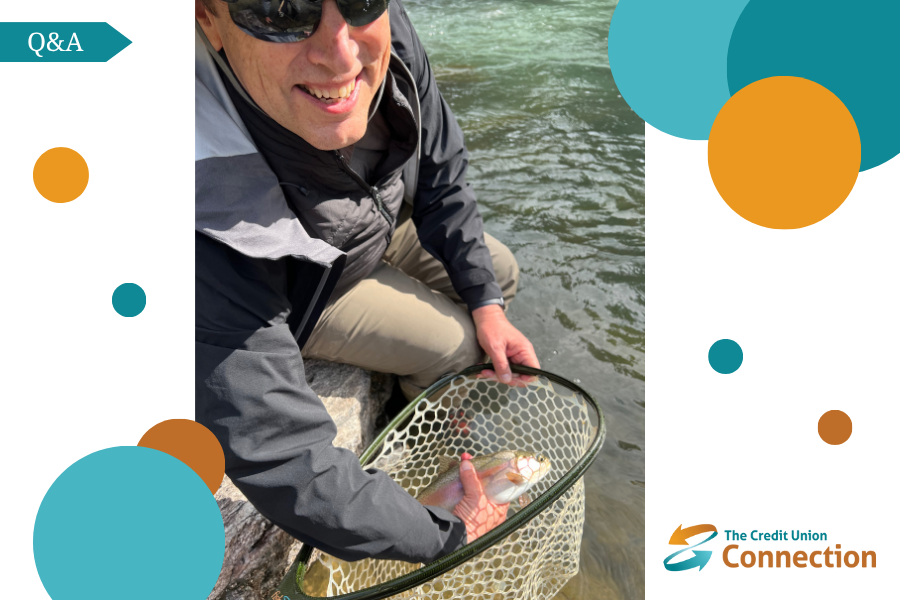
Bill Cheney has spent nearly four decades leading and advocating for the credit union movement, from his early days in Dallas to Washington, DC, running then-CUNA (now America’s Credit Unions) to his current role as President and CEO of SchoolsFirst Federal Credit Union.
Under his leadership, the nation’s largest credit union for school employees has grown to 1.5 million members and $34 billion while staying true to its founding mission.
In this candid conversation, Cheney shares why growth isn’t a strategy, what he believes credit unions must stop doing to stay relevant, what superpower he wants and much more! He also opens up about leadership lessons, the importance of the People Helping People philosophy, and the values that guide his decision-making.
Whether you’re a new leader or a seasoned executive, Cheney’s insights offer a purpose-driven perspective on navigating people-driven change.
Q: How do you think about growth?
In my view, growth is an outcome, not a strategy. At SchoolsFirst, we have a Member Service strategy that has served us very well over many years and has led to strong growth.
Q: How do you evaluate and implement emerging technologies? How are you rethinking member engagement as digital expectations evolve?
We typically use a test and learn philosophy with emerging technologies.
Our service strategy for decades has been built on World Class Personal Service. This is different with the digital experience, so our team is working hard to personalize the digital experience and eliminate channel switching as much as possible.
Q: What role do strategic partnerships play in your growth strategy—and how do you decide who to work with?
Strategic partnerships are integral to our growth, although growth is not a strategy at SchoolsFirst. These partnerships are integral in terms of how we offer service to our Members, how we protect them and how we remain in compliance with ever evolving regulations. We prefer to work with partners that support the credit union movement when possible and in particular those that are closely aligned with credit unions and owned by credit unions.
Q: What’s something you believe credit unions need to stop doing to remain relevant over the next 5 years?
Having a stop-doing list is just as important, and maybe more so, than a to-do list. We are all juggling numerous priorities and projects and none of us have unlimited resources, so we have to get better at focus and prioritization.
Q: What’s a recent decision you’ve made that went against industry norms, and why did you choose that path?
It is not necessarily a recent decision but we revisit it often – SchoolsFirst FCU for 91 years has focused on serving school employees and their family members. While we have expanded geographically throughout California, that focus has not changed. And it has been successful. We now serve 1.5 million members.
Q: What would you advise an up-and-coming credit union leader to ensure they’re trained/educated on?
It starts for me with the People Helping People philosophy of credit unions. This is a huge part of what makes us different. We are in the banking business, but we are not banks. We are not-for-profit financial cooperatives, owned by and operated for the benefit of our Members. This is not something most of us studied in business school or otherwise, so take the time to learn how and why we are different and how that can benefit our members and our team.
Q: How do you approach leadership differently today than you did five years ago?
Wow, great question! So much has changed in the last five years, starting with the pandemic and continuing with much uncertainty and a certain amount of chaos since then. I’ve always considered myself to be a servant leader, but the need to approach our team and our members with respect and empathy has never been more important.
Q: What’s something you believe most credit union CEOs are overlooking right now?
I certainly don’t have all the answers, and I can’t really speak for other CEOs, but there are certain values and basics of our cooperative model that I think sometimes get lost as some focus on the business aspect of a credit union and less on the people. This is a people business.
Q: Best apps to help you get the job done?
I honestly don’t use a lot of apps professionally. Some personally yes and certainly outlook on my iphone and ipad is essential. We also use Workday and the Workday app at SchoolsFirst, so I guess I can add that as one that is helpful.
Q: What books are you reading/have you read this year that you found valuable?
Right now, I am reading Destiny of the Republic by Candice Millard, a nonfiction book about the life and assassination of President James A. Garfield. I’m not sure how valuable it is except as a good read about a fascinating person who has not been studied as much as many former presidents, as he was assassinated shortly after taking office. He was, however, a man ahead of his time and a reformist after the Civil War.
I am also reading The Fourth Turning by William Strauss and Neil Howe, which was recommended by a friend and staff member at USC. The sub-title is, What the cycles of history tell us about the next rendezvous with destiny. It is a very interesting look back in history to help tell us what the future might hold.
Q: What’s the most important thing to you about your legacy?
I don’t really think about legacy in my career. With my family, yes and our two children and now five grandchildren are that legacy. I guess if I had to think of a professional legacy as a soon-to-be 40-year, credit union and credit union trade association professional, it would also be that family, the thousands of people that I’ve worked with around the country and the millions of Members that we’ve served.
Q: Travel tips?
Pack light and try to get some rest.
Q: How did where and how you grew up affect your adult life and career?
I grew up primarily in Dallas but also spent two years living in London in 5th and 6th grade. Living in such a large, diverse city from 1970-72 was transformational in many ways. I also learned a lot about life and leadership as a Scout and eventually an Eagle Scout when I returned to Dallas. I have shared that experience with our son Will and now with our oldest grandson, Jack.
Q: What do you do outside of work?
My primary hobbies, other than and including spending time with family, outside of work are snow skiing and fishing.
Q: Favorite movie or TV comedy and why?
My favorite movie comedy is Caddyshack. It’s a classic and just doesn’t seem to get old. As for TV comedies, I’m still a Seinfeld fan. A TV comedy about “nothing” is just too good and also doesn’t seem to get old.
Q: Who would you want to play you in the movie of your autobiography and why?
No one is going to make a movie about my autobiography, but I appreciate where you are going with the question. I don’t really have a good answer for this one though, sorry!
Q: If you could pick a superpower to have, what would it be and why?
The superpower I would choose would be to be able to see the future. Just think of how much better prepared we could be to serve our members and our team!