

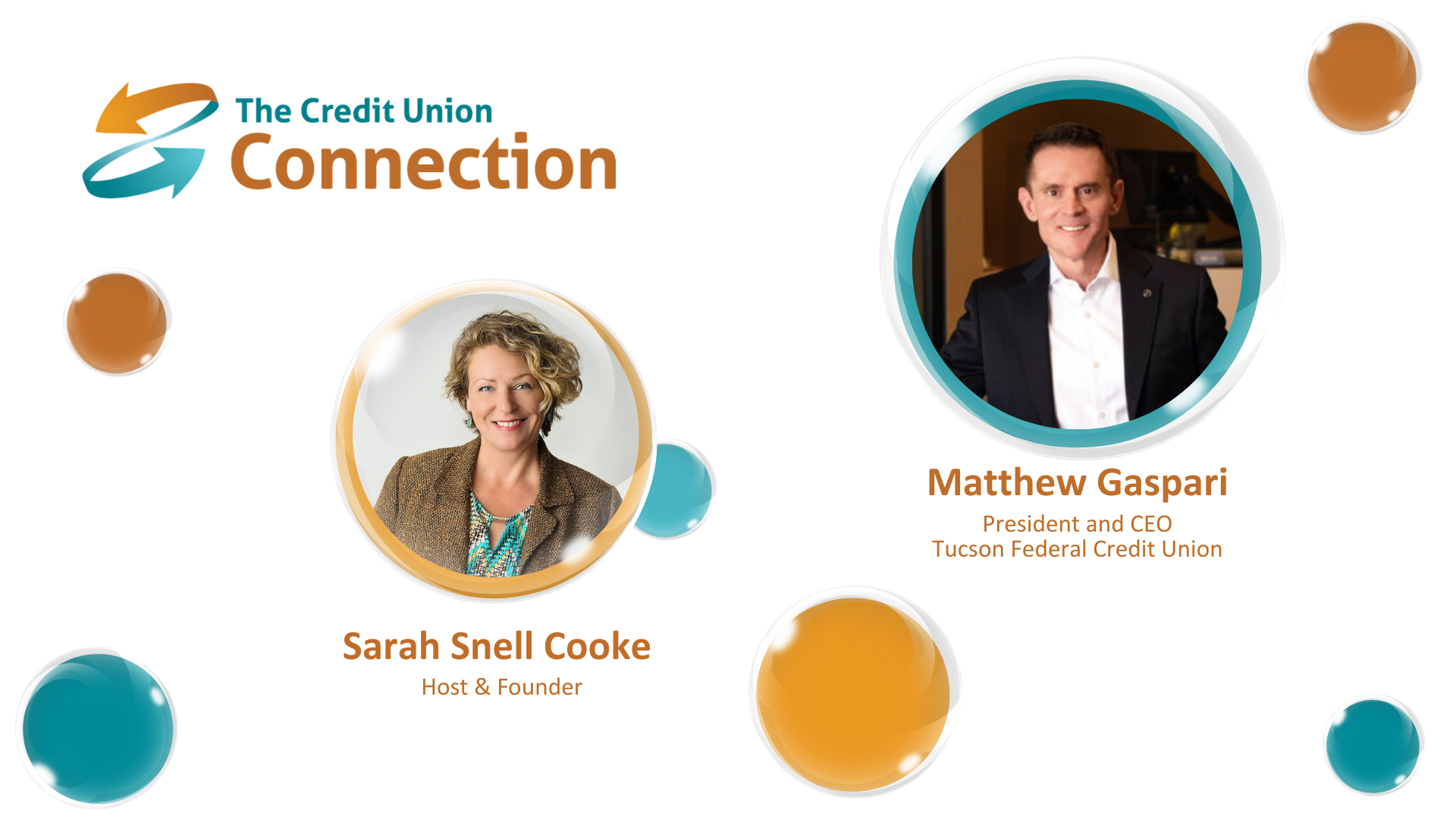
Matthew Gaspari didn’t enter the credit union community with a master career plan. He started part-time and worked his way through lending, operations and executive leadership, regularly asking for suggestions and opportunities. Now he’s president/CEO of Tucson Federal Credit Union, and he’s ensuring others have a guided experience through the credit union’s leadership development program.
But this podcast interview with founder/CEO, Sarah Snell Cooke, isn’t just about career trajectory. It’s about what happens when a credit union decides to stop leaving leadership development to chance. On The Credit Union Connection, Matthew shares how that realization led to a structured, four-year Prospective Leaders Program that is reshaping how Tucson FCU builds bench strength.
What makes the story compelling is the transformation. Employees present to the C-suite, tackle executive presence, strategy and financial decision-making. Some enter the program unsure of themselves, yet leave it leading their own teams.
Even more telling, dozens have gone through the program and none have left the organization. Several didn’t even complete all four years because they were promoted before they could finish. That detail alone says more than any statistic.
In the full conversation, Matthew gets candid about what surprised him when he became CEO, why internal advocacy matters, and how investing time changes the culture of leadership development. It’s a practical discussion for credit union leaders who want results but don’t know where to start. Matthew even offered to share his playbook with other credit unions!
It’s a reminder that sometimes the most strategic growth plan begins with the people already standing in your lobby.
NOTE: The AI-generator that created this transcript should not quit its day job.
Sarah Cooke
Hello. Welcome everybody. I am Sarah Snell Cooke, your host here at the Credit Union Connection. I am joined today by Matthew Gaspari, welcome.
Matthew Gaspari
Thank you very much. Good to be here. Good to see you, Sarah.
Sarah Cooke
Yeah, great to see you. Now. Matthew is the president and CEO at the 876 almost million dollar Tucson Federal Credit Union. Why don’t you go ahead and make your own introductions of yourself in the credit union?
Matthew Gaspari
You bet, actually. So we’re very close to the billion. Like you said, we’re actually the we ended the year 920, 5 million. Okay, we expect to cross that threshold about middle of the middle of the year this year. But yeah, Tucson Federal Credit Union, we started out serving teachers in the largest school district in Tucson, Arizona, and then in, I guess, 2016 redid the charter, and no 2006 redid the charter, and became community charter, and that kind of opened up everything else I’ve been I’ve been at TFCU for 33 years, starting as a part time Teller and CEO for five. I was the CEO and EVP for 13 before that. So a lot of stability here. The our average tenure for employees across the board is 10 years, and for the C suite, it’s about 19 years average and senior management, 1617, so very unusual in the financial services area, not so unusual in the credit union industry, of course, but unusual on the broader scale. So it’s easy to be successful when you have a team like that around you.
Sarah Cooke
Absolutely. I think the team makes all the difference, truly. So you got a little you touched a little bit on it, but tell us about your career trajectory, starting back at the teller line.
Matthew Gaspari
You bet. So yeah, 1992 April 14, I think it was of 1992 and answered an ad back in the day you would answer ads, right? So I answered an ad for a part time teller position, and got that. And I I’ll tell this before I tell the rest of the story, and that is that. And I tell this to the team that through somebody’s career, you’re generally going to have a few people that are important to have in your career, meaning that you’ll find some advocates here or there that are kind of walking you to the next level of your position. And I say that to say this, that you don’t, you don’t, you don’t achieve a lot without the help of others and the guidance of others. And so I had several of those throughout my career that kind of saw something in me and gave me an opportunity when maybe that might not have been the might not have happened at other at other places. And so, you know, for example, was a part time teller for about a month before I was promoted to a full time position, which I was grateful for, by the way, first time I had insurance for about a year and a half, and was very happy about that, and from there to actually to a loan officer. So I left the branch network and went to a loan officer for about three years to kind of understand what underwriting was all about, and then wanted to get back into the branches. So Assistant Manager, then Operations Manager, AVP of operations, kind of on the way up to the COO, when our previous CEO took over, and so was, was that for 13 years, really got a lay of the land, you know, kind of broad scope at that point in time, a great, a great learning ground, if you will, for becoming CEO. And then that happened in December of 2021, I became CEO then, and learned what a lot of CEOs learn, which is, it’s different once you sit in the chair, and you have a lot of ideas, maybe when your second chair, I know I did, and you sit in the chair and things start to look different, but it’s been the greatest experience ever. And you know, like I said, you don’t achieve a lot without a great team around you, and it’s fortunate to inherit some, and then and then find some. And we’ve created a really dynamic, synergistic team that’s achieving a lot of the goals that I set out about five years ago, and then this the second set of goals that we set out about two years ago. And one of those goals was to get to a billion dollars by the end of 2027 wanted to achieve some scale. Or 2026 sorry, wanted to achieve some scale. And we are just about there at 920, 5 million. So other things we started back in commercial lending and commercial services that type. Things so that we had another business line to be able to bring loans in when loans got difficult to find. And so a lot of the things that we’ve chatted about doing over the last five years, we’ve been able to do, and it’s led to a really strong balance sheet at this point and an average NPS score of about 72 and pretty well so far, very happy, very happy with where we’re at. But again, I’ll repeat it one more time. Just really happy with the team that we have.
Sarah Cooke
Yeah, yeah. Tell I want to get into because you’ve started this professional development program, but I want to first, when you were doing it, when you were going up the ladder, you didn’t have that necessarily a formal program. So talk a little bit about the importance of like, mentors and sponsors and things like that you had along the way.
Matthew Gaspari
Yeah, thank you for asking. The process when I was coming up, was very informal, and it was more along the lines of, if something opened up that you posted for it and you hoped you got it. And every so often you’d get lucky and you’d ask a manager, Hey, can I shadow that person? Or I’m kind of interested in that, can I sit with somebody and just see if it’s something that I might like? And generally, you get a yes. And so you kind of get exposed a little bit that way. But there wasn’t any trajectory, or any you know, process to get from point A to point B at the time, though, when I started, we were $72 million and had just a couple of branches and that kind of thing. So I think, I think some of this formality comes with, you know, growing and really seeing the need to begin to develop internally. On a from the opportunity to have teams that are ready to go when, when you have an opening, and so that all so that’s my journey. As far as what it was like, it was very informal, and the leadership program that we’ll talk about was developed really through our human resources team initially, and then put some weight behind it after that. But it was, it was from the perspective of both needing to have a succession plan across the departments, but also as a retention tool, and making sure that our employees realize that there is a path forward. And I tell our new hires in that regard, that that it’s a partnership between TFCU and them. And I mean, what I mean by that is that their 50% is they need to work hard and learn and excel and let us know what their what they’d like their path to be. And then our job is to look for opportunities to get them there through development and education and that kind of thing. And when we’re both doing the things that we’re supposed to do. It often. It often turns out that there’s people moving into positions that they’re excited about. When they do that, then they tend to stick around a lot longer, which is good for everybody. Most importantly, good for the membership.
Sarah Cooke
Absolutely, absolutely. So you kind of jumped ahead of me, but that’s okay. So we’re going to dig. We’re we at the crane connection, are digging more into educational opportunity, offering educational opportunities as well. So I love that you had turned your experience kind of into a program. So this is Tucson federal credit unions prospective Leaders Program. So give us, like a high level framework and what’s involved in that.
Matthew Gaspari
Sure, and it’s morphed over time. As often ideas do, they kind of organically become something other than maybe you thought they were going to be, because the students and even the teachers start to have some input. But it started out more is almost like a lecture series, if you if you will. And so before it was what it is now, it was a much shorter program. But what we have currently is a freshman, sophomore, junior, senior track, each with different weights put on what the course of study would be. You know, the idea is we want to generate and cultivate the generation of emerging leaders that are that are coming our way. And we need to, we need them to know what credit unions are all about, not just what we do, but what the credit union movement is all about as well, and really kind of understand the importance of advocacy as well, which we’ve become very involved in, and then that helps to drive sustainable growth for TFCU, the qualifications, if you will, or the employee needs to be here for a year to start with, and they’ve got to be exceeding expectations in their current role. No corrective action, obviously, and that their leaders have seen some sort of demonstration of leadership, whether that’s through experience, volunteerism, initiative, that kind of thing. Prior to the last couple of years, it was an invitation only program, and so the leaders of each department would actively seek out one or two of their employees to become part of the program. Program, and they go through a pretty robust interview process, which includes an interview with the C suite at some at one point in time, kind of at the end of it. And so that’s very daunting, obviously, for especially newer employees, to sit in front of all of the C suite and answer questions from us, and that helps us to kind of ascertain what the qualification levels are and that type of thing. About two years ago, we decided to open it up to all comers and really see what the initiative would be, and kind of remove a little bit of the exclusivity that maybe wasn’t really there, but was perceived to be there. And we didn’t want it to look like it was some sort of a special club that you had to, you know, make friends to get in, type of thing. And so we opened it up to all comers, and that process stays the same. It’s just that you can, you can nominate yourself, versus having to be nominated. And that led to slightly bigger classes, which is great, I think also that there might have been unintentionally, some pressure put on students who were asked to do it, and whether or not they wanted to, they felt like they needed to. And we would find a little bit of dropout within the second and the third year. And so since it’s now the employees asking to become part of it, there’s even a little more buy in, perhaps, than there was before, which is really important. But each I can talk about the curriculum if you want, or answer another question, but there is a specific curriculum each year has a different purpose, all leading towards a capstone at the end of each year, which includes a presentation back to the C suite.
Sarah Cooke
Yeah, no, I would love to hear about the curriculum. I think you know, this is something that a lot of credit unions could share even and use even at, like, even if it has to be a smaller scale at a smaller credit union, for example. But yeah, no. Love to hear about the curriculum that’s involved.
Matthew Gaspari
Absolutely so the time commitment first of all. So there are eight monthly learning workshops, if you will, April through November. They go through mandatory orientation and some meetings. There are some professional standards. Are expected to exhibit high integrity, professionalism, ethical conduct. So all of those things are kind of being spoken about and vetted through the interview process, and then the process as they’re going through each of the different years, freshman year is all about self and learning how to lead others, and so focuses on personal values and that kind of thing, emotional intelligence, communication style, at the end of that year. During that year, they’re given an assignment by our VP of culture and engagement. And while they’re taking those eight courses, they’re also working through that project that they’re given the end of the first year, they do the Capstone, which is to present their the results of the project that they were assigned. And again, I mentioned, they said they present to the C suite, and we have we review them as a group, but also review them individually for communication style, that kind of thing, and just give them some constructive criticism along the way, or, you know, positive reinforcement sophomore year kind of skill expansion is the focus, and so risk management, people, development, goal setting, that type of thing becomes the focus. So they work on that through the eight workshops. Again, they’ll have an assignment to work on throughout the year, and then the Capstone at the end of their sophomore year. And at the end of each year, I didn’t mention this, but at the end of each year, there’s a recommendation from the C suite to move forward or to not move forward, that we that we will give, frankly, generally, I don’t know that we’ve ever said no, because it’s not about that as much it is as it is about really, kind of building up confidence and teaching them how to, how to lead in that kind of thing. So unless there was a really poor fit or something like that, we generally say, Yes, move forward.
Sarah Cooke
Junior. Ask if it’s like, pass, fail or something, yeah.
Matthew Gaspari
I mean, technically, technically, it is. But really the spirit of it is, we’re trying to, it’s a much bigger picture, right? Trying to develop the person. And so if they happen to not have a great presentation or whatever, that’s not going to prohibit them from, you know, moving to the next level. The the junior cycle is really about change management, strategic leadership, project management, executive presence, so beginning to kind of build up the skill set that they’ve been learning. And then the senior year, they focus on more of a discovery type of a project. And that’s the, that’s the thesis, if you will, for the end of their four year cycle, they do the presentation before they graduate the interestingly. And I’ll get into this a little bit later, probably, but the number of participants versus the number of graduates is, is, there’s a pretty, pretty big disparity, but the reason for that is interesting, so like, I’ll expand on that if you want me to later, that we’ve had about 75 employees go through, there have been 10 graduates. And so the reason for that, though, is actually a good reason that we’ve had a few that ended up dropping out, but generally, before they can get through the four year, course, they’ve promoted into a leadership position, which is really ultimately the what they’re trying to achieve anyway. So the 75 to 10 ratio doesn’t sound good until you have the context behind it. So it’s really It’s unusual to have a senior class, if you will. And we do have a couple of people this year, and that doesn’t mean that they have not done well or not been successful, it just means that they haven’t promoted for whatever reason, we have one of the two that actually did promote and decided to stay in the program, even though it’s a pretty big time commitment. So but 75 have gone through of those that have gone through the program to whatever point until they promote. It out, we’ve had zero loss of those employees, so it’s 100% so serving all the purposes that we were hoping that it would.
Sarah Cooke
Yeah, I was going to ask about results. So, I mean, it’s great tool, obviously, for developing bench strength and employee retention. What kind of results have you seen as from it, other than a bunch of people not leaving?
Matthew Gaspari
Yeah. I mean, they stick around so, tangible results. We’ve had several different programs, or seven, several different presentations that have been given to the C suite and the Vice President of culture and engagement that have actually become programs or products or services that we’ve offered, which is really cool, and so they don’t all reach that necessarily, but we’ve had several that have and so it really is a bottom up strategy, if you will, of making sure that the membership has everything that they need. And often, who better to tell leadership what the membership needs other than those that are working with them on a daily basis. Anyway, absolutely, yeah, but that’s really working. So, when that happens, the classmates are incredibly proud of the fact that they not only did well in the class, but they actually created something. And they have a tan, they have tangible evidence of their success now, because it’s an offering that TFCU has.
Sarah Cooke
Matthew savings account or something like.
Matthew Gaspari
I’ve always advocated for my name being part of everything and but, so that’s the tangible component, but, but the intangible or intrinsic piece is watching the maturation process of them throughout the course of the 234, years, however long, they stay in from very nervous, kind of timid, as they’re presenting, unsure of themselves, that kind of thing, to and you can see as the years go along, the confidence that builds in them, the synergy, the dynamics that go that go On within the teams too, right? Because they become, they become interdependent on each other for their success, which is also very relevant to the workplace. And so I watched a young lady who was who was very shy, very smart, very shy, kind of a little bit nervous, over the course of three years, go from that, and you could see her confidence build, and now she’s a branch manager for us, and her personality has completely changed, and her confidence level is high, and she’s leading others versus what she was doing before. So those are, like, the big wins, I think, for us, because we’re really growing, growing employees and helping them become who they can be professionally. So whether or not the project, the project or the product or service, makes it to something that we end up offering is kind of secondary to the to the real value that’s being created in the in kind of a 360 development of an employee from, like I mentioned, from somebody who might be a little bit more shy or timid to somebody who is standing in front of C suite and presenting, and now a branch manager and driving sales, and, you know, driving service and leading a team of, you know, 10, 1214, whatever. And I’ve talked to them, and this person in particular, I talked to him like, did you ever think you know that you would be able, that you would be from here to here? Could you have, Could you have imagined that that would be your journey? And she said, There’s no way you know I that I thought I would be able to do that. She said, I thought on the inside that I had enough talent to make something like that happen, but like to be able to actually manifest it, and to have a personality now that that is more outgoing and. Leading somebody or leading a group of people. She said, I never would see that happening. And she said you couldn’t have done it without the program. And then, of course, there’s support all along the way, right from their from their leaders and from senior leadership to make sure that they’ve got time to work on their projects and to make sure that that they’ve got resources that they need. Senior year, often, they’re interviewing different senior leaders about the roles and that kind of thing. And they’ll talk to me about the charter and what and where creating this came from, how TFCU was developed, and all of that. So they’re getting a lot of exposure to which is helpful down the line. So it’s so that’s the part that really gets me excited is watching, watching that development process go on over the course of the years?
Sarah Cooke
Yeah, I was gonna ask, what kind of feedback have you gotten from the employees who are either graduated or going through it? You mentioned the one. Do you have other great stories from that?
Matthew Gaspari
I do, and I have a quote, actually someone to look at the quote now, but I asked for some feedback from a couple of employees. So here’s one of the quotes. The prospective Leadership Program challenged me in ways I never imagined, and helped me grow into a more confident, motivated leader. Through meaningful leadership insight and real world experience, I gained a clear understanding of the bigger picture while remaining deeply rooted in the credit union’s culture and values. PLP is not only powerful, a powerful investment in the credit union and its future leaders, but a unique opportunity to give back to the community wall, staying true to who we are and what we believe in. So that’s a quote from an employee, and she’s a senior this year who is on the branch manager path, and that is generally the feedback. You know, that’s a good synopsis or encapsulation of the feedback that I, that I tend to get, that we tend to get from the employees, is it’s a transformational experience, and often they’re surprised that an organization would invest, you know, that kind of time, treasure and talent into their development. But you know, what we gain back is so much more than what we put in.
Sarah Cooke
And so is this on work time, some of it, and then other parts, like homework, if you will.
Matthew Gaspari
Yeah, both Yeah, we definitely make sure that they’ve got time during the work hours to do what they need to do. And that’s really kind of managed by our VP of culture and engagement, as he leads the program, as to how that works. But they are not expected to do all of that, you know, on their own time. Make sure that they’ve got time during the work day to get some stuff done too. And I don’t know the hours by percentage of what is on, what is not on the clock, not on the clock, but for sure, we make sure that they’ve got the resources available. And I wanted to add one other thing that I forgot to mention, the format’s changed over the years. I mentioned that it was kind of a, almost a lecture series to begin many years ago, but the formats change. And so senior leadership, most all of us are facilitators now, and so each of us teaches a workshop, and so I do an executive presence workshop, and our CFO does a decision making through financial analysis workshop, and our CEO does a does a communication, you know, influential communication workshop type thing. So, it’s become even more organic in that way. It’s an, it’s, it’s, you know, Now, part of everybody’s DNA, not just the students that are going through that, but senior leaders who are investing time and talent to teach what they’ve learned to the students, which I think puts a bit of a different spin on it. I mean, we are all fully invested and fully engaged in every way we can be, including being a part of the education itself.
Sarah Cooke
Yeah, yeah. No, that’s so important to see that the C suite is actually investing in them and really not just throwing money at it too. I think that’s always important is you’re actually investing time in it as well. So as we wrap up here, I always give my guests the final thoughts. What would you like to leave our credit union audience with today?
Matthew Gaspari
I guess a couple of things. First, the level of effort to start a program like this is not huge, and as most credit unions, or all credit unions, would do, we’re always happy to talk to anybody about putting something like this together. It’s not a secret, the value that we get out of it is so much more than we put into it. And that’s the other thing, I guess, that I would say is that our most valuable resource and asset are the employees themselves. We are no stronger than our front line, who is delivering service every day, and have the ability to make or break, you know, our brand and that kind of thing. And so to have the spirit to want to do something like this is special, and I’m proud of that. To have the capability and the drive it takes to keep a program like this going. This is our 15th year program. Program, and it’s as strong as it’s ever been, is a testament to everybody in recognizing the kind of value that we get out of it, and being willing to continue to invest resources into it. And again, the capstone of all of that, for me is watching people move into leadership positions, and knowing that at least part of that was a result of what they were able to learn through the pop program itself, there’s really nothing better than that.
Sarah Cooke
Absolutely I hope every credit union leader hears that right now. Thank you so much for your time. Matthew, appreciate it.
Matthew Gaspari
Very welcome.