

Primary financial institution. That used to mean something. Now, according to Mark Sievewright, it stands for “porous financial institution” because your members no longer have one or two banking relationships. They have seven, eight, sometimes 13. And a growing number of those relationships are with companies you have probably never heard of.
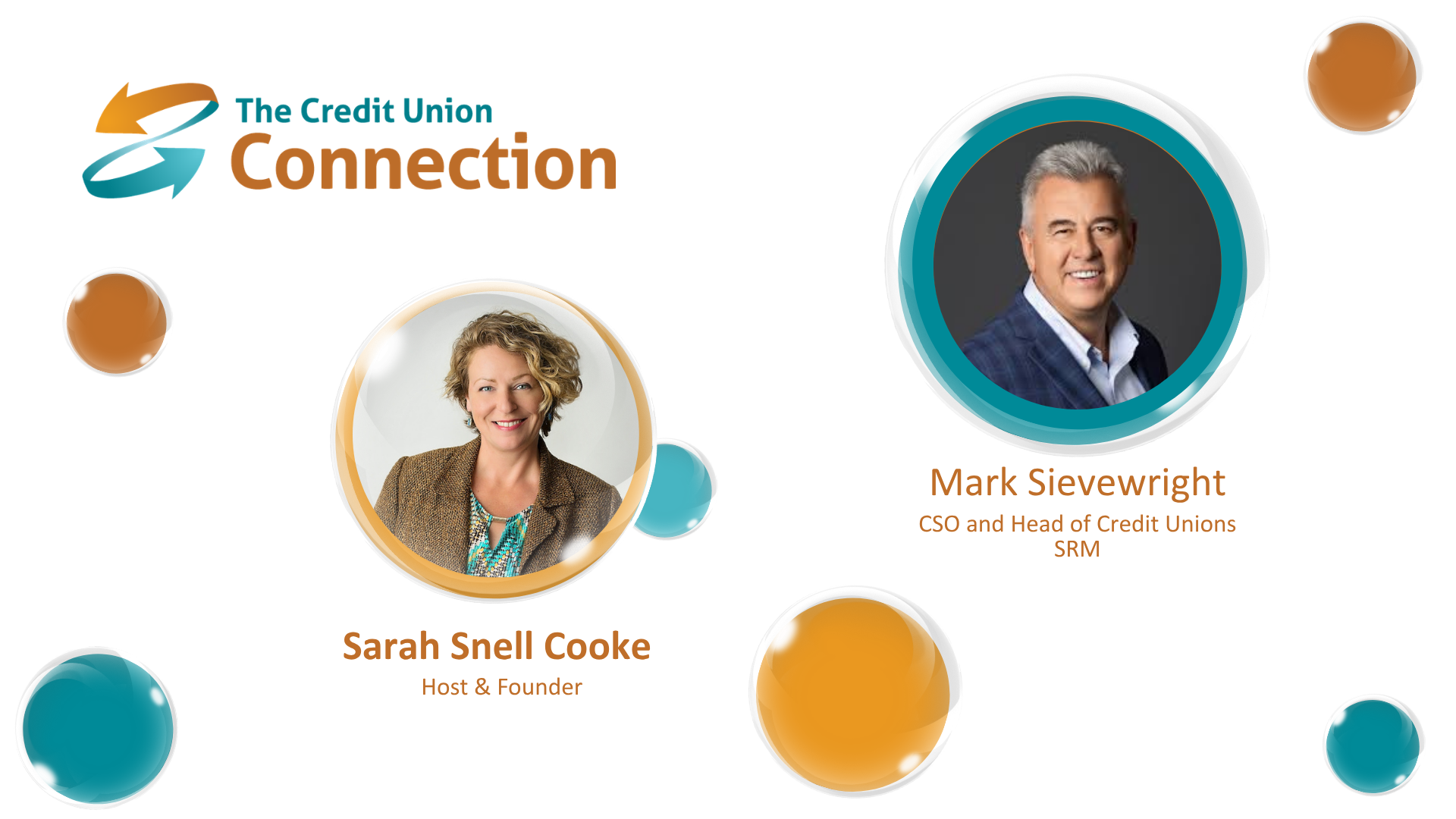
Mark Sievewright, Chief Strategy Officer and Head of Credit Unions at SRM, joined Sarah Snell Cooke of The Credit Union Connection for a wide-ranging conversation about 30 years of watching the competitive landscape transform, why Chime built an empire on a single paycheck trick, what Apple’s reinvention of the credit card should have taught the industry and why Mark thinks this is actually the most optimistic moment for credit unions in a very long time.
The competitive landscape conversation is worth settling in for. When Mark started in this industry, you could list credit union competitors in five or ten minutes. Today you would go all day and still leave some off the list. Fintechs with names most credit union executives would not recognize are going after slivers of member relationships, one product at a time. Loyalty has become fickle. And the concept of a primary financial institution, he argues, has been replaced by a distributed web of apps, platforms, and providers that each own a little piece of the member’s financial life.
“If you trust us with your relationship, you will be better off. That’s the story credit unions are trying to get back to.” — Mark Sievewright
His take on Chime is particularly sharp. The entire business was built on one thing: getting you your paycheck two days earlier than you used to. That is it. And, you only experience that benefit once, because after that every paycheck is two days early and the cycle has simply shifted. Credit unions have the technical capability to offer the exact same thing. Many already do. The problem, as always, is the storytelling. They just are not telling anyone.
The broader strategic argument Mark makes is one worth bringing to your next board meeting. Credit unions need to become data-driven and AI-enabled. Not as buzzwords but as operational realities. AI is not just a technology budget line. Deployed well, it frees up loan officers and member service reps to do more valuable human things, the counseling, the relationship work, the moments that Chime will never be able to replicate. That is the asymmetric advantage credit unions hold. The technology can be copied or licensed. The relationship cannot.
Mark closes on a note that cuts against the doom and gloom that tends to dominate industry conversations right now. Be more optimistic today about the future of credit unions than you have ever been, he says, and he means it. The system is challenged, the K-shaped economy is squeezing the very members credit unions were built to serve, and the competitive list keeps growing. But if the movement gets a few strategic things right, the future is genuinely bright.
NOTE: If transcription were this AI’s superpower, it would be a very disappointing superhero origin story.
Sarah Snell Cooke
Hello and welcome everyone. I am Sarah Snell Cooke, your host here at The Credit Union Connection. PFI used to stand for primary financial institution. Now Mark Sievewright, Chief Strategy Officer and Head of Credit Unions at SRM, says it stands for porous financial institution, because your members do not have just one or two banking relationships anymore. They have seven, eight, thirteen. Mark has been 40 years in the industry watching the competitive landscape go from something you could list in five minutes to a list that could go on for days. We are talking about companies you have never heard of going after slivers of your member relationships, fintechs that built empires on getting people their paycheck two days early, and why Apple reinvented the credit card. But Mark has good news hiding in all the chaos. Credit unions can win. They can copy the digital experience. They can become data-driven and AI-enabled. And they have the one thing Chime will never have: an actual relationship with their members.
Hello, welcome everyone. I am Sarah Snell Cooke, your host here at The Credit Union Connection. I am joined by the excellent Mark Sievewright. Welcome.
Mark Sievewright
Thanks Sarah. The plaudits equally apply to you, my friend.
Sarah Snell Cooke
Mark is the Chief Strategy Officer and Head of Credit Unions at SRM. Tell us a little bit more about yourself and the company.
Mark Sievewright
Thanks Sarah, great to see you. 40 years in this industry now, and I’m only 36. Hard to believe. About 25 of those years have been spent working very deeply with credit unions. A lot of what we are focused on right now is brand new. Artificial intelligence has become a bit of a buzzword but it is probably the most significant technological event of our lifetimes. SRM has evolved very quickly. My business was acquired about three and a half years ago. We used to be known primarily for helping credit unions and banks with their third party contract negotiations, and we still do a lot of that. That is a huge part of our business. But we have also diversified into technology advisory support and payments and strategy, which is where my team comes in. As an organization we are supporting credit unions from the boardroom to the back office, pretty much all their needs. I am just struck by the amount of change going on all around our credit unions right now. I wake up every day focused on what is best for the credit union system, and I am still having as much fun today as I did 25 years ago doing that.
Sarah Snell Cooke
Today apparently is National Storytelling Day, which is fitting given how much the industry was talking about storytelling at GAC. In your mind, what story are credit unions telling their members right now?
Mark Sievewright
What is old is new again. The essence of credit unions is people helping people, and credit unions today are trying to find new ways to connect with what is a very different consumer base than 20 years ago. I think the story is somewhat the same as it used to be but better, in that credit unions are really trying to support the financial lives of their membership in a unique way. They are not focused on next quarter’s earnings above all else. They are focused on what they can do today to better the lives of those they serve and the communities they serve. That differentiation is becoming even more emphasized today because the American consumer is challenged and needs credit unions potentially more than they ever have. The economic conditions are difficult right now, and these are not political points, just practical ones. People are struggling to buy their first homes. They are dealing with constraints on their spending. They are worried about the future socioeconomically and geopolitically. Credit unions are at their best in those kinds of times. This is probably the most challenging time many credit union leaders have ever been through, but it is also a moment where the credit union mission matters most.
Sarah Snell Cooke You have pointed to the K-shaped economy and the people on the bottom part of that K being a lot of who credit unions are serving. One of my themes has been encouraging credit unions to invest in member experience over just promoting rates. How has that attitude shifted from both the consumer perspective and inside credit union management and boards?
Mark Sievewright
The expectations that consumers have of any financial institution have never been higher. Across all age groups now, not just younger people, we want everything faster, simpler, and easier to consume because we are all time-deprived. We do not want to spend much of our finite time managing our financial lives. So the time we do dedicate to it, everything has to be simple, easy, fast, convenient, and truly available when we want it. The big shift I have seen recently, really in the last two years or so, is the shift in loyalty. I was talking to a client at GAC and I said: remember the concept of PFI, primary financial institution? Gone. I called it porous financial institution because our members have multiple relationships with multiple different venues. I do not even say financial institutions anymore the way I used to, because of the impact fintechs have had. Look at the competitive landscape today versus a decade ago. It is totally different. If you and I were having this conversation 15 or 20 years ago and we wrote out the competitors for credit unions, we would be done in five or ten minutes. Today we would go all day and probably leave some off the list. Companies I have never heard of are after just a sliver of that financial relationship with a consumer. Loyalty has become very fickle for the American consumer. The opportunity for credit unions is to win back the relationship play. To say: look, we truly exist for you. We may not have the best rate or the best product in any given category, but if you trust us with your relationship, you will be better off. That is the story I hear in a lot of boardrooms as credit unions try to get that differentiation back.
Sarah Snell Cooke
Fintechs like Dave and Chime with their bright branding are really eating credit unions’ lunch with their go-to-market strategies. How can credit unions battle back?
Mark Sievewright
They cannot beat them on branding and advertising spend. But imitation is the sincerest form of flattery. Here is what I find incredible: Chime built an entire business on the fact that you get your paycheck two days earlier than you used to. That is all digital, no branches. And here is something most people do not know: you only experience that benefit once, because once the cycle shifts, every paycheck is simply two days earlier. Credit unions have the technical capability to do that too, and many have copied it. But to your point about storytelling, they are not telling anyone. That is the problem. On the digital side where Chime truly thrives, the good news is that the digital capabilities that exist in the market now through third parties mean credit unions can copy that experience. They really can. From a payments perspective, whether it is Velera or other great payment providers in our industry, credit unions can access tools that compete with Chime. Do not hold back from copying that value proposition. Do it. It is within reach. But then wrap around it the uniqueness and the relationship that you have with your members, which Chime simply does not have. If you do something a little better than them, they have nothing left. Nothing. That relationship is the asset Chime will never own.
Sarah Snell Cooke
It is interesting too that it took Apple, a tech company, to reinvent the credit card after 70 years of plastic.
Mark Sievewright
Exactly. After 70 or more years of payments experience in this country, it took a technology company to reinvent credit cards, not any of the incumbents. We needed to pay attention to that because the disruption it caused meant we as an industry were not thinking innovatively enough about how to do it ourselves. Financial institutions should have invented PayPal. They should have invented Venmo. Zelle is doing well and that is somewhat collaborative across the industry, which is great. But innovation is something we just have to get better at. I also think we look at competitors too much. You should pay attention to your competitors, but you should really be working on being better than you were yesterday.
Sarah Snell Cooke
What is the advantage for fintechs that are willing to work with smaller credit unions rather than just chasing the billion-dollar institutions?
Mark Sievewright
There are 4,000 credit unions in this country that are not a billion dollars plus. If a fintech finds a way that is truly turnkey to serve and implement their technologies with credit unions, they can sell to all 4,000 rather than just the few hundred larger ones. That scale matters enormously. And from the credit union standpoint, they get access to technologies at a price they normally could not afford. Some of our clients are investing directly in fintechs as companies. The work of organizations creating venues for credit unions to become part of something at an affordable price allows them to access technologies that perhaps they otherwise could not. That is the great advantage of what we are seeing right now.
Sarah Snell Cooke
You mentioned becoming data-driven and AI-enabled. What does AI actually do for the human side of credit unions, not just the technology side?
Mark Sievewright
AI properly implemented allows you to attack not just your technology budget but the human side of the credit union in a good way. If I can free up loan officers or member service reps to do more valuable things for their members, things that are not routine and repetitive, that is really good news. We are starting to see AI play on the human resources side, not just the tech side. And I think for the first time in our lives, we now have a technology that can feel human. I cannot think of another technology we have ever used that does that. As it advances, and it will advance very quickly, we are humanizing technology to the point where the experience we give our members can be replicated by technology, freeing us up to do even more valuable things for them. Imagine if the experience a member has could be replicated and then humans could go do more. That is the great opportunity.
Sarah Snell Cooke
I always allow my guests a final thought. What would you like to leave our credit union audience with?
Mark Sievewright
Be more optimistic today about the future potential of credit unions than you have ever been. I truly believe that if we as a system get some things right strategically, the movement has a wonderful and very relevant future. Be more positive, be more optimistic, and be more direct in how you are going to deliver those great stories and values to consumers. That is the uplifting and optimistic note I want to leave them with.
Sarah Snell Cooke
Amen. Thank you so much, Mark, for your time. Appreciate it.
Mark Sievewright
It is always a pleasure, Sarah. Good luck to you. Take care.