

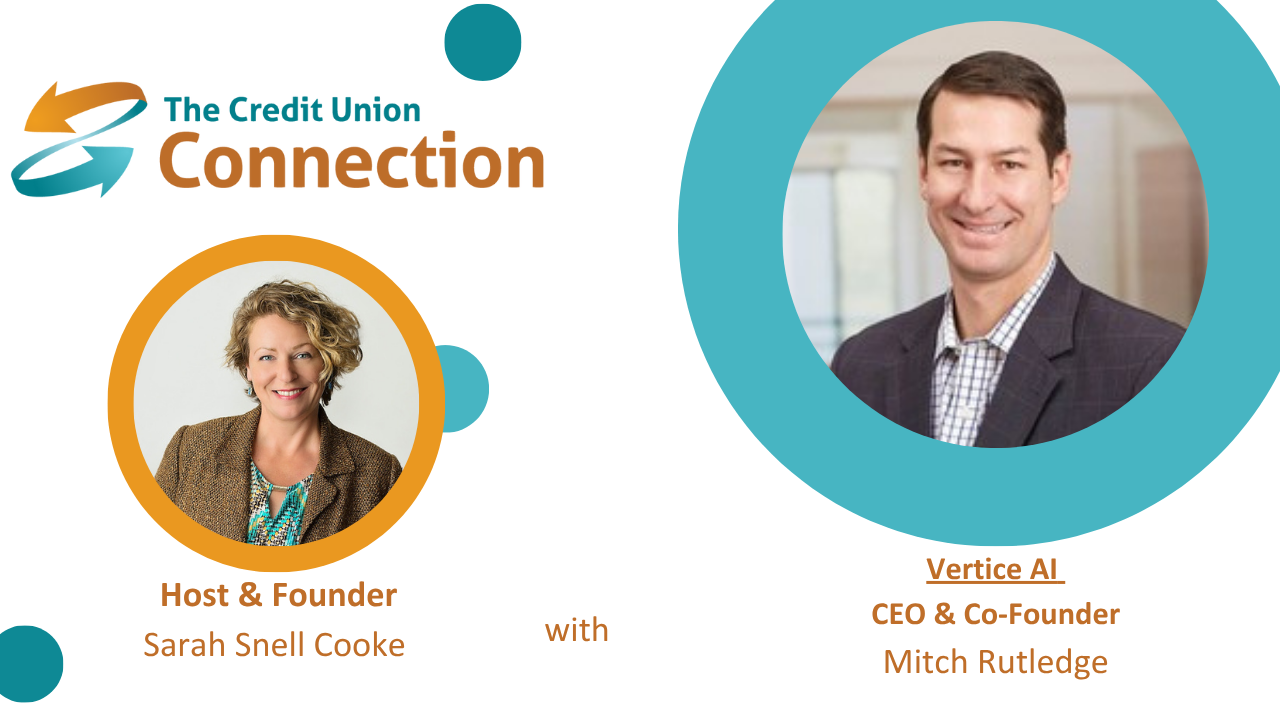
In an insightful discussion at the Government Affairs Conference in Washington D.C. earlier this year, Mitch Rutledge, cofounder/CEO of Vertice AI, shed light on how data-driven engagement is revolutionizing member personalization for credit unions. Rutledge, whose background is rooted in analytics and software, recognized an opportunity to adapt the data-driven personalization techniques used in retail for decades to benefit the credit union movement.
Vertice AI was founded three years ago with the mission of empowering credit unions to personalize member engagement. Rutledge highlighted that credit unions possess a wealth of member data, but often lack the resources, such as in-house data scientists, to fully leverage it. Vertice AI bridges this gap by providing marketing and strategy teams with actionable workflows that transform insights into targeted, personalized campaigns at scale. This approach is particularly crucial for attracting and retaining younger demographics, who expect personalized experiences.
Rutledge emphasized Vertice AI‘s focus on creating “actionable workflows” rather than just reports and dashboards. He provided an example of how their platform can easily segment members based on behavior and demographics, allowing credit unions to craft tailored messages for different groups, such as younger individuals interested in specific checking programs. This capability enables even smaller credit unions with limited marketing staff to execute multiple, targeted campaigns efficiently. Vertice AI supports credit unions of all sizes, from those under $100 million in assets to those over $5 billion, by offloading data analysis tasks from busy data science teams.
A significant announcement from Vertice AI included the launch of two new modules: Vertice Acquire and Vertice Compose. Vertice Acquire leverages insights about existing members to identify and attract new prospective members who are likely to become highly engaged, long-term participants.
The second module, Vertice Compose, is an AI-powered copywriting engine designed specifically for credit unions. It understands a credit union’s brand voice and, crucially, adheres to NCUA compliance rules. This allows credit unions to generate multiple versions of campaign copy segmented by generation, life stage, and geography at scale, addressing a common challenge for marketers.
Rutledge addressed the hesitation some credit unions have about adopting AI, explaining that AI has been in use in the industry for nearly 50 years through applications like credit decisioning. He encouraged credit unions to embrace AI as a powerful tool to efficiently engage members at scale and address the real challenges facing the movement.
For a deeper dive into how Vertice AI is transforming member engagement and acquisition for credit unions, watch the full interview with Mitch Rutledge.
Disclosure: Transcript below is automatically generated
Sarah Cooke
Hello and welcome to the government affairs conference. We are here today. Live in Washington, DC. I’ve got Mitch Rutledge here with me. Welcome. And he’s with Vertice AI. Okay, now, why don’t you give us a little more of your background as well as the company?
Mitch Rutledge
Sure. So I’m Mitch Rutledge. I’m the co founder and CEO of Vertice. Ai. We launched this company about three years ago to really bring a data driven approach to member engagement for credit unions. My background is in the analytics and software space, and so I’m not from the credit union movement, although been a member of my credit union for over 30 years, but we found this opportunity when we were doing some work with one of our first credit union clients that said we need to understand the data that we have and a way to action it to serve the members, and that’s what I’ve been doing with my co founders in the retail space for many years, and we said we’ve learned a lot in retail. Who’s been doing data driven personalization for decades. I think we can help the movement. And so this has been a great journey over the last two and a half years to create a solution that’s really purpose built to empower credit unions to personalize member engagement,
Sarah Cooke
and that’s so important because, you know, 10 years ago, member service was very different than what it is today. So talk a little about the the technology and the strategy for credit unions in using this platform.
Mitch Rutledge
Sure. So our strategy is that credit unions have plenty of data about their members already, but we also recognize that at the size that they are hiring data scientists or teams of data scientists is really prohibitive, and so we want to bring the power of a team of data scientists into a solution that’s really built for marketing and strategy teams, and more than just reports and dashboards, but really actionable workflows that we can get from insights to more targeted, personalized campaigns at scale and an efficiency to really get to that personalization journey that all credit unions are looking for, and that’s what we’ve really built, again, a solution that’s built for a marketer, built for an operations team, but gives the power of a team of data scientists. Wow,
Sarah Cooke
and you’re right, yeah, credit unions can’t afford that on their own, and so there’s so much this data can be used for too. It’s like you mentioned, the marketing side, you can personalize that the marketing pieces which people love, especially younger generations expect. That’s right. So it’s very important, the cranium has been having a hard time getting and retaining those younger members. The average member age is like 53 now, which is sad. What is the dashboards and what are the data? These points that the other executives, the training executives, are looking for sure.
Mitch Rutledge
So again, while insights are important, we’re very focused on, how do we create actionable workflows? And I’ll just give you a very, you know, specific example of the kind of things that we’re doing, you know, you think about last year was about deposits, right? And how do we, how do we have focused deposit programs? And, you know, very often, the old way was, Okay, put the email together, and we’re going to send it to everybody for, you know, this new checking program, or the rates, or whatever it might be. And what we want to make it very easy to do is say, no, no, this younger demographic cares about these attributes, and these are the people that show based on their behaviors, again, the behaviors that we know they show high propensity for it. So let’s focus on the right programs and the right tactics to engage the younger demographics with the right messaging and the right programs. And it’s a different message if we’re going to a different demographic, a very simple example, but if you think about scaling that across geographies right, I can have different messages for different geographies, and everybody knows that they want to do that, but it’s hard to distill who’s the right audience for this, you know, campaign or this email, and the right audience for this email. And so we do that in a very efficient way, that even for small credit unions, you know, we have credit unions under 100 million in assets small, you know, one person or two person marketing departments, they see the value in quickly interrogating their data and finding a way to engage with smaller audiences with the right messages, and doing that efficiency so that we can do many campaigns, not just one, we’ll blast it to everybody. So that’s really focused on.
Sarah Cooke
That’s so awesome. So many vendors just don’t even want to bother working with the smaller credit unions. And they really need the support
Mitch Rutledge
we you know, look, we’re supporting. Bring credit unions of all sizes. We say that we want the ones that are data curious and want to be data driven. And like I said, there’s, you know, there’s ones that are sub 100 million that say, Yeah, we have that mindset of being data driven. And that’s we want to be able to support them up to credit unions over 5 billion that see the value of and some of them may have hired some some data scientists. And you know, even if you have a data sciences or two, or, you know, maybe a small team, what we usually find in those scenarios is there’s a list of 120 projects long for this small data science team. And what we can say is a data science team, we can take, you know, five or 10 of those off your plate for the marketing or for the ops teams, there’s still plenty more work for you to do. So let us offload that. And we actually have one of our one of our credit unions that saw that, where we are a partner between marketing and business intelligence, business analytics team, where we, you know, are just making marketing more self service and being able to use advanced analytics and AI to be more personalized.
Sarah Cooke
Yeah, that’s so excellent. You also had an announcement at the show.
Mitch Rutledge
Yes, we did. We did. So we’ve actually had two big announcements in the last about six weeks, since the beginning of the year. So we launched two new modules of Vertice. And just for context, when we started the company, it was focused on, how do we empower member economic participation growth with the existing members. So think about, how do we grow the wallet share, you know, get members using more products and services and more engagement. And that was very valuable. We all want to do that. But we know, and we’ve heard in many places that new member acquisition is even a bigger priority than it has been. And so Vertice acquire was launched just, you know, a month or so ago, and Vertice acquire is, how do we take the knowledge that we’ve gained about the existing membership to go find new prospective memberships that are going to not just join the credit union but also become highly engaged, long term members? So we really score these prospects across two dimensions of, can we get them? And, more importantly, can we grow them? And so it’s not just we can get them to take an auto loan or take one product certificate. How do we get the ones that are going to be those highly participant members? And we think we’ve got a unique way for using what do we know about our existing members to go and then find the best prospective members. So we’re very excited. We launched that our first client, our pilot was education credit union down in Texas. They’ve seen fantastic results, and now we’ve got, you know, three more of our credit unions that are signing on to launch that with us. So that was going
Sarah Cooke
to be my next question, what have been the results at education? So
Mitch Rutledge
as they kind of put in our initial press release, and you know, they continue to see these results their initial compared to the way they did it, the old way, they saw three times higher interactions and engagements from these prospective members. And the adoption of new products is much higher than they’ve seen in the past. They’re through their, you know, through the first campaign that they’ve done, and in fact, it’s still ongoing, and they’re very happy with the results that they’ve had. And again, we have new a few others that are coming on board as well, and we’re very excited. So you know, the initial results are very exciting. And we have a happy, a happy first client, and we’re excited for more of those to come. And just to pick up on that, the next piece. As you said, for the show, we just launched what we call Vertice compose, and that’s the next piece of this. So Vertice compose is a AI powered copywriting engine built for credit unions that understands the brand and voice of a credit union, as well as the NCUA compliance rules. So if you think about on the journey to personalized member engagement, yes, I want to have smaller target, hyper personalized audiences, but now I have to create the content for them, and that’s why we launched bird. Is compose, is that we can create many versions of campaign copy that’s segmented by generation, by life stage, by geography, and do that at scale. And while many credit unions are using chatgpt as a great tool, it’s not built for credit unions. It doesn’t always understand the brand voice of a credit union and their kind of historical copy, and most importantly, it does not understand the NCUA compliance rules. And if we can wrap around a workflow that makes it so small credit unions and large can efficiently create multiple versions of campaign, copy at scale. We think that’s going to be a powerful game changer, absolutely.
Sarah Cooke
Yeah, that’s so interesting. Bad for marketers, potentially, but
Mitch Rutledge
Well, we believe that, you know, you go and we say, hey, we want to create a campaign that’s hyper personalized, and we’re gonna need 10 versions of the email, right? And you see their eyes just go, you can’t do that. And so we just want to empower the small teams already to be able to support that, that scenario. So we don’t think it’s about, you know, real impact to the marketers. It’s just what we see in the power of AI is, how do we 10x the. Team that we have and we’re
Sarah Cooke
doing. And how do you I mean, some people are still hesitant, probably most people are still hesitant to really introduce AI into their credit union. Some of them probably don’t know it’s already there and some other vendor. But how do you talk people over that, that obstacle? It’s a
Mitch Rutledge
great question. And my co founder, he gave a talk here in one of the keynotes, or in one of the breakout sessions yesterday, very much around this idea of why all credit unions need to take the first step to start to embrace this. Because, as you said, Most credit unions have been using AI for close to 50 years when you think about credit decisioning, right and Fair Isaac right, the first is kind of an AI model, and they have it already in house, so we are really encouraging them to not be afraid of it, that they need to educate the entire organization about what it is. And if that session was recorded, I would encourage folks to go and watch that, because I think we really laid out the, you know, the high level concepts of why this isn’t scary. We’ve been doing it before, and other industries are embracing it. And, you know, this is the movement is ready and needs to embrace. And I think that’s been a common theme of GAC this year, is that AI is with us, and that it is a powerful force multiplier. It’s not the, you know, it’s not the easy button. It’s not going to solve everything. It’s a tool that will help us solve the real challenges of the movement around efficiently engaging members at scale to serve them where they are. And that’s what it can really be, a powerful tool.
Sarah Cooke
Excellent. And, you know, AI, while it, some people have asked me, as a content creator, you know, are you worried? Are you scared? I’m like, oh, hopefully gonna be retired before it takes over. So I’m gonna let you have the last word. What’s your final thoughts you would like our credit union audience to take
Mitch Rutledge
away? I think you kind of hit on it, which is, AI is a very powerful tool. We’re one of the many providers that are out there that are focused in the credit union space. Come talk to us. It’s not scary. It’s just another powerful tool that can help you serve your members. We’re challenged in this day and age to get attention with our members. They’re being bombarded from so many places, and you know, solutions like Vertice and what we’re trying to bring to the movement are really there to empower the credit unions to serve the members, and that’s what we’re really excited about. So we’re, you know, we’ve got over 20 credit unions on our platform now, and we’re excited for this year to launch these new modules and bring it out to the movement, and so we look forward to sharing more results this year and engaging more credit
Sarah Cooke
union I get the scoop right. That’s right. Absolutely right, absolutely right. Alrighty. Well, thank you for your time today. I appreciate
it. Thank you so much for having me. You.