

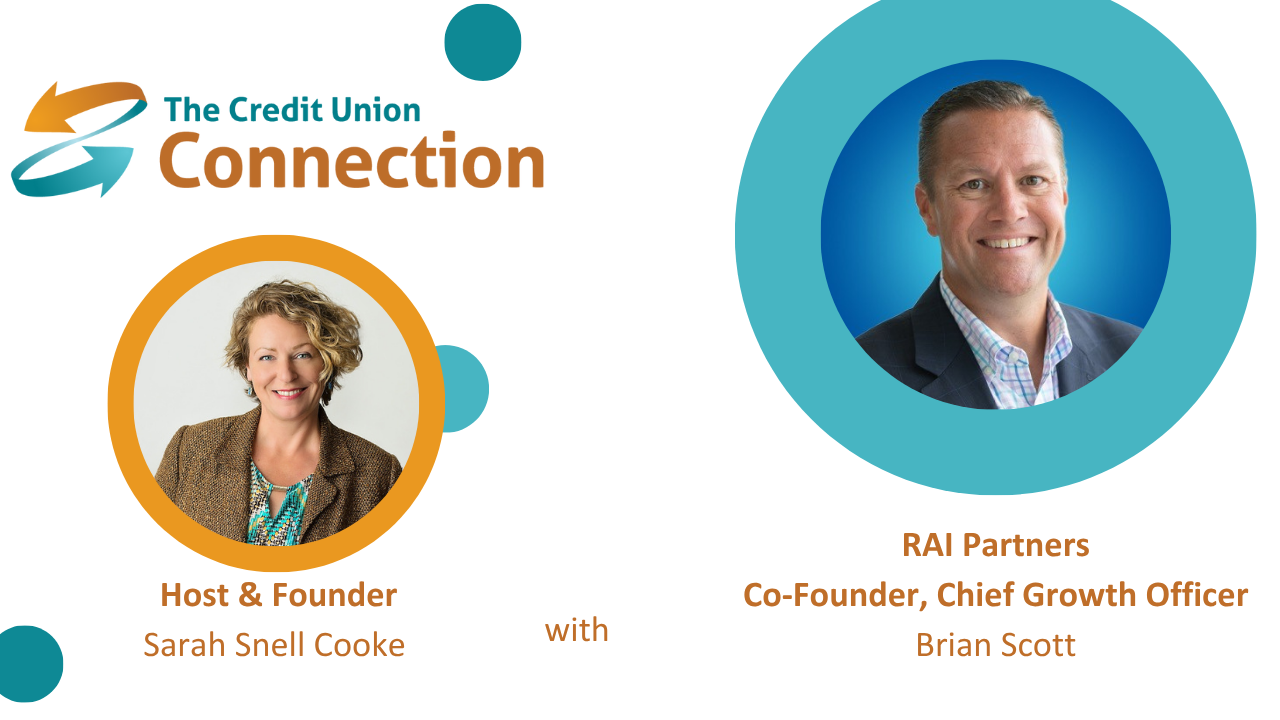
Brian Scott, formerly of Velera and now with RAI Partners, is doing for credit unions and credit card applicants that others shy away from. It’s a simple idea with big impact, and in his conversation with Sarah Snell Cooke on The Credit Union Connection, it’s clear this is about more than cards – it’s about financial inclusion and credit union relevancy. It’s about helping credit unions serve members who would otherwise be turned down for a credit card..
Brian recognizes that smaller credit unions are losing members, lending has tightened and the pressure to grow responsibly continues to climb. RAI Partners offers something different, a way to keep those relationships alive even when a loan doesn’t make the first cut.
What makes the conversation so engaging is the practical application. Brian doesn’t speak in buzzwords or hypotheticals. He talks about real members and real credit card portfolios, and the challenge of saying ‘yes’ in a tougher economy. When credit unions work with RAI, they can still put their brand on a card, still own the relationship, but without the risk that comes with underwriting or collections. It’s a way to keep members connected while strengthening the balance sheet.
There’s also a quiet optimism in the way Brian talks about the road ahead. He compares a credit card portfolio to a mutual fund. Not every card will perform perfectly, but taken together, the mix works. That kind of long-term view feels refreshing at a time when most headlines focus on what’s going wrong.
Sarah and Brian dive into affinity programs and emerging payment tools. Brian lights up at that part, responding about school partnerships, small business cards and the potential of stablecoins to reshape payments. Innovation does not have to come from the biggest players; credit unions can absolutely lead the way. Just look at an old problem with a fresh set of eyes.
By the end, it’s easy to see why RAI’s approach is getting attention. It’s people-first and reminds credit unions what makes them special in the first place: the ability to turn a decline into a second chance.
NOTE: The following transcript is automated with AI. No, it didn’t replace someone’s job.
Sarah Cooke
Hello and welcome everybody. My name is Sarah Snell Cooke, of course, I am your host here at The Credit Union Connection. I am joined today by Brian Scott, welcome.
Brian Scott
It’s great to be here. Thanks for having me
Sarah Cooke
me. Yeah, absolutely great to see you here as well. Now, Brian recently left Valera, where you may know him from, to be join us wonderful self employed people. He is the co founder at RAI Partners, excuse me and yeah, tell us a little bit more about that.
Brian Scott
Yeah, it’s super fun. First of all, I’ve been kind of joined together with Ed and Jay, the other two founders of REI, for a number of years, they were actually clients of Valera, and that’s how I got to know them, and been helping them on the side, you know, build the business, and decided to join up. And so it’s been a fun ride over the last couple months, and it is fun, and it’s very different being part of the self employed kind of generation, so it’s been fun.
Sarah Cooke
Yeah, cool. Yeah, I’d be hard pressed to go back. We’ll see. But So Brian, tell us a little bit more about RAI. I said it right. Oh, wow. Partners and what you all do there?
Brian Scott
Yeah, a lot of the key focus is helping credit unions grow. All of us have seen the need for credit unions to grow. Just recently, the statistics came out that if you take all the credit means below a billion in assets, they’re actually declining in membership. So part of our focus at RAI is, how do we help credit unions grow, specifically using their credit card programs. And we see credit cards is a great entree to bring in new members and serve more members. So what we do is we take all the credit card loans that a credit union wouldn’t approve, and we give them a second look. And right now, we’re offering 90 plus percent of those that get turned down, we’re offering them a card and it can have the credit unions brand on it, or it can have ours, but keeping the credit unions brand is a great way to say, hey, remember, this is we’re serving you. We’re serving you with our brand. Or to bring in new members. A new member comes in, applies for a card if you decline them. You know, does that leave a great taste in their mouth, as they would go for other loans or other types of services at the credit union. So this gives us a way to serve them. We also will take a portion, a hand selected portion, of an existing credit card portfolio, and we can acquire that so it may not be profitable for the credit union, but we can take that on and help make it profitable and pay back a rev share, back to the credit union. So it’s really a way for credit unions to serve more members with a credit card.
Sarah Cooke
Yeah, wow. So does that card, it comes completely off the credit unions books. Or how does that work?
Brian Scott
Completely so they can remove the allowance for loan loss, they can remove any of the rewards redemption expenses that they’ve allocated, plus they don’t have any of the fraud risk, any of the collections risk. It all becomes us, but branding remains the credit union’s brand, and we share all the data and information about that card holder, about that member, back with the credit union, because we view it as their member, and we want them to feel the member. We want them to feel like they’re integrated into everything else the credit union’s doing.
Sarah Cooke
Yeah, that’s awesome, because it’s, I mean, you were mentioning you can have it as you know your brand, but really, you know, keeping the credit union, or keeping the member invested in the credit union because they feel like the credit unions invested in them, because they’re the front man, if you will.
Brian Scott
And at some point, you know, maybe that member becomes a good, credit worthy member that the credit union wants to bring back in, and we’ll allow that to happen too. So it’s not just if that member comes to us, they’re gone forever. From the credit card perspective, the credit union can bring them back too.
Sarah Cooke
Yeah, I imagine that’s going to be pretty, pretty important in the coming year or two. Things are on, a little bit on the decline in the economy in general.
Brian Scott
Yeah. I mean, a jobs report just came out where essentially no new net jobs were added. And so that’s going to put a crimp on, you know, credit quality and those kind of things. And we become another option for credit unions to again offer credit cards to their members.
Sarah Cooke
And so how do you, I mean, do you just take any portfolio, or do you take, like you analyze it first, I would assume.
Brian Scott
But yeah, so we’ll take any portion or all of a credit union’s portfolio, we’ll do some analysis on it and decide, you know, what is the value of that portfolio, we have to make money off it too, but we also have the ability for federally chartered credit unions to charge more than 18% interest, which gives us a little bit of extra breathing room. Now it again. If your member doesn’t get a card from you, they’re probably going to Capital One or somebody else that’s really going to charge. Them a high interest rate. We don’t have any rates above 30% or anything crazy. But that difference between 18 and maybe 22 or 23% which is super common amongst Capital One and others, it gives us the ability to serve that member. For us to make a little bit of money off it, but also we share some of that back with the credit unions, so they’re making some money off that member as well. So it’s a way for all of us to be profitable and still serve the member.
Sarah Cooke
Yeah, yeah, that’s great. And so do you do any types like the CD paper that that’s serving? Because that’s their job, right?
Brian Scott
Yeah, we do so everything from obviously a and a plus paper all the way down to we have share secure programs, secure card programs. You know, somebody may only get a $500 credit line with a little bit higher interest rate, but again, that member, if they’re not getting a card from you or from us, they’re going to go to Capital One or chase or one of those other bank lenders, and then they become a part of the bank ecosystem. And they’re, you know, they’re getting marketed to every Saturday and Sunday when you’re watching football on TV about Capital One, you know. So this is, again, a way for the credit union brand to stay front and center with that member.
Sarah Cooke
Yeah, yeah. And I feel like credit cards are becoming more important. More important. More credit unions are getting into credit cards, which I 20 years ago was saying, why aren’t we doing more with credit cards?
Brian Scott
I think payments are so important. I mean, you think about how many times you make a payment on either a credit card or a debit card each month, it’s 7080, different times. And that’s 70 or 80 different interactions the credit union is having with the member, and especially with the compression on interchange on debit, credit becomes a great way for credit unions to serve more members. And we don’t want to serve the members that the credit union wants to serve directly with their program. We’ll take all the rest, and again, it’s a way that you can be deeper in the wallet of your members and just more products and services, the better it is when they want to mortgage or an auto loan or the other things they see the credit union’s brand every time they’re pulling their credit card out.
Sarah Cooke
Nicholas, your personal little billboard right there.
Sarah Cooke
And so how does it work for a credit union like when they want to, you know, engage you all. How does that work?
Brian Scott
Yeah, yeah. So, I mean, they can call me, we’re still small and mighty, but they can call me, interact with any of us at RAI, it’s really a simple process. So we’ve gotten the process down to six to eight weeks from the time somebody says they want to do business with us to the time where we can actually be issuing cards with their brand on it. So it’s a really fast process. We integrate with the loan origination providers that they have, so it can be a seamless experience. So if Brian applies for a card, he’s not credit worthy of the credit union, he doesn’t see that the credit union declined him. We’ll integrate to the systems behind and we’ll make an offer. And so it’s not like Brian says, Oh, the credit union declined me, but somebody else approved me. It looks like, hey, we declined you for the exact card that you applied for, but here’s three other different cards that you do qualify for. So it’s a great experience for the member too. It’s instant real time. If we, if the credit union, doesn’t want that real time experience, we can also do it with files. But most everybody I’ve talked to, they want their brand on it, and they want experience for the members. So Right?
Sarah Cooke
Exactly, because I think that’s part of treating those members who may have poor credit or have been historically underserved and still treat them with dignity, because it’s not going to take because it’s not going to take them two days to decide for a loan committee to decide what’s going on here.
Brian Scott
Yeah, we’ve also got some neat things where, like CO branded or affinity cards, we’re doing some things with college programs and some credit unions, where the credit union can market a card at a college football game and use that as a way to bring in new members. Well, if you’re not going to apply all the credit card applications you get, it trickles down. You’re not getting those as members too. So we can kind of help behind the scenes do, whether it be sports marketing programs, startup programs, we’re doing some of those business programs where credit means may not have the expertise to do a business program, but we can help them issue cards to their business members too.
Sarah Cooke
Yeah, yeah. I gotta talk to you about that one. All right. Um, so, um, what do you have any concerns about? What’s going on in the market going, you know, for the next couple of years, where it seems like we’re we are looking at a downtrend, downward trend, and how would you advise credit unions to kind of mitigate that?
Brian Scott
Yeah, well, there’s a couple things. The economy goes through peaks and valleys all the time. And you know, if you look over a longer timeframe, it’s pretty much always gone up. Right? And so we kind of take the long view of this, and we take the view and we encourage credit unions to do the same thing, that not every single credit card might be a great risk, but when you put it into a mutual fund of other just like a mutual fund of stocks, not every stock is going to go up, but they work in conjunction. Some go up, some go down, and that’s the way we view credit cards. Like not every credit card is a perfect credit risk, but when you put it in with others, it is. And so we really encourage credit unions take what we do and use it in your own portfolio. But anything you can do to serve more members, get your members using your payment vehicles, is a good thing. It encourages them to stay in the credit union, use more products and services from the credit union. So that’s kind of the view that we have. Yeah, we think there’s some things in the economy that are going to be a little bit tougher. Jobs is a big one. Interest rates might also come down as part of that. So there’s different factors working, pros and cons. So again, we take the long view on that, and we encourage credit unions to do the same thing.
Sarah Cooke
Yeah, absolutely. And so when a credit union is looking at its overall income, you know, one of the things that I think is attractive about especially credit cards. And you kind of touched on this. And debit cards is the non interest income, yeah, that your members never see, and it helps keep you a little less interest rate sensitive, a little less, you know, balance sheet sensitive. You talk a little bit about that, how you advise credit unions to use credit cards in other ways, I guess, yeah, yeah.
Brian Scott
We’ve been fans for a long time of use credit cards to, in some way cannibalize debit activity. Because again, that non interest income, the interchange income on debit, has been shrinking. It’s been relatively stable on the credit card side, and it’s much higher. So for the members that are a good credit risk, encourage them to use credit versus debit. And people like us, we can actually help with a non interest income too, because they’re not taking any of the risk, either the fraud risk or the underwriting risk when we have the credit card, but we are sharing the profitability back with the credit union. So we also can be a positive influence to that non interest income, too. Yeah.
Sarah Cooke
And when you were talking a little bit about the affinity programs, those have been so popular, you see where those really help further get members interested and excited about their card and using it.
Brian Scott
So I think about schools a lot. There’s a lot of, you know, school related credit unions. You think about if I could use a card and have some of the income from that card go back to benefit my school, like, I’m going to use that card all the time. And those types of affinity programs have really strong ties, whether it be for athletic programs, schools, firefighters. There’s a lot of different things like that. We have one that’s a pool players. They play pool. They have a strong affinity to that group.
Sarah Cooke
And so those dollar down, they put the cards down.
Brian Scott
So I mean those things, people that are loyal to those things, they’ll use those cards, and they’ll use the credit union frequently too, that because of that affinity. So we see a lot of power in the affinity marketing programs.
Sarah Cooke
How many credit unions are you working with right now?
Brian Scott
Right now, we have eight that have signed up and are live with us. Right now, I probably have 30 others that have interest that we’re going down the path with, but we have eight that are live with us right now.
Sarah Cooke
Yeah. Cool. And so what have been the results like, if you can speak, maybe in aggregate, as far as the benefit to the credit unions?
Brian Scott
Yeah, so the biggest result is the eight credit unions that we’re dealing with, they are bringing in way more members, and they’re able to use their credit cards to market to new members. And that’s been that one of the best things that we’ve seen is credit unions no longer are scared to offer their credit card to new members that they don’t know if they’re a good credit risk or not. And so having us behind the scenes to help with that has been really positive. The other is just serving more of your members that want the card from you. So existing members that are already in have been extremely satisfied that they’re not getting turned out. So those have been two of the biggest benefits. And then obviously, we just talked about the non interest income. It’s just an extra source of income that the credit unions weren’t getting before. Getting before you decline the card. There’s nothing that comes out of it. When we process it, you get a rough share.
Sarah Cooke
And you know, the whole point of being a credit is to say yes, as much as you can. I think personally, anyway, you think that too, yeah. And. So tell us what else is new with you. I know you. You left your previous employer, and you know what else you’re into? What you got your fingers into.
Brian Scott
My whole career has been in credit unions. It was my college internship. I was a freshman at Drake University, and I started at the members group, which ended up combining with Co Op. Co Op and PSU combined to form Valera. So I’ve been a part of that for over 30 years. And great companies, great experiences. I loved working there. It got me into this, and so it’s just been fun. And I’ve loved to see credit unions grow. I’ve loved to see the passion that credit unions have for serving their members. So what’s next for me is obviously doing this, but I’m always looking out for what can I do to help credit unions grow? I think there’s a lot of great smaller companies like ours out there are doing unique and positive things for credit unions. I’d love to help those companies like ours get deeper into the credit union space. So, you know, there’s a lot of really good companies that are smaller startups. Then that’s part of what I recognized is, man, if I can help all these great startup companies get deeper into credit unions and help them grow, there’s probably a place there I can help too.
Sarah Cooke
So, and so, I mean, there’s also all these other payment systems entering, so that’s an exciting time for you. I’m sure
Brian Scott
Crypto is big. You know, not even the Bitcoin side of it, the stable coin side is, I think, an interesting way to bring in new members too. So there’s a lot of really positive ways that I think credit unions can do more with their members. And part of it’s just kind of looking outside the typical box that a lot of credit unions have been stuck in for a long time.
Sarah Cooke
Yeah, and I think they’re ready for that now. I feel like, you know, you too that with the AI and understanding that now, I think, to a to a certain level. And before that, it was like when crypto was first introduced. And, you know, although we’re getting comfortable with that as well, and now with the stable coin, the genius bill, yeah, became law. I think that’s a whole new gonna be a whole new system at some point. But yeah, so any thoughts on where that’s heading for credit unions?
Brian Scott
Well, I listen. I think a lot of credit unions are starting to look at it. On the bank side. There’s a lot of banks that are already in it. And I think it’s one of those things that you have to be in early the stable coin market is very different than the more speculative Bitcoin type market, and it’s really important for credit unions to understand the difference between those two. Might be an investment vehicle, you know, a growth vehicle. Another is just a payments vehicle. And so using stable coins and using that as different ways to pay and transfer money, whether it be cross border, some of those kind of things, it’s coming, and if not here already, so something that credit union should definitely be in.
Sarah Cooke
Yeah, we’re starting to see more and more. Oh, we introduced our own coin, who ends up, in the end with,
Brian Scott
That’s a big difference the speculative side versus just the state,
Sarah Cooke
yeah, yeah, because the stable coin are based on the US dollar, or whatever market you’re in. So anyway, yeah, I always offer my guests the final thoughts. How would you like to close out with our credit union audience today?
Brian Scott
Yeah, first of all, I want to thank you. I appreciate you having me here. You know, being a smaller startup company like it’s great to have some of these outlets like this to share our message. So first of all, thank you to you and to credit unions that are listening and watching, look for all the great, smaller companies out there that are doing unique and innovative things, there’s a lot of benefit that credit means can get out of it. So hope to talk to many of them.
Sarah Cooke
Yeah, awesome. Thank you so much. Appreciate your time today, Brian.
Brian Scott
It’s great being here. Thank you.