

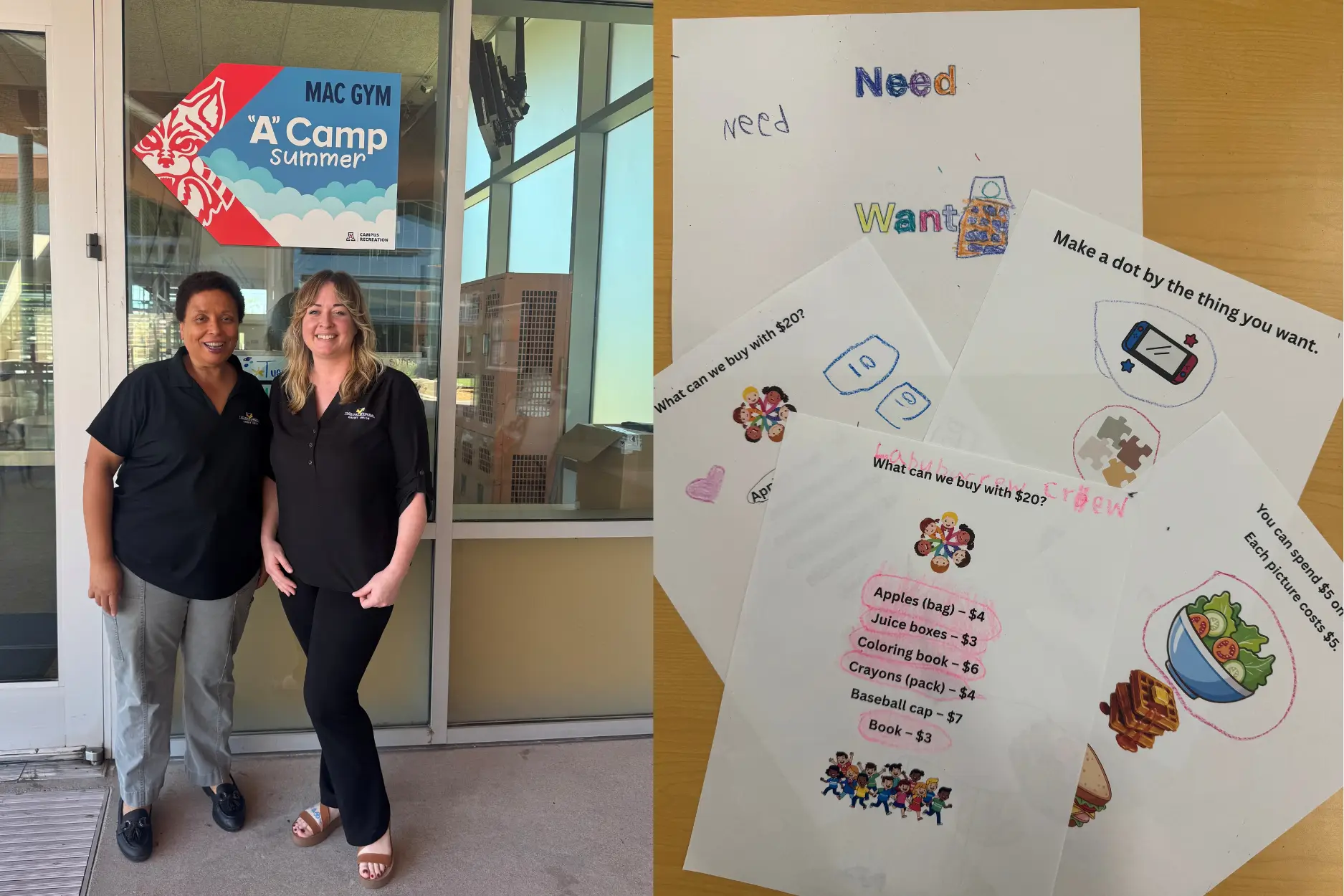
Teaching kids about money doesn’t have to involve dusty textbooks and boring lectures. Just ask the 322 campers at the University of Arizona’s “A” Camp who got a crash course in financial literacy this summer—courtesy of Tucson Federal Credit Union volunteers who proved that learning about cash can actually be fun.
TFCU’s Community Impact Manager Robyn Austin and Human Resources & Community Impact Specialist Katie Mckeever rolled up their sleeves and headed to campus recreation this summer with a mission: make money make sense for kids ages 5 to 14. Over four energetic 50-minute sessions spread across June and July, they broke down age-appropriate money concepts that ranged from piggy bank basics for the littlest campers to more complex financial ideas for the teen Counselors in Training.
The collaboration came together thanks to some smart networking. TFCU Board Member Cori Rodriguez, who also works with UA Campus Recreation, connected the dots between the credit union and the university’s youth camp team. Sometimes it really is all about who you know.
More Than Just Counting Change
The sessions weren’t your typical “here’s what a quarter looks like” fare. Each group got content tailored to their developmental stage, because explaining compound interest to a kindergartener is about as useful as teaching calculus to your cat.
“Financial literacy is at the heart of everything we do at Tucson Federal Credit Union,” said President and CEO Matthew Gaspari. “We were founded by local educators, and empowering the next generation with smart money habits is a tradition we proudly carry forward.”
That educator DNA runs deep at TFCU, and it shows. Rather than treating financial education as a one-and-done checkbox, the credit union is planning to expand these efforts throughout Pima County schools and community programs year-round. Because let’s face it—in a world of one-click purchases and digital wallets, today’s kids need money skills more than ever.
The summer camp sessions mark just the beginning of what TFCU hopes will become an ongoing investment in Southern Arizona’s youth. After all, the best time to learn about saving, spending, and financial responsibility is before you’re staring down your first credit card offer or student loan.