

James Chemplavil, Founder/CEO, Salus
Younger members remain elusive for most credit unions. As they look at an aging member base, they often struggle with how to attract younger members. Amongst the noise for how younger members engage with financial institutions, the evolution of an old product holds more insight than you may believe.
While the current economic climate is presenting challenges for everyone, they can be more pronounced for younger members. 63% of people aged 18-29 don’t have three months of emergency savings (vs 45% for ages 45-59). 55% of people aged 18-29 would struggle to handle an unexpected $400 expense (vs 34% for ages 45-59). As a result, access to cash for short-term financial needs is a real need for many younger members.
The bottom line: they’re looking for a quick buffer for short-term emergencies, which presents an opportunity for the institutions set up to help them quickly. But does a credit union offer them the best path forward? Let’s consider two options for a Gen Z member looking to borrow $400.
Traditional Credit Union Personal Loan: A Forced Fit
The young member looks into a personal loan at their credit union.
The loan product often has a minimum loan size above the amount they need, which is only $400. They know they don’t want to over-borrow, because they only need this amount of money for a week or so.
Even though they joined the credit union a month ago to take advantage of better products, eligibility for the loan requires a few months of direct deposit history.
The loan product requires a credit pull. Not only does the member not really know what their credit score is at the moment, is it really necessary for a loan this small?
At the end of the application process, they find out that they’ll be notified “shortly” of the decision. While that sounds good, does that mean within the hour? The next day? How long does it take to get the funds in an account to use once they’re approved?
While trying the credit union seemed like a sensible choice, getting a solution suddenly seems like more trouble than it’s worth, especially if the cash is needed today.
But what if these members had a different option?
Fintech Earned Wage Access: Fast and Easy
Instead of trying a credit union solution, let’s see how the member fares when they try a fintech solution – an earned wage access.
They can borrow up to $500, a great match for their needs.
They can sign up and be eligible in minutes, without a minimum tenure.
There’s no credit pull, they just link their checking account.
They find out in minutes that they’re eligible for the $400 they need. They can choose to get the money in a few business days, or they pay a fee to receive the money that same day in their own account.
Now this young member has their short-term problem solved in minutes. No uncertainty, no waiting. And while the fee may have cost them more than they planned, a few dollars seems like a small price to pay to solve their problem. Plus, they see an option to waive those fees, and get better access, by signing up for an account at the fintech and direct depositing into that account. For this young member, it sounds like a great way to solve this problem in the future, at an even cheaper cost.
The New Competition Winning the Direct Deposit Relationship
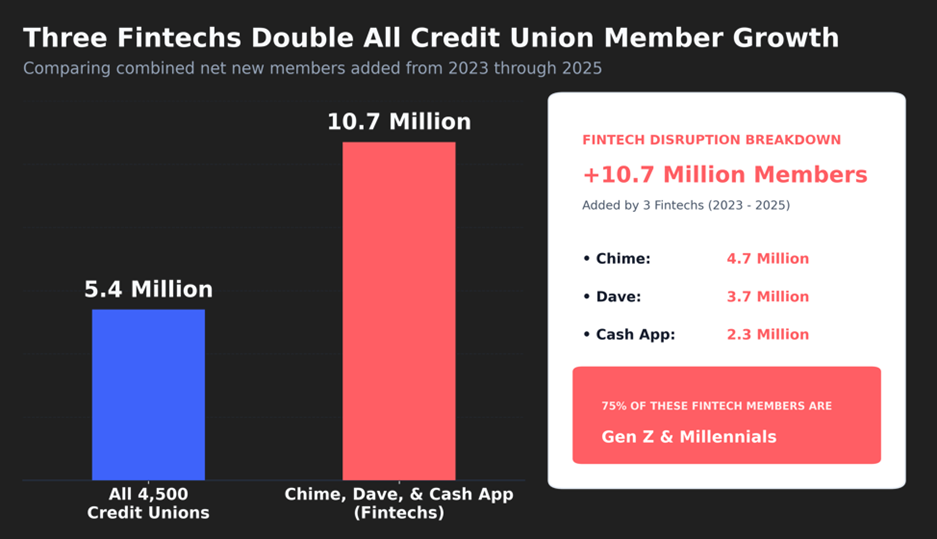
Credit unions spend a lot of time thinking about traditional competition, but here’s what digital neobank entrants have been doing to win younger members:
- Dave, 3.1 million monthly transacting members (+18% versus last year), issued $2.3 billion in their earned wage access product in the three months ended June 2026. Their goal? “Achieve highly-efficient [customer acquisition cost] by addressing members’ most crucial need – liquidity – and then deepening into long term relationships.”
- Cash App, 9.4 million active users that have a primary banking relationship (+18% versus last year), issued an estimated $7.6 billion in their short-term loan product in the three months ended June 2026. Their goal? “In the second quarter of 2026, we continued to prudently invest in our lending products, including growing Cash App Borrow given the strong unit economics and returns we have seen.”
- Chime, 10.4 million active members (+20% versus last year), issued $4.5 billion in their earned wage access product in the three months ended June 2026. Their goal? “At the core of our competitive advantage is our success in developing primary account relationships.”
Credit unions have not historically offered a product like this to members, let alone advertised it. When a member logs onto the website, they’re more likely to see an advertised HELOC rate than a product to help new members with short-term emergencies. But the younger audience you’re trying to win isn’t thinking about home equity; they’re looking for solutions that solve the problems they face today. And the competition is proving, a million young members at a time, that a banking relationship can be built around solving that need.
Partner With Fintechs To Beat The Competition
Credit unions don’t have to build solutions from scratch to compete with fintechs and neobanks. Collaborative fintechs can help credit unions offer tested, cutting-edge solutions that level the playing field. The Salus platform delivers solutions like earned waged access and more, so credit unions can meet younger members where they are. When you’re ready to make Gen Z members for life, check us out to learn more.