

Tursio, a structured data search platform, just got accepted into the demonstration track at VLDB 2026—that’s the International Conference on Very Large Data Bases for those keeping score at home—happening this August 31 through September 4 in Boston.
So what’s the big deal? Context is basically AI’s Achilles heel right now. You can have all the fancy language models in the world, but if they don’t understand what your data actually means in your specific business context, you’re going to get garbage answers. Tursio’s paper, “Tursio for Credit Unions: Powering Structured Data Search with Automated Context Graph,” tackles this head-on by showing how to automatically generate a context graph for credit union core data.
Think of this context graph as a really smart map that includes not just what the data is, but what it means and what rules govern it. The platform uses this graph to translate plain-English questions into accurate SQL queries that actually follow business rules—no months-long setup process required. You know, the kind of setup that makes most AI and business intelligence tools feel like assembling IKEA furniture without instructions.
The Member-Centric Problem Nobody Talks About
Here’s where it gets interesting. Most core banking platforms, including Symitar (which is huge in the credit union world), are organized around accounts instead of members. That design choice made sense once upon a time, but it creates a headache when you want to answer basic business questions. Without a data analyst or report writer on speed dial, good luck getting answers quickly.
Tursio’s approach solves this by doing some pretty clever automated work behind the scenes. The platform figures out how different tables relate to each other, distinguishes between dimensions and measures in your data, applies the right kinds of aggregations, and screens for personally identifiable information before any query runs. And crucially, everything happens inside the credit union’s own security perimeter—not in some distant cloud server.
Why This Matters Beyond Credit Unions
“Database conferences have traditionally talked about general-purpose systems, and not the specific industries running on top of them,” explains Alekh Jindal, CEO and Co-founder of Tursio. “What AI changes is that you can specialize far more than before. Instead of building one broad solution meant to work for everyone, you can build something that solves a real problem for a specific industry.”
That’s a significant shift in thinking. Instead of trying to be everything to everyone, AI tools can now go deep on industry-specific problems and actually solve them well. It’s the difference between a Swiss Army knife and a purpose-built tool—sometimes you really do need the specialized version.
What to Expect at the Conference
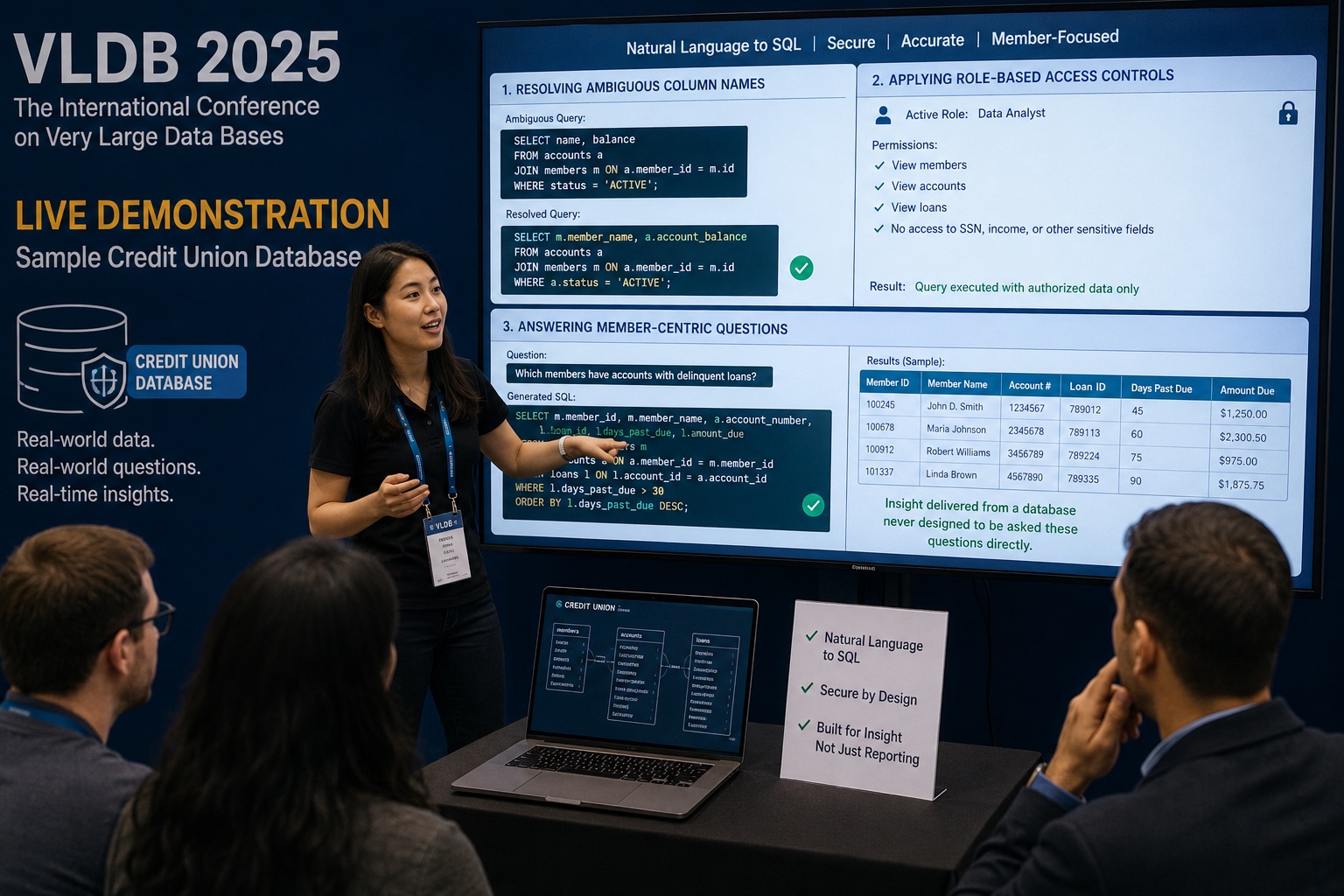
At VLDB 2026, the Tursio team will run live demonstrations using a sample credit union database. They’ll show how the platform handles tricky real-world scenarios like resolving ambiguous column names (because every database has about seventeen fields called “date” or “amount”), applying role-based access controls, and answering member-focused questions such as identifying which accounts have delinquent loans—even though the underlying database was never designed to answer those questions directly.
It’s a concrete example of how AI can bridge the gap between how data is stored and how humans actually need to use it. And for an industry that often gets overlooked in tech conversations, it’s pretty cool to see credit unions taking center stage at a major database conference.