

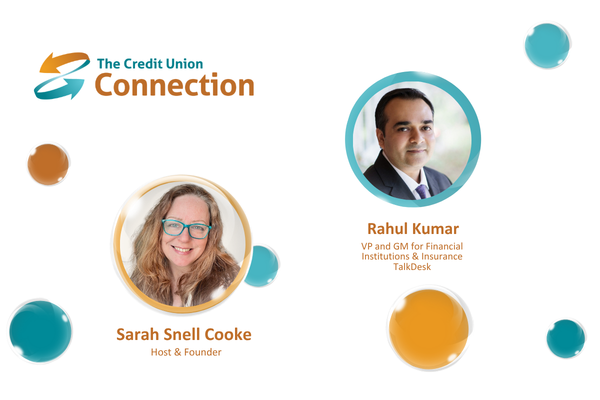
That’s the core warning from Talkdesk’s Rahul Kumar in a recent chat with Sarah Snell Cooke on The Credit Union Connection podcast.
Sure, virtually every organization has dabbled in AI, but a staggering 85% of them still don’t have it working across departments. Instead of acting as an organization-wide operating system, AI is stuck in isolated silos—a chatbot here, a lending tool there—creating what Kumar calls a “fragmentation tax.”
The era of casual AI experimentation is over. It’s time to stop looking at AI as a shiny tech toy and start treating it as the strategic lever that reimagines how your credit union operates.
So, how do credit unions break the cycle of expensive, piecemeal experiments? Catch the full conversation with Rahul and Sarah!
NOTE: This transcript may contain minor imperfections courtesy of our AI overlords-in-training. We’re not complaining. We’re definitely not complaining.
Sarah Snell Cooke: Hello and welcome everybody. I am Sarah Snell Cooke, as always, your host here at the Credit Union Connection. I’m joined today by Talkdesk’s VP and GM, general manager, for financial institutions and insurance, Rahul Kumar. Welcome.
Rahul Kumar: Thanks, Sarah. Good afternoon.
Sarah Snell Cooke: Yeah, great afternoon, and just such a long title to get through. Sounds like you have a lot of responsibility there.
Rahul Kumar: Yeah, and it can mean a lot of different things to different people. At Talkdesk, I essentially lead the financial services and insurance business, here to drive mind share and market share for an organization, and partner with organizations that are really looking to leverage our technology to drive better member experience.
Sarah Snell Cooke: Now, you all recently did some research that caught my eye. Apparently, and this is not terribly shocking, 99% of organizations, basically all, have deployed AI in one way or another, but only 15 have it actually working across departments. What should be top of mind regarding this stat as a credit union executive?
Rahul Kumar: I think the basic response, the immediate response is it highlights a critical risk where organizations are investing in AI without really measuring the return on investment that they’re getting out of it. It also shows that organizations… And we work with credit unions, and I’m sure you speak with a lot of them, Sarah.
I think AI is still being treated as an experimentation project by a lot of them. I think the fact that the value realization across departments is low points to the fact that a lot of credit unions are still operating in a lot of departmental silos. If you go and ask a particular credit union executive, what are they doing with AI?
“Yes, we’re using AI.” “What are you doing with it?” “Oh, we have a chatbot.” “Our lending team is using it for X. Our fraud team is using it for Y.” But I think it also shows that there is a lack of right now, where AI is not being truly used as a centralized orchestration engine.
It can truly be an operating system across the organization, connecting the different departments, the different channels to your members. Obviously, that’s easier said than done, but I think that’s where the next emphasis should be for executives. How do we move away from piloting some of these point solutions which have proven value?
I’m sure if you ask a credit union executive, “Hey, is AI returning value?” In small pockets where it is being used, there’s a direct correlation to value unlock that we are seeing across the credit unions that we partner with as well. I think, in the research report, we allude to a terminology called fragmentation tax.
I think that’s where the bulk of the emphasis should be. How do we move away from the siloed, fragmented experimentation that is happening within the organization to a more organization-led, value-led utilization of this technology that can deliver or help unlock a lot of value for you all?
Sarah Snell Cooke: Yeah. So much more when lending talks to the call center and whatever, departments need to communicate or at least know certain things about members or about the organization. And one of the things that you talk about too is virtually none of the organizations can actually quantify what AI is doing for their business.
And I think you spoke to this a little bit about how much more a cross-department usage of AI can help. But how should credit union executives define, measure, and share their AI adoption level internally and with their boards whom tend to be older and might be a little concerned about the use?
Rahul Kumar: Yeah, I think it’s a fundamental shift in mindset as well, I would say. Traditionally, if you look at any tech… AI is still being looked at as a technology initiative, because by nature it’s tech. So a lot of times where we have seen, and this is the mindset that we are trying to change, AI is still being looked at as a cost-led initiative.
“Hey, can we save costs by deploying AI?” A lot of the initial usage of AI, if you think about in the call center environment, is “Hey, can I use AI to contain the inbound calls that we are getting?” I think, yes, that’s where the stories fall short, at least when you think about board executives—they don’t really care, “Hey, I deployed three AI bots and saved $100,000 this year.”
What they’re looking for is, is this technology really helping us make an impact, and helping us deliver on our mission and our promise to our members? So I think that’s where the storytelling aspect, the redefinition of metrics that are being used to gauge the success that AI as a key enabler can have for the organization, needs to change.
So moving away from, “Hey, my handle time in the contact center went from five minutes to three minutes because we have Copilot running in our environment.” The storytelling there needs to be, “Hey, we unlocked 30% capacity in our workforce by saving time in the way we are serving our members,” and now that 30% workforce capacity that we helped unlock can be reused or pivoted to more member-facing tasks that can deliver incremental value.
I think that’s the mindset that needs to come in, and it has to be business-led and not tech-led. So the value stories that are being created for the board to consume need to be business-led, where the business executives are standing up and raising their hands and telling the story which truly resonates with members, rather than really telling, “Hey, we deployed AI and it’s working.”
Sarah Snell Cooke: Right. And you alluded to it before with the reference to a chatbot. That’s backwards, I feel they should be starting somewhere more foundational. So you also found, and this is going to be something that will slow AI adoption, that about half of leaders don’t trust AI decisions quite yet.
Where is that balance between trusting and ensuring that you’re moving forward to a more modern organization, and ensuring you’re not putting any member data at risk?
Rahul Kumar: Yeah. I think that’s a fair question because if you look at… And you’ve spent a lot of time sitting alongside and talking to credit unions in your career, Sarah. Member trust is actually a currency for credit unions in the way they have operated over the last several decades.
So being skeptical about a technology that is newer and has implications is normal for that segment. But I think where it becomes a barrier is if it leads to inaction. The way we’ve always said is, look, once you identify some of the early use cases and workflows where you think AI can add value, whether it’s on customer experience, whether it’s on other processes that you’re looking to automate, having the right governance structures in place, at least having a framework, and partnering with organizations that have a similar mindset when it comes to risk and security—those are all areas that can help credit unions find the right balance between adopting a technology that can deliver value while keeping their fiduciary responsibilities to the members at bay, maintaining their risk posture.
I think that’s where it needs to be. Fundamentally, the pace at which the technology is evolving, though, inaction is not an option anymore. In the last 12 to 18 months, just look at where ChatGPT was and where ChatGPT is today. Even as normal users, we can see how far the technology has come.
And if as a credit union, you say, “Okay, let me wait 12 months before we touch this,” you’re already three years behind. The time horizon for roadmaps and the pace is shrinking with every second, and that is why it is imperative for credit union executives to nail down their initial frameworks.
Whatever it is, have something in place, have your governance policies on paper, and let’s start the journey. And then finding the right partner obviously helps. If you find the right partner, that can be helpful as well.
Sarah Snell Cooke: Now, I’m not sure we need to research on this, but you found that the legacy infrastructure that many credit unions have is hampering the adoption of AI as well.
A lot of these core system upgrades take a lot of time, especially if you’re transitioning to a new provider. So is meaningful AI progress even realistic for those type of credit unions, or is it too late?
Rahul Kumar: I think AI can influence a lot of different areas of the business, Sarah. That’s what we are finding. So yes, if you’re able to connect your AI agents to your core systems to execute on some of the key transactional workflows, that’s great. But you can pragmatically start infusing AI into your member journeys, whether it’s in the self-service channel or even the assisted channel, where those things might not really be your day-one objectives.
So if you think about utilizing… I’ll just talk to you about a workflow that’s top of mind for me. Think about where credit unions typically don’t see themselves as a supplier of checking accounts. That’s not the business that they want to get to, although having a member open up a checking account is the start of a relationship for them.
So if you think about, hey, somebody opens a checking account, can we use AI to actually or systemically orchestrate their day zero, day one, day two, day three engagement with the credit union so you’re not lost? You’re always rolling out the red carpet even when somebody’s not in the branch.
So Sarah opens a checking account. Two days later, somebody reaches out with a welcome message: “Here’s rolling out the red carpet. Welcome to the credit union. This is who we are. This is the mission that we are after.” Three days later, Sarah hasn’t set up a recurring or a deposit, you send Sarah a message to say, “Hey, let’s tell you the benefits that we can offer if you set your payroll into the checking account that you just opened with us.” Three months later, when the account is transactional, Sarah’s outflow from the checking account to her mortgage that is not with the credit union…
You can use that data to say, “Can we help you lower your mortgage payment that we see going out of your checking account?” And you do not really need everything to be connected, but even the thought process of identifying some of these workflows and systemically trying to start to orchestrate some of these proactive engagements are going to help credit unions.
Yes, the Nirvana state is, hey, all my data is in one place, all my systems are connected. We have invested in a data lake that is giving us a single pane of the entire relationship we have with our members. Credit unions are investing; they are on that track.
Pero I think it is still okay to have a pragmatic approach to automating all of the transactional workflows. You can get there. You don’t need everything in place. You just need to identify some of the low-hanging fruits and start to execute from there. That also gives you the opportunity to nail down your governance framework, identify your guardrails, and decide where you want to start—member-facing or employee-facing. Those things can be done. You don’t really need to wait for everything to be in place.
Sarah Snell Cooke: Yeah, ’cause it does seem like there’s a lot more that can be saved in time in the back office-type work than a chatbot, of course. And actually, your research found that a lot of these chatbots, however, there’s no context if a human has to take over, or if the person had to leave and then come back, there’s no context saved.
Rahul Kumar: The final thing I would say on that question, Sarah, is when I started my journey at Talkdesk six years ago, one of the fundamental pieces I wanted to solve first, especially as we built our offering for credit unions, was the core integration problem. We are in the customer experience, member experience space, and it was paramount for Talkdesk to be able to speak in real time to core banking systems.
So when we start a new relationship today with any credit union that decides to partner with us, the core integration is pretty much a day-zero item for us. We do that immediately. So I would also say that the investments that some of the… and this is not just with Talkdesk, I’m sure there are other providers that are doing it… rely on our ability to integrate into their core environment. So we’ve done that, the Jack Henrys, the FIS, the Fiservs of the world. Our connectivity has gotten a lot better than it was six years ago.
Every new credit union gets onboarded, that connection is created by default. And a lot of AI organizations, especially organizations like Talkdesk that are investing in customer experience automation capabilities, are investing in the right cloud-native, real-time data infrastructures that will allow us to help our credit union customers get away from the latency that they currently have in their existing environments around data.
Long-winded answer, but I’ll summarize. You don’t have to wait. The technology is only getting better. Organizations that are looking to help you automate member experience are investing in capabilities that allow much better integration capabilities than ever before.
Sarah Snell Cooke: Yeah, absolutely. And the research also found that the more sophisticated AI organizations are four times more likely to see major gains in satisfaction scores from their members as well. What does that look like operationally? Who owns making this all happen? Will it require a new position, or is somebody already probably in a credit union that can do it?
Rahul Kumar: I would love to create more positions for executives to get into. I like new fancy titles around chief AI officer and chief innovation officer. But what it translates to from my perspective for credit unions is member loyalty. Ultimately, it’s about a credit union being able to continue to deliver on the promise that they made.
Pretty much every credit union makes their members a promise of quality service and always being available. I think AI makes that case a lot stronger. That is not to say that AI has to handle everything and anything. But in certain scenarios where it makes sense, especially even for credit unions that always want a person to pick up the phone and answer when a member calls:
What happens when somebody’s not there to answer a call? What if it’s at nine o’clock and somebody’s debit card is locked, or somebody’s seeing fraudulent transactions? Do you really want them to wait all the way until 8:00 AM the next day? I think AI, augmented with human support, can really help unlock proactive service, faster resolutions, and even empower employees.
In traditional contact center environments, especially for credit unions and community banks, it’s a hard job for those agents. So if there can be ways where we can empower the employees by leveraging AI—so it’s not all about automation, but also giving them guidance, making their life simpler and easier—it has so much applicability.
When we talk about value, who needs to own it? It needs to be a joint ownership between tech and business. I would say it needs to be business-led and tech-supported rather than the other way around. Although by nature, like I was saying earlier, AI can be a technology, the business needs to own it.
We are seeing this, and I’m sure you’re hearing of a lot of the AI pressure that is coming on credit union executives is actually coming from the board: “Hey, what are you doing? How are you doing it? We are hearing all about this. Who owns this?” So ultimately, it is coming down from the board to the CEO, and then delegated from there.
It has to be a joint initiative between the COO and the CIO. That’s where the buck stops from my standpoint.
Sarah Snell Cooke: And it’s so important. I really like the way you put that, that business leadership—maybe a CLO or COO—is supported by technology. Because I think a lot of credit unions might be making the mistake of keeping it siloed within the tech department, and they don’t necessarily understand the business, and vice versa. Working together will help. And this will force it, too. I can’t do one of these interviews without talking about AI, and knowing that AI is definitely, if not already in your institution, next on your roadmap. But I always allow my guests to have final thoughts. What would you like to leave our credit union audience with today?
Rahul Kumar: Thank you first for the opportunity. The one thing I would want executives to stop thinking about is AI just as a capability. It can foundationally impact the way business processes are getting executed today. It’s really time where AI orchestration should be top of mind for every single business executive tasked with delivering impact to members, whether on the member experience side, the lending side, or any core business.
The time for experimentation is done. Credit unions really need a proper, inherent playbook for the next 12 to 18 months where every aspect of the credit union needs to be looked at where AI can potentially help them.
It is not to automate for the heck of automating it. It’s about leveraging AI to also generate capacity to do some of the things that you want to do. Do you want 80% of your employees on the phones just giving your members a balance because that’s what they need?
Or do you want to automate 80% of those conversations to generate capacity in your employees to have more meaningful conversations? “Hey, we see you have a loan. We can help you reduce your payment.” “We see you don’t have overdraft protection on your account. I think you should have it, and these are the reasons why.”
So that’s the message I want to leave our executives with: start thinking about AI not as a tech tool, but more of a strategic lever that is available to you to rethink and reimagine the way your organization is operating today.
Sarah Snell Cooke: Excellent. Thank you so much for your time today. Appreciate it, Rahul.
Rahul Kumar: Yeah. Thank you, Sarah. I appreciate you.