

OCCU | Oregon Community Credit Union is expanding its 32-hour workweek this fall, with a plan to move most of its nearly 700 employees to a four-day schedule by the end of 2027 without cutting pay or benefits.*
Think of it like a restaurant kitchen that decides to cut an hour of prep time. You can’t just tell the cooks to chop faster and hope the dinner rush goes fine. You have to rework the stations, toss the steps nobody needs, and prove the plates still come out right. That’s the logic behind what OCCU calls its Road to 32 initiative. The credit union isn’t closing for an extra day, changing business hours, or hiring extra people to cover the gap. Each team first lines up its staffing and coverage with member demand, and only then makes the switch.
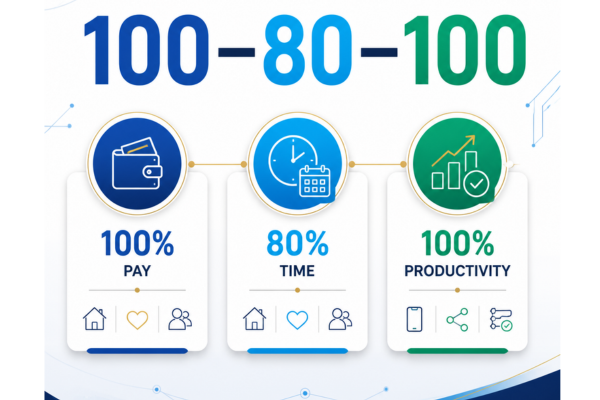
The formula is called 100-80-100: all of the work, done in 80% of the time, for 100% of the pay. The goal is to work differently, not just frantically. Teams cut unnecessary tasks, streamline processes and lean on technology more effectively. And no team moves to the shorter week until it has shown, with measurable results, that member experience, service, productivity and business results will hold steady or get better.
OCCU has already run the experiment. It introduced the 32-hour week in its call center in 2023, and the numbers back it up. The average number of employees absent without advance notice each day dropped from 5 to 1.6. Average tenure climbed from nine months before the change to 3.1 years today. Members have noticed, too. Abandoned calls, wait times, transfers and first-call resolution have all improved, so people get to a human faster and get their problem solved with less runaround.
Greg Schumacher, OCCU president and CEO, framed it as a long-term bet. “Investing in our employees is an investment in OCCU’s future,” he said. “We want OCCU to be a place where talented people can build meaningful careers, do exceptional work and still have the time and flexibility to live full lives outside of work, all while maintaining an outstanding experience for our members. That’s good for our employees, our members and our communities.”
That community angle is real. Most OCCU employees live in the areas the credit union serves, so an extra day off means more time with family and friends, more time to recharge, and more time to show up in the places they call home.
The rollout is phased and driven by data. By the end of 2026, 15 teams and 188 employees will be on the 32-hour schedule, drawn from a wide mix of departments including business intelligence, consumer underwriting, video tellers and card services.
The expansion also includes OCCU’s first branch pilot, in Roseburg, Oregon, which moved to the 32-hour week on Oct. 1. A branch is a tougher test than a call center: normal member volume, full service expectations and no change to branch hours. The Roseburg team is tracking service levels, wait times, appointment availability, coverage and process improvements, and those findings will shape future branch transitions.
The shorter week is the most visible part of a bigger overhaul. OCCU is also investing in flexible and remote work, technology and employee development, and it’s rethinking where work happens, including plans to relocate its corporate headquarters. It all traces back to the approach Schumacher brought when he became CEO earlier this year: rethink how we work and let the results guide us. That means testing ideas and expanding only what proves itself.
“We’ll continue to challenge conventional thinking when we believe there’s a better way to serve our members and support our employees,” Schumacher said. “Our goal is to build a workplace where people can thrive, members receive exceptional service, and OCCU remains strong for the communities we serve.”
Watch the Roseburg pilot closely. Its results will show whether the model holds up in a traditional branch, and they’ll likely determine how quickly other branches follow. The headquarters relocation plans are the other thing to keep an eye on as 2027 approaches.
*The 32-hour workweek transition does not apply to executive team members.