

Rising gas prices, healthcare costs up, auto insurance premiums jumping. Members are feeling financial stress from every direction. Is your credit union showing up as it needs to for members?
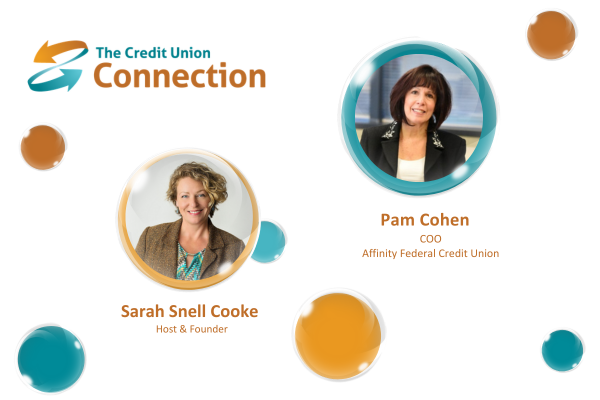
Pam Cohen, COO at Affinity Federal Credit Union in New Jersey, joined Sarah Snell Cooke in The Credit Union Connection studio to discuss how credit unions can take a holistic approach to member wellbeing when everything feels expensive and overwhelming.
The conversation covered what that actually looks like in practice: loan deferments combined with member relief fund grants, financial wellbeing counselors offering free sessions with no product sales pressure and community resource lists for rent assistance and utility payments alongside mental health resources.
Rethinking Financial Education
Traditional financial education isn’t working for most people. Sitting through a 45-minute course, whether in person or online, doesn’t fit how people learn or the time they have available, Pam advised. Instead credit unions need to meet members where they are. That might mean gamified content, short videos or personalized, step-by-step guidance instead of generic courses. It also means addressing the shame and stigma around financial struggles.
“If we understand that most of our financial decisions are made not necessarily logically but emotionally, then it becomes a lot easier to ask the right questions and understand why people make the decisions they do,” Pam said.
The approach includes proactive outreach when members show signs of financial stress—late payments, missed payments, increasing credit card balances—and offering help before things spiral out of control.
The conversation also tackled credit union brand awareness, still frustratingly low after 100+ years. Pam’s take: stop calling yourselves the “best-kept secret” and start talking about the work being done. Affinity’s examples include making 5,000 lunches for food-insecure families on their volunteer impact day, hosting blood pressure checks and wellness coaching in branches and collaborating with other New Jersey credit unions on food drives. Holistic wellness.
Small credit unions can’t do everything, Pam acknowledged, but they can focus on where they can make the biggest impact in their specific communities. The nimbleness smaller institutions have is something larger credit unions actually envy at times.
Watch the full conversation for specifics on financial wellness program design, removing barriers to member education and why sticking to the credit union mission matters more during difficult economic times, not less.
If this AI-generator were a chef, we’d all be eating cereal for dinner.
[00:00:00]
Pam Cohen: I think Affinity, and a lot of credit unions, we take a more holistic, human-centered approach to serving members during difficult times because we believe it’s truly about the members’ overall wellbeing. So if one element of wellbeing is suffering, then the member suffers throughout.
Sarah Snell Cooke: welcome, everyone. I am Sarah Snell Cooke, your host here at The Credit Union Connection. I am joined today by Pam Cohen.
Welcome. Thank you so much. Absolutely, and Pam is the COO at Affinity Federal Credit Union out in New Jersey. Why don’t you give us a little bit more about yourself and the credit union?
Pam Cohen: Awesome. Thank you. Affinity Federal Credit Union was started 90 years ago. We’re headquartered in [00:01:00] New Jersey, and we have around 20 branches throughout New Jersey and New York and Connecticut. We were the AT&T’s employee federal credit union, and we’re now a multi-SEGC- credit union, which, as presents its own challenges. I’ve been with the credit union for nine years, and this is my first nine years in the industry.
Sarah Snell Cooke: Yes. It kinda- y- you kinda drink the Kool-Aid. It sucks you in. There’s no escaping. It does. It does.
Energy inc- increases, healthcare, health insurance increases. I got hit with that one hard. auto insurance premiums have jumped. I’ve been told that eventually we’ll pay what, pay for them just like we will a mortgage, where the, it, insurance is included in your car payment. but can you provide a high-level overview of how Affinity Federal Credit Union looks at members differently during difficult times like this?
Pam Cohen: So if their financial wellbeing is suffering, they’re gonna struggle [00:02:00] all the way through. If their health- is struggling, they’re gonna struggle all the way through. we do look at it a bit more holistically. We provide a lot of different resources, I feel, for our members in our communities. We have, our member relief fund through our foundation, and we offer the loan deferments.
We can combine the two to help our members. Like you said, it’s a really tough time right now. And so many people are struggling. we look at, we have so many different financial tools and courses- We have financial wellbeing counselors where people can get individual, support and guidance on how to move forward with their financial goals.
We have two things that I think that, make us different, I think, than banks, and one is we have a list of nationally recognized mental health resources on our website. We put that up during COVID. and we also have a list of community [00:03:00] resources if you need help with your rent, if you need help with your utility payment, those sorts of things, that make us- a little different than a traditional financial institution.
Sarah Snell Cooke: Yeah, absolutely. And I love that you brought up, like, the holistic human being service, um, because if your finances are in a mess, then your mental health might be a mess too, or if your health is not great, then your financial, situation may become less great.
certainly all… I think a lot of us have experienced one thing or another like that. you to step back a little bit, um, a little bit higher level, and talk about, like, credit unions’ role during complicated times.
Pam Cohen: I think our role, if I take a step back, is, it’s a lot more important during complicated times like this compared to banks.
When you think about our purpose as a credit union and how we’re grounded in these cooperative [00:04:00] principles and cooperative values, and the member ownership, and we just have- live with this mission of financial wellbeing, that’s so much different than banks. And I think during, when we think about how credit unions were started and why, and it was because people couldn’t get access to financial services, that says it all, right?
that’s why we exist, and we need to show up even more during these times and come up with, like, tailored solutions. One size doesn’t fit all. You could be struggling with rent. I could be stu- struggling with medical debt. somebody else could be struggling with a student loan.
Another person could be struggling with just putting groceries on the table.
Right.
Is it the right thing to give a personal loan for groceries, or are they better off, as horrible as this sounds, going to a food pantry- and using that money for utilities? It’s tailored solutions based, based [00:05:00]on the individual.
Sarah Snell Cooke: Yeah. And I love that you’re saying that too as a very large credit union, because, as we’ve heard on Capitol Hill many a time, that the bankers want credit unions taxed or they want the larger credit unions taxed because they aren’t behaving like credit unions anymore, and that’s con- Complete BS in my mind.
But, yeah, I think, doing these kinds of efforts, like financial education, financial wellness, is so important. but of course they’re more important now. I don’t know if you wanna comment on that at all.
Pam Cohen: They are, and credit unions, and maybe not all credit unions, but we have taken a very traditional approach and said, “Okay, we’re gonna offer these courses, and they’re either gonna be in person or online.
They’re gonna be 30 minutes, 45 minutes, an hour.” Not everybody learns that way. And not only does not everybody not learn that way, but they don’t have the time or the inclination. And if we make it difficult, [00:06:00] people aren’t going to embrace it or take it. So we need to find different ways to educate people around f- finance, whether that’s gamifying it, whether it’s making short digital sort of, I don’t wanna say TikTok, but TikTok-like- Like, yes.
videos. Yeah. and look, I’ll say, you see it on TikTok or Instagram all the time, “Oh, if you save $100, you’ll be a millionaire by the time you retire.” Well, I have a 28-year-old, and he’s like, “Mom, I don’t- I can’t afford $100 right now, so why even bother?” I think we have to get away from some of that stigma of, oh, we believe everything we see, and encourage our members and our communities to say, “Well, no, it’s okay if you can’t save $100.
Can you save $2? Can you save- Right … $20?” And make it so that it’s realistic, and that the [00:07:00]person feels good about it, right? Sometimes you feel so bad and that you’re failing at finance. we’ve heard people say, I don’t do finance. I’ve never learned it.” So how can we help teach them even tactically, step by step, in a way that resonates with them-
Right
that get them to feel good about it and strong.
Sarah Snell Cooke: Yeah. So, so much shame is wrapped around our financial position as well, whether it’s your fault or not. you were just talking about basically personalizing your member financial wellness coaching and, and guidance.
Uh, and of course personalization’s what everyone wants now. Has that helped with the absorption, if you will, the success of the, information that you’re sharing?
Pam Cohen: I think so. You know, I mean, everybody, every credit union and e- every bank wants to say, “Oh, we’re member-centric.” We’ve got this personalized journey for you, and, we’ve got 10,000 members that are just like you.
No. [00:08:00] Right. Everybody has different dreams. Everybody has different issues. Everybody has different emotions around finance, and I think if we understand that most of our financial decisions are made not necessarily logically but emotionally, then it becomes a lot easier to ask the right questions and go, “Blah,” and understand why people make the decisions they do, and help them get to a place where emotionally they might feel better about it.
But there’s things that we look at. did somebody make a late payment? Did somebody miss a payment? are they increasing their expenses on their credit card? Those are good, like, intervention things to say- we’re here if you need help or if you wanna talk about something.” And again, taking that stigma and shame away from it.
so and you all offer grants and scholarships, what are some of the things that, [00:09:00] what are some other things that you offer, and is it time for credit unions to ramp up these types of programs?
I, so we o- i- you’re correct, we offer the grants, we offer the scholarships.
We offer our wellbeing coaches for free sessions. sometimes when you go, speak to somebody about finance, you have to pay or you’re pressured to open different products or services. we don’t do that. we have s- small personal loans, different products and services that are, that help our members.
I do think it’s time for us to ramp up. I don’t think the economy and what’s going on in the world is gonna slow down, and I think it’s going to become increasingly more difficult. I think one of the great things about credit unions is that we are cooperative in nature, so there are things that, New Jersey credit unions have done together.
we’ve done a food [00:10:00] drive together for our members. so whether you are a small credit union, a mid-size credit union, a large credit union, we can always do something, or we can collaborate with our cr- with our partners, our credit union partners, to do a little bit more. yeah, I think to really answer your question, yes.
It’s not getting easier. Things get, life is getting more complex, and we need to help our members and our communities learn how to be resilient and get through these times.
Sarah Snell Cooke: Absolutely. Absolutely. Affinity, as we mentioned, is 4.4 billion in assets, larger credit union.
Where do you think credit unions that are smaller and likely have a smaller budget for these kind of things, where can they make the most, most impact for their members?
Pam Cohen: Oh, my gosh. it would be pretentious of me to say that I know what a smaller credit union can do because, I look at some of our smaller credit unions, especially in New Jersey, and I say they are, they have [00:11:00] this nimbleness and this resilience- that I would love for us to be able to emulate. That being said- … regardless of size, we know our members, credit unions know our members and our communities best. And sometimes as credit unions, we feel that we have to say yes to everybody and take care of everyone, and maybe we can’t, and it’s okay sometimes to say, “No.”
So as a credit union, regardless of size, where can we make an impact?
And let’s focus on that.
Sarah Snell Cooke: Right. One thing at a time. One step at a time. Yeah. , So one of the things I often get high on my soapbox about is, , for, , regarding credit unions, is the lack of brand awareness after 100 years or more.
Um, and I’m not saying Affinity, just credit unions in general. , It seems like being on the front lines like this and , being essential,, to members [00:12:00] is, will help you build a brand of an organization that cares, pillar of the community, that sort of thing. , And so a lot of credit unions, like you mentioned, are doing this type of work, and, , it seems it would be impossible not to build a brand from it, yet awareness and understanding of credit unions still remains low. So how does Affinity use it to help support your brand and supple- subsequently credit unions’ overall brand?
Pam Cohen: So we do a lot of tabling events, not necessarily, yes, for the leads, right? So we could talk about how amazing we are, but also to explain why a credit union over a bank.
And it’s like our elevator pitch, right? You gotta get it done in 30 seconds. probably less than that or the people are walking on. we also do a lot of, w- when we think about it, we too, we’ve done a lot of different types of things. We’ve done, blood pressure checks in our [00:13:00] branches, or we’ve done paint and sips.
We’ve done, we spent a lot of time thinking about- Wellness overall. So we did a series on physical well-being with a coach who came in and talked about nutrition and exercise. We talked about career, and I think that helps get the brand out there because it’s a different sort of educational opportunity for people that they wouldn’t necessarily think they would get from their financial institution, so thinking about different ways to get out there and meet our members’ needs.
I think one of, one of the things that we did that I’m really proud of that got our brand out there, the credit union brand out there, is that we, on our impact day, where we come together and do volunteer work, we made 5,000 lunches for the food [00:14:00] insecure. And we partnered with different non-profits in the area.
And so credit unions are amazing at that. I think we’re never gonna win against big banks, but if we can stay true to our mission and our purpose and be there for our communities, I think the brand will, will move on.
yeah, spread the word.
Sarah Snell Cooke: because, yeah, it drives me nuts when credit unions, “Ooh, we’re the best-kept secret.”
don’t brag. Don’t brag about that.
Pam Cohen: No, that’s not what we wanna say. We wanna say, “Look, we made 5,000 lunches,” or, “We were in this community”- Yeah … or, “We were in this community,” or, “We volunteered this many hours at this food pantry,”
you know?
Sarah Snell Cooke: And so many just don’t even realize the work that they’re doing every day is extraordinary, ’cause I do it every day, too. that’s why you need good PR and marketing in there. so I also allow my guests to have the final thought. What would you like to leave our credit union audience with today?
Pam Cohen: Stick to the mission. Stick to why we [00:15:00] exist, why we started, and don’t get overwhelmed. small things over time lead to huge change, so just keep at it, ’cause we’re all making a difference.
Sarah Snell Cooke: Awesome. Thank you so much for your time today. Appreciate it, Pam.
Pam Cohen: Thank you. It was my pleasure.