

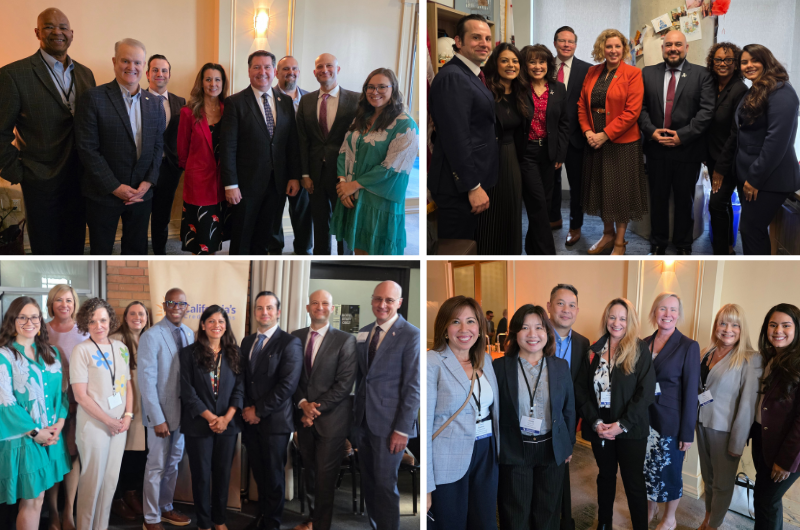
Nearly 175 credit union leaders made their voices heard at the state capitol in Sacramento this week for the 2026 California Government Relations Rally (GRR), participating in nearly 100 state lawmaker office meetings and representing 14.4 million credit union members across the state.
Credit union leaders shared praise for the event’s impact in the capitol building halls, with many attendees highlighting their two-day experience of guest speakers, panelist insights, networking, and advocacy.
The rally kicked off Monday at The Citizen Hotel with a two-hour CEO Roundtable. Attendees had the opportunity to share strategies on industry challenges and innovations.
Leaders also met with officials from the California Department of Financial Protection and Innovation (DFPI), followed by a political overview provided by NBY Consulting Inc., as well as a state budget overview from the California Legislative Analyst’s Office (LAO). One of the highlights of the first day was the speaker panel, “Telling The Credit Union Story,” which featured a diverse group of experts.
The day’s events were followed by networking and fundraising opportunities as attendees gathered for a special visit with Senate Banking and Financial Institutions Committee Chair Tim Grayson, as well as one with California Senator Laura Richardson.
On Tuesday, attendees geared up for an entire day of back-to-back legislative visits that allowed credit union leaders to bring their perspective directly to the offices of California legislators.
“Credit unions are the original consumer financial protectors, a message that was clearly heard all day as we visited with lawmakers and their aides,” said Jeremy Empol, president and CEO of California’s Credit Unions. “Through sharing the stories of more than 14 million members, credit union leaders made sure our industry’s perspective remains front and center in California policy discussions.”
Defending the Member-Owned Tax Status
A focus of this year’s rally centered on a proposal from the LAO that suggests taxing non-member credit union income. Credit union leaders strongly opposed the measure, arguing that it fundamentally mischaracterizes the role of credit union revenue.
Attendees explained that credit unions do not treat income from ATM fees, interchange, and investments as “profit” for shareholders. Instead, credit unions operate as not-for-profit cooperatives and return every dollar earned to members through better rates and lower fees — a model generating $2.9 billion in total financial benefits for Californians in 2025 alone, averaging $202 per member.
Taxing a credit union is effectively taxing its members, attendees communicated to legislators. They warned that such a tax would incentivize state-licensed institutions to switch to federal charters, leading to a loss of state oversight and a reduction in revenue for the DFPI. Essentially, the juice would not be worth the squeeze — a strong visual painted for lawmakers.
Addressing the $138 Billion Fraud Crisis
With California leading the nation in fraud complaints, advocates also urged legislators to reject any proposal — specifically Assembly Bill 2674 (Schiavo) — that would hold financial institutions liable for fraud-induced transactions originating outside the banking system.
Citing data from the Federal Trade Commission (FTC) and Federal Bureau of Investigations (FBI), leaders highlighted that Americans lose up to $138 billion annually to scams. Since 2020, Californians have reported over 723,000 fraud cases totaling more than $3.3 billion in losses. The advocates also emphasized the human cost, noting that older adults suffer high median losses: $1,200 for those in their 70s and $2,400 for those aged over 80.
Financial institutions should not be penalized for the actions of multi-national organized crime rings, attendees argued. Credit unions and their members need a coordinated, cross-industry approach that includes technology platforms and law enforcement rather than siloed liability that shifts the burden onto the very institutions investing heavily in detection and consumer education.
Advocates also referenced the Little Hoover Commission’s recent report on financial scams, which notably refrained from recommending that the state hold financial institutions financially liable for fraud-induced authorized transactions.
The Credit Union Difference and State CRA
Advocates also addressed Assembly Bill 801 (Bonta). While the author has moved the bill to a two-year status, credit union leaders continued to highlight why a state-level CRA (Community Reinvestment Act) is unnecessary for credit unions.
Data shared during the rally showed that California credit unions already outperform banks in 150 of 159 Home Mortgage Disclosure Act (HMDA) metrics:
- Mortgage Savings: Consumers in minority-majority areas save approximately $58,591 on a $225,000 mortgage compared to banks.
- Auto Loan Savings: Borrowers in the lowest credit tiers save over $8,721 on a $40,000 auto loan through a credit union.
GRR attendees emphasized that field-of-membership restrictions already limit who credit unions can serve, making a traditional CRA model an unworkable fit that would only increase compliance costs and reduce efficiency for members.
Strengthening the State Charter and UDAAP Clarity
Beyond specific bills, GRR also provided a platform to discuss the importance of a balanced regulatory environment. Leaders spoke with the DFPI about Senate Bill 825, emphasizing the need for proactive guidance on abusive standards to avoid regulation by enforcement.
Attendees communicated that maintaining a strong state-charter system allows for local oversight and the flexibility needed to innovate. Whether it’s leveraging artificial intelligence to improve member service or providing small-dollar loans to underserved communities, the goal is to guarantee California remains a leader in financial inclusion without the burden of outdated or inconsistent requirements.
“Once again, this year’s GRR renewed our movement’s commitment to advocacy,” said Robert Wilson, senior vice president of state advocacy for California’s Credit Unions. “Thanks to every credit union advocate who attended, our voices made sure California’s credit union member-owners remain at the forefront of the state’s economic and policy landscape as the legislative session continues.