

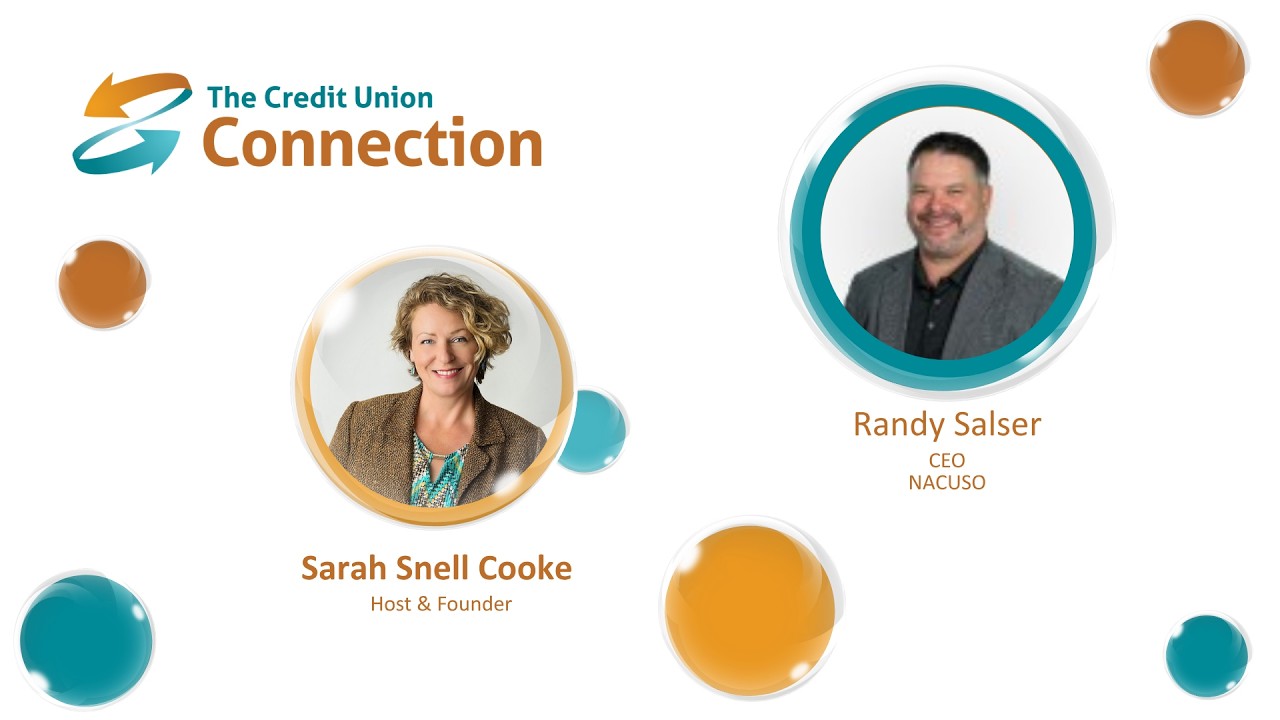
There are roughly 4,000 credit unions in this country and about 1,500 CUSOs. A lot of those credit unions have three or four CUSOs. A lot of them have none. And according to Randy Salser, the gap is not about strategy. It is about awareness.
Randy Salser, the relatively new CEO of NACUSO, joined Sarah Snell Cooke of The Credit Union Connection to talk about what he has been doing in his first five months on the job, why NACUSO is now heading to Capitol Hill, what fintechs creating their own CUSOs means for the credit union system, and why the competitive threat from Walmart and Meta should make every credit union leader pay attention to the collaboration tools they already have available.
The advocacy push is genuinely new for NACUSO, and the timing couldn’t be better. The GENIUS Act included credit unions, which Randy credits as a positive development, but there is a catch: if a credit union actually wants to issue a stablecoin, they cannot do it directly. They have to do it through a CUSO. And under the current 1% investment capital rule, scaling that kind of collaborative effort becomes nearly impossible. Randy has been back to Capitol Hill three times working on draft language to raise that cap, and he says there is positive momentum. The significance of changing that number goes well beyond stablecoins. The same 1% aggregate limit constrains everything from insurance CUSOs to wealth management to member business lending. Raising it levels the playing field with institutions like JP Morgan that spend $4 billion a year on fintech investments alone.
“Collaboration is our superpower, and it’s really really evident inside the CUSO space.” — Randy Salser
The strategic case for CUSOs is practical and immediate. A $500 million credit union cannot afford a $300,000 data scientist. But three credit unions of similar size forming a CUSO and sharing that resource can. A $600 million credit union cannot finance a $40 million commercial real estate deal on its own. But participating in one alongside a few others through a CUSO structure? That is doable. Randy is careful not to oversell the concept. His point is simpler: CUSOs are a tool in the toolbox, and right now too many credit unions do not fully understand what that tool can do.
The fintech angle is worth noting too. Fintechs are increasingly creating their own CUSOs or spinning off CUSO structures to serve credit unions, and Randy sees that as a net positive. Credit unions that invest in those fintechs early get to participate in the upside when a larger player acquires them, rather than just receiving a new contract and being told to adapt. That kind of financial participation in innovation is something the credit union system has historically underutilized.
On the internal improvements front, Randy is focused on rebuilding the NACUSO website into a genuine educational resource, from CUSO 101 all the way through the complexities of co-investing alongside venture capital firms. He is also working with Callahan and Associates and the NCUA to get better data on which CUSOs exist and where, so that a credit union in Michigan can actually find out which member business lending CUSO they could invest in or partner with. That data currently lives somewhere at the NCUA but is not publicly accessible in any useful way. Randy wants to fix that, and he is not planning to put it behind a paywall when he does.
NOTE: If transcription were this AI’s superpower, it would be a very disappointing superhero origin story.
Sarah Snell Cooke
Hello, welcome everyone. I am Sarah Snell Cooke, your host here at The Credit Union Connection. I am joined today by Randy Salser, who says that CUSOs might be the most underutilized competitive advantage in credit unions, and I am inclined to agree. Randy is the new CEO at NACUSO, fresh off the advocacy battlefield, which is a newer effort for NACUSO. Turns out the rules written decades ago do not actually account for digital currencies, modern fintech partnerships, and so on. We are diving into why fintechs are now creating their own CUSOs to serve credit unions, how smaller credit unions can punch above their weight through CUSO collaboration, what is happening with third party oversight that is making everyone nervous, and a few changes Randy is making during his tenure at NACUSO.
Hello and welcome everyone. I am Sarah Snell Cooke, your host here at The Credit Union Connection. I am joined today by Randy Salser. Welcome.
Randy Salser
Thank you, Sarah. Always great to see you.
Sarah Snell Cooke
Good to see you too. Randy is the relatively new CEO of NACUSO, about five months in now. Tell us a little bit more about yourself and the organization.
Randy Salser
It is going on five months now and it has been great. I spent about 15 years in the industry, 13 of those with NAFCU. I fell in love with credit unions there, candidly not knowing much about them when I arrived. I came from the insurance sector. But very quickly, like most folks, I grew to appreciate how incredibly collaborative credit union people are, how they work together and share policies, procedures, and ideas. NACUSO is very similar in that same spirit. In my first month I went to a roundtable that Mark Ritter and Bill Beardsley host, and even on the CUSO side, the for-profit side, people are sharing ideas, sharing what worked, and importantly sharing what did not work. It has been great and we are in our 40th year now, so I am looking forward to many more.
Sarah Snell Cooke
Talk a little bit about the direction you are looking to take NACUSO.
Randy Salser
Very early on, one of the things we wanted to focus on is advocacy and education. From the advocacy front, with the GENIUS Act being passed, we went to Capitol Hill in October just as an introduction and to start talking to lawmakers. Everyone wanted to talk about the GENIUS Act. As we started walking through how it actually works, we were talking to lawmakers about how grateful we were that credit unions were included. They were proud of that as they should be. But if a credit union actually wants to issue a stablecoin, they cannot do it directly. They have to do it through a CUSO, or they can partner with someone. For us, that is the opportunity to discuss the 1% investment capital rule. If they want to do this at scale, even as a collaborative movement, they are going to need to invest more than 1% of their capital. We have made a lot of progress on that. We went back to a few leagues and America’s Credit Unions, put some draft language in front of people, and have been back to Capitol Hill three times now building support and looking for sponsors. There is positive momentum on that. And because that 1% is in the aggregate, raising it opens up so much more beyond stablecoins: shared services, insurance CUSOs, wealth management, member business lending, commercial real estate. Increasing that cap really creates opportunities for credit unions to compete on a more level playing field with institutions like JP Morgan that spend $4 billion a year just on fintech investments. I am excited about this because I believe we will get something in front of Congress in the next few quarters. It does not move quickly, as you know well.
On the education piece, we really want to start telling the stories of what is happening in the CUSO space, the success stories, the how. I have a lot of friends in this space who call me and say they are going to start a CUSO. And then I say, from a strategic standpoint, let us talk about that first and then we can go into whether you should partner with a CUSO, invest in a CUSO, or start your own. We want to have so much education out there that the men and women running these institutions can decide whether they need a CUSO during strategic planning. If they are not as familiar with it as a tool in the toolbox, that is our job. We need to be telling that story.
Sarah Snell Cooke
It feels like a big change for NACUSO to be on the Hill.
Randy Salser
It is. Third party vendor oversight has always been a big industry-wide issue, and Brian LaDour from our team who serves as general counsel has always done a lot of that work. But doing more of it and telling the NACUSO side of that story is really important. I am excited and feel confident that something will get done before the end of the year.
Sarah Snell Cooke
Talk a little bit about fintechs coming in and either creating a CUSO or spinning one off. What are the advantages there?
Randy Salser
For credit unions, all of that is great. These fintechs really help them be innovative and be seen on the same level as the Wells Fargos, Chases, and JP Morgans of the world. The fintechs coming into this space see that and they love the community aspect of it. Some of these credit unions can now invest in these fintechs so that when a larger player comes along and acquires them, they are at least participating in that upside rather than just receiving a new contract and being told to adapt. I do like that side of it, but also just the ability for credit unions to innovate at scale. Fintechs are really the way to do that. And some of the CUSOs use those same fintechs to bring new capabilities to legacy CUSOs in commercial business lending, insurance, and other areas. So we have CUSOs helping CUSOs inside this space as well. I love all of the fintech activity in the CUSO space and it helps the industry have a hand in guiding what comes next.
Sarah Snell Cooke
What are some of the strategic reasons for having a CUSO that we have not fully covered?
Randy Salser
Shared intellectual capital is almost as important as shared financial capital. It is very hard for a $400 or $500 million credit union to afford a $300,000 a year data scientist. But if you form a CUSO and share that cost across three credit unions of similar size, you create a real competitive advantage. The insurance side and the legacy CUSOs are still incredibly powerful. Fintechs are the shiny new toys, but insurance and commercial business lending are still just as lucrative and critical to credit union success. A $600 million credit union cannot finance a $40 million commercial real estate deal on its own, but they can certainly participate in one with three others through a CUSO structure. Collaboration is our superpower. I did not create that term and I am not sure who did, but it is really evident inside the CUSO space.
Sarah Snell Cooke
I would imagine too that with non-interest income being challenged, CUSOs not only add non-interest income but can help balance out interest rate sensitivity.
Randy Salser
Absolutely. Everything is under attack right now. Interest rate compression, non-interest income, interchange, all of it. CUSOs are just another tool in the toolbox to help you be creative as you try to serve your members.
Sarah Snell Cooke
What are the trends in CUSOs right now that we have not talked about?
Randy Salser
The biggest trend over the last few years is the Circle model of the world, investment vehicles coming in and those companies becoming CUSOs and being able to serve credit unions far more effectively. But more broadly, the biggest opportunity is just getting knowledge about CUSOs out there. If we have 4,000 credit unions and 1,500 CUSOs, are some of them not participating because they have made a deliberate choice, or is it because they do not know the competitive advantages available to them? That is our job. And many of those 1,500 CUSOs are not 1,500 individual entities. Many credit unions have three or four CUSOs and many have none. I want to go out and tell that story about this competitive advantage. Let the men and women running the institutions decide, but I want them to know about it. That is where I think we have a lot of room to grow.
Sarah Snell Cooke
What has been your biggest surprise joining NACUSO?
Randy Salser
The most welcome surprise is the league infrastructure. From the NAFCU side, I always looked at the leagues with envy because we did not work with them as directly. They have been incredibly welcoming and open. From Brad Miller at Accolade to Paul Mercer in Ohio, they light up when you bring them something to work on together and they give more than they get. That has been the most welcome but previously unknown surprise for me, and it has been really fun to engage in that additional layer of collaboration.
Sarah Snell Cooke
Where are credit unions missing the boat on collaboration?
Randy Salser
I do not know that they are missing the boat as much as it is death by a thousand cuts. Interchange is under attack. Interest rates are all over the place. Every time you turn around there is a new fintech your member wants and you have to ask yourself whether 100,000 members actually want it. It is a constant process of managing fraud, regulatory burdens, and everything else. But I do believe there is a huge opportunity here, particularly in the next three to five years. Competition is not going away. It is only getting stronger, especially with non-bank entities coming in because of stablecoins. If you told Walmart they needed one-to-one capital for stablecoins, they would give you ten to one. They have more capital than anybody. Apple, Meta, they also have a base of customers that creates a genuinely scary proposition. Would I use a Walmart stablecoin if they gave me 10% off my purchases? Yeah, probably. And when you start bringing in the Walmarts and the Metas, it starts to look a lot like the trillions of dollars sitting on the Starbucks app that are completely outside the traditional interchange world. That is scary to me. The collaboration we can do inside the credit union system is incredibly important as a counterweight to that.
Sarah Snell Cooke
Talk a little bit about the third party oversight issue and where it may or may not be heading.
Randy Salser
It was certainly on Chairman Harper’s mind every day when he was at the office. It has died down a little but it is ever present. I do not think the vast majority of members of Congress are actively pushing for third party vendor oversight, but it is always on the table during end of year negotiations when people are trying to get things done. The good news is that with CUSOs, the NCUA already has the ability to look at them through the credit union exam process. That is a bit different from the broader third party oversight push. It is something we always keep our eye on. We use the same lobbying firm as America’s Credit Unions and we have a lot of contacts on the Hill. That is one we watch carefully. We will keep working on the 1% investment capital rule, keep strategizing on ways to increase the 12.25% member business lending cap, and those three issues will be our focus on Capitol Hill. We will not spend dues dollars on the tax exemption or other issues that America’s Credit Unions handles well. We will sign letters and support them, but let them do what they are good at. There is plenty of noise on Capitol Hill already.
Sarah Snell Cooke
What changes are you making at NACUSO itself?
Randy Salser
The biggest improvement we can make is to the website and the education pipeline. It is being rebuilt right now. We have already started recording podcasts and webinars with some of our members and credit unions. The goal is a centralized resource that goes all the way from what is a CUSO at the most basic level, all the way through the intricacies of partnering with a fintech that has gone through a Series A and has venture capital on the cap table. CUSO 101 to the very complex. We are also working with Callahan and Associates and the NCUA to get better CUSO data publicly available. Right now if a credit union in Michigan wants to know which member business lending CUSOs they could invest in or partner with, there is no clear place to get that. The data technically exists at the NCUA but is not accessible in any useful way. We want to be that resource as the national trade association and we are not going to put it behind a paywall. We want people to be able to go find out who their options are and learn about them freely.
Sarah Snell Cooke
I always allow my guests a final thought. What would you like to leave our credit union audience with?
Randy Salser
If we can help in any way, please let us know. If there is something we could do better, please tell us. Please engage. If there is something you wanted to see that does not exist somewhere else, particularly as it relates to CUSOs, reach out. If you are a member, thank you. If you are not, please become one. We need the scale on Capitol Hill as we embark on a lot more advocacy work. I look forward to serving this industry for many years to come.
Sarah Snell Cooke
Thank you so much for your time. Appreciate it.
Randy Salser
Thanks as always, Sarah. Great seeing you.
Podcast: Play in new window | Download