

Ever feel like traditional account opening processes are moving at the speed of a dial-up modem?
You’re not alone.
Between clunky onboarding screens, disjointed systems, and manual review backlogs, members—and business owners in particular—are often left waiting until Monday just to hear if their Friday night application went through. Spoiler alert: by Monday, they’ve usually moved on to Chase.
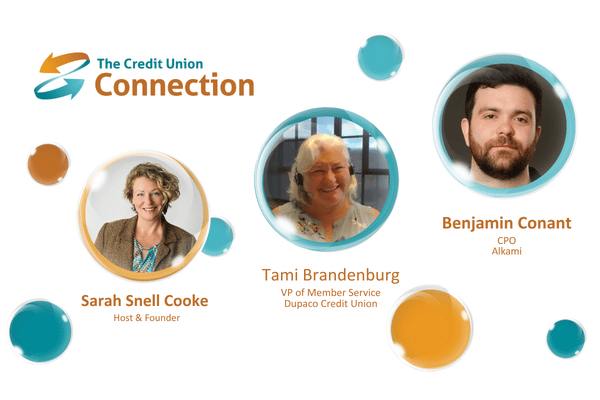
In our latest episode of The Credit Union Connection podcast, host Sarah Snell Cooke catches up with Tami Brandenburg, VP of Member Service at Dupaco Community Credit Union ($3.6B in assets), and Benjamin Conant, Chief Product Officer at digital banking provider Alkami Technology to dissect how Dupaco completely flipped the script on deposit growth.
How flipped, you ask? Dupaco doubled their annual deposit growth goal by Q3.
Curious how your credit union can eliminate friction, defeat latent demand, and stop sending prospective members straight into the arms of big banks?
Watch or listen to the full interview!
NOTE: This transcript may contain minor imperfections courtesy of our AI overlords-in-training. We’re not complaining. We’re definitely not complaining.
Sarah Snell Cooke: Welcome, everyone. I am Sarah Snell Cooke, your host here at The Credit Union Connection. I’m joined today by Tami Brandenburg. Welcome.
Tami Brandenburg: Thank you.
Sarah Snell Cooke: Tami is the vice president of member service at Dupaco Credit Union. And Benjamin Conant, welcome.
Benjamin Conant: Hey, Sarah. Great to be here.
Sarah Snell Cooke: Alkami’s chief product officer.
So, Tami, I want to start with you, because this is actually a really cool story. There are so many credit unions that are having issues with growth, and particularly deposits right now. Your credit union is $3.6 billion in assets, so it’s a bigger credit union for sure. But you doubled your annual growth goal from the year before by Q3 of this year. How did that come about? How did that happen?
Tami Brandenburg: Well, you have to make things very easy for your membership. You have to make it so that you can meet them where they are and remove any friction.
Prior to the omnichannel experience and having the automated approvals, it was a very manual process. Someone could technically apply for an account on Friday night and not hear from us until maybe Monday afternoon, as we were working through what was coming through the online channel.
When you automate those approvals, it speeds things up. Now members can move through that system so much faster, and you don’t have the abandonment that you have when there’s that manual process. With omnichannel and auto-approvals, that really took off, alongside other outside economic and pricing factors. But I do believe that with MANTL and the omnichannel experience, that’s where some of our success comes from.
Sarah Snell Cooke: Yeah, for sure. Simplifying anything makes it better for everybody. You mentioned abandonments, because that’s always been a big issue. Can you tell me any stats on how that changed?
Tami Brandenburg: I can. I have our abandonment rates pulled up right here. They’re not near what they used to be. We’re running in the high 80s to low 90% range, start to finish, getting booked to the core. So it’s moving really well that way.
Sarah Snell Cooke: Yeah, for sure. So Ben, tell us a little bit more about why this success was possible for Dupaco.
Benjamin Conant: Dupaco has been a great partner to MANTL, and Tami has been amazing as well. I think there was alignment on goals and a really solid technology choice. The MANTL platform is an omnichannel platform. You can apply online and in-branch; it all works through the same system. You can automate up to 100% of your applications, so if you don’t want to do manual review, you don’t have to.
Now, a lot of customers do want to do some manual review. There are legitimate edge cases that you want to give a little bit more care and feeding to, but the power of the platform is it allows you to decide how much of that you’re doing.
As we saw in this case, for all of these credit unions and banks around America, there’s latent demand. There are folks who are going to the website and can’t figure out how to apply for an account, or they look at it and say, “I’m going to Chase. This is too hard.” You might not even know from the systems you’re running how much of that latent demand you have—folks who are driving by and seeing your branches. Dupaco has about 23 branches, so that’s a big footprint and a lot of loyalty in a community.
When you get your technology into a world-class place where members are surprised and say, “Wow, this is really good,” you start capturing that, and that’s how you start hitting goals in Q3 that were supposed to be year-long goals. It’s a partnership. It’s looking at how we can use the data available on the internet to make the experience less difficult. It’s retraining, and it’s deploying into the branch. There’s a lot of work that goes into it on both sides.
Sarah Snell Cooke: Did you have any follow-up on that, Tami?
Tami Brandenburg: Yeah, he’s absolutely right. It was the automation, and it was letting stuff move through the system. If you pause your applications and make people wait two or three days to get that account, I know what I do. If I’m online and somebody says, “We’ll call you Monday,” I find the next one where I’m going to get that experience in real time. I think that’s where it’s made a huge difference for our members in the process.
Sarah Snell Cooke: For sure. What other types of results are you seeing? I imagine your team saved a lot of time as well.
Tami Brandenburg: Behind the scenes, where we’re double-checking account cards and all of the quality control pieces we had in place, we probably have almost a one FTE savings in that area. We’ve eliminated a lot of extra work that we had to do.
We have a quality control checkpoint here for account accuracy. As we got everybody out of the old manual system and into the MANTL system, we saw accuracy numbers come up to where errors aren’t being issued like they used to. Accuracy is a big thing. When you automate them and keep them in that one contained system, you can’t get too far outside the buoys. I’m a boater, so keeping inside the buoys keeps things accurate.
They’re saving time and spending a lot less time looking down and a lot more time talking to members and connecting. One of the things we had to go back and do was engagement training. Right now, looking at my numbers, 4.75 minutes is how long it takes to open a new account. What are we going to do with the other 45 minutes we used to spend? We’re going to engage, cross-sell, and deepen that relationship. We’re doing a lot of training around that right now, which creates a better experience for both the employee and the member.
Sarah Snell Cooke: Yeah, for sure. And you’re probably booking more loans faster, too.
Tami Brandenburg: Yeah.
Benjamin Conant: That’s a really important point about the in-branch experience. Online, we talk a lot about taking five minutes to open up a new account. It’s important to understand that this is not just a consumer online build. It’s not just checking, savings, and CDs. We’re doing IRAs and the types of accounts that people typically come into the branch for, as well as accounts for businesses.
When a business comes in, that’s a really valuable relationship for the credit union. You want to spend time understanding the business, and there might be a whole suite of treasury management services you want to offer. If it’s going to take 90 minutes sitting in the branch, that’s not a good experience or a good first impression. Business owners are busy, and they appreciate when things can go faster.
With the MANTL platform, when employees interact with these high-value customers, they get a digital checklist in the MANTL console that walks them through everything needed to follow the rules and stay inside the buoys for opening that specific type of account. It might be a checking account or an IOLTA; there are many different types of deposit accounts, and branch employees might not remember how to open all of them. Previously, folks spent time thinking, “I have to go dust this off” or “I have to send an email to someone who knows how to do this.” The MANTL platform makes it possible for really anyone to open these specialty types of accounts, making it a better experience for the business owner.
The cool thing about omnichannel is if a business owner comes in to open an account and has an emergency where they have to leave, you don’t lose that customer. They don’t have to come back to the branch; you can send them a link, and they can finish their business application online. Getting to these 93% submission rates of applications is because of the power of omnichannel. If you get confused online, you can go into a branch, and they know exactly what you’re doing.
Sarah Snell Cooke: Mm-hmm.
Tami Brandenburg: I looked up businesses, and it takes 14 minutes to open a business account, which is unheard of from start to booking. If you have multiple signers, they don’t all have to sit there or drive over; we digitally send out for those signatures. Our business owners really like that they don’t have to stop what they’re doing to come in and sign an account card.
Sarah Snell Cooke: Absolutely. I’ve done the 90 minutes to two hours in a branch.
Benjamin Conant: This is the thesis. As community banks and credit unions, we are competing against the top five banks like Chase, who have pumped billions of dollars into their technology. We’re competing against SoFi, Chime, and Stripe Atlas in a national digital competition.
What we’re seeing here is Dupaco has been able to make the digital experience excellent. When you have a digital experience that can compete with super-funded fintechs and the top five banks, it gets back to relationships. Dupaco has an advantage on the relationship front. People love going into the branch, they love the brand of the credit union and the mission, so we’re seeing an ability to compete and win against these huge institutions.
Tami Brandenburg: I always tell the team, “Nobody comes into the credit union just to look.” You can go to the mall and say, “I’m just looking,” but that doesn’t happen here. People come in because there’s a bump in the road or something in their life is different. For routine stuff, they want digital and remote. We’re here when they have a bump in life in a way that some fintechs aren’t, because they don’t have that option. Members like having both. We have a heavy younger population here, and offering both drives that.
Sarah Snell Cooke: We all think Gen Z only wants digital, but that’s not really the case. If you’re going to buy your first house or car, there’s a lot you might need to ask about.
Ben, following up on how credit unions can compete with fintechs and big banks using the right tools: What do you see as credit unions’ current Achilles’ heel when it comes to the digital member experience, and how can they solve for that in-branch?
Benjamin Conant: The biggest problem credit unions face from a digital experience perspective today is fragmented digital experiences. You either have a fragmented experience where some things you offer are really good, or you have a loan origination system that is pretty old and results in a bad experience where most loans are done in-branch.
Your deposit origination system online might be really good, but it doesn’t talk to your in-branch deposit origination system or your loan origination system. If members are trying to benefit from all the services the credit union offers, throwing people into disjointed experiences creates a frustrating relationship. The credit union won’t have a 360-degree view of that customer or understand where they dropped off.
What the combined Alkami and MANTL platform is doing is giving you one fintech-grade platform that covers deposit and loan origination both online and in-branch, as well as the digital experience, all as one unified experience. That is game-changing. Only 2% to 5% of banks and credit unions today have actually accomplished that. Over the next five years, what we’re trying to do together is make that digital experience world-class so there is no difference from a technology standpoint between Dupaco, Chase, SoFi, and Chime.
Tami Brandenburg: As of last week, we are completely out of any other deposit origination product we had; everything runs through MANTL. Some credit unions go a little bit and stop because it gets harder, but you have to go all in. Whether your frontline is on the phone or in the branch, everybody is coming through the same system, which makes a huge difference.
Sarah Snell Cooke: Seven fragmented onboarding screens and three disconnected systems leave your data all over the place. I imagine it eases your vendor management time and training as well.
Tami Brandenburg: Training is so much easier.
Benjamin Conant: Our teams estimated that a little over 4,000 hours of manual work were saved. When you manage one system instead of seven, things flow better and you gain a better understanding of who your customers are.
Sarah Snell Cooke: What has been the feedback from your employees, Tami?
Tami Brandenburg: They really like the ease of use and that members can travel through it. There’s a mindset shift when moving to digital forms when staff wonder why they don’t have a piece of paper to take home, but once they understand it, they say, “We’re not going back. This is great.” We would never go back; it has been a really good experience for employees.
Sarah Snell Cooke: What about your members?
Tami Brandenburg: They really like it because it’s easier and they don’t have to come in. We used to make people come in and sign a signature whenever they wanted to renew a CD, but we’ve eliminated all of that. Because MANTL helped us think differently, we looked at our other processes outside of MANTL and made them more efficient, too.
Sarah Snell Cooke: Ben, I want to ask you about fraud protection. Fraud is a huge topic in financial services, particularly with the boost AI has given it, as well as helping to prevent it. How does the system ensure against fraud?
Benjamin Conant: To talk about fraud, we should consider the scale we’re operating at here. Dupaco is over $3 billion in assets with 23 branches, which is a sizable footprint to protect. A lot of folks index toward manual checks for in-person interactions, almost waving hands around the fraud checks done online.
We’re running the same process for an online fraud check that we would for an in-branch fraud check. The same universe of fintech, government, and anti-fraud data sources available online is now available in-branch. As you automate more of this, you have fewer errors and omissions, meaning fewer things fall through the cracks when it comes to fraud.
MANTL is partnered with companies that help fight fraud, such as Alloy, bringing leading industry experts in as partners. When you go with a platform like MANTL, you get the partnership of MANTL’s and Alloy’s anti-fraud experts and the ability to create a digital-first approach that drives outcomes.
Tami Brandenburg: 63% of our applications in the last year have been auto-approved, meaning we didn’t have to touch them. I used to have one full-time person who came in every morning to manually review online apps. Now they spend about 20 minutes on the ones that do need a manual review.
We’re catching stuff we wouldn’t have caught before because the partnership between Alloy and MANTL helps us identify things differently. Only 1% were auto-rejected, and the rest required a quick look. It’s working great.
Sarah Snell Cooke: I always allow my guests to have the final thoughts before we wrap up. Ben, what are your final thoughts for our credit union audience?
Benjamin Conant: A big shout-out to Tami. She has driven a lot of success with this platform across online, branch, business, consumer, and all account types. Seeing these strong numbers when that vision comes to actualization makes me happy. The team at Dupaco has done an incredible job driving a world-class digital experience for their members. Congratulations to the team at Dupaco.
Sarah Snell Cooke: Take us home, Tami.
Tami Brandenburg: It has been a great partnership. From the beginning, our vision was to get everything running seamlessly through one system. MANTL, Alkami, and Alloy were great partners to help us hit all of our key objectives. We’re seeing those results in deposit growth, and I couldn’t be happier with where we are today.
Sarah Snell Cooke: Awesome. Thank you guys so much for your time.
Tami Brandenburg: Thank you.
Benjamin Conant: Thank you, Sarah.