

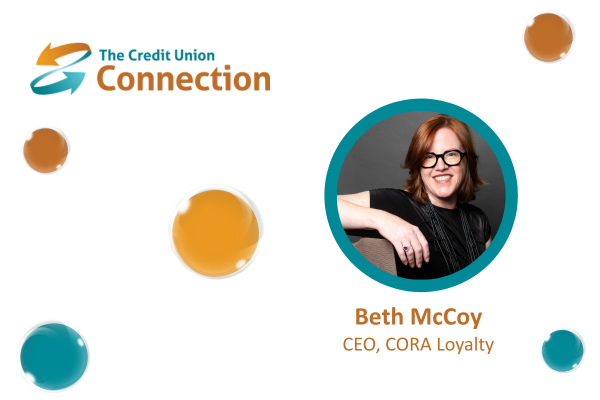
Beth McCoy, CEO of CORA Loyalty
Loyalty in financial services is entering a new phase.
For years, credit unions have relied on product-based rewards, most often tied to card spending, to drive engagement and retention, but this approach is showing its limits. Enterprise loyalty is emerging as a more durable option, one that recognizes the full member relationship rather than rewarding a single product or transaction.
Part of this shift comes down to economics. Historically, many loyalty programs have relied on interchange revenue to fund rewards, but that model is facing growing pressure across the globe.
At the same time, broader margin pressure, driven by higher cost of funds, deposit competition, and overall balance sheet constraints, is forcing credit unions to scrutinize programs that were once easy to fund, exposing the limitations of models built around a single product. Debit and credit card programs, in particular, are finding it harder to deliver sustainable returns or consistently secure top-of-wallet status, not just because of cost, but because they capture only a narrow slice of the overall member relationship.
Also, members’ expectations are changing. They don’t see their credit union as a collection of products or departments, but expect a seamless, connected experience that makes them feel seen, known, and understood. A digital banking app, a loan application, and a service interaction in a branch all contribute to a single perception of the institution, and when those experiences feel fragmented or inconsistent, loyalty weakens regardless of how well any individual product performs.
Responding to both economic and member pressures requires a different approach to loyalty, one that looks at the full member relationship rather than isolated transactions. This is where enterprise loyalty comes in, shifting the focus away from a single behavior, such as card spend, toward a broader set of actions and outcomes.
Members are recognized for maintaining accounts, engaging with services, transacting regularly, and building long-term relationships, with the same principles extending across retail, small and medium-sized businesses and commercial clients. The emphasis moves naturally from short-term activity to outcomes that are more beneficial to the credit union, including deposit growth, service adoption, and deeper, more sustained engagement.
Partner-funded rewards are an important part of this equation. By working with partners such as airlines, retailers, grocery chains, gas stations, and food delivery services, credit unions can extend the value of their programs while sharing the cost. These partnerships also introduce a level of everyday relevance, allowing rewards to show up in moments that feel tangible and timely, which helps maintain engagement without relying solely on internal funding.
Ultimately, the shift toward enterprise loyalty reflects a broader redefinition of what loyalty means in financial services. It is no longer driven by the volume of rewards or the frequency of transactions alone, but by how well an institution understands and supports its members across the full lifecycle of the relationship.
In a more competitive environment, the credit unions that stand out will be those that move beyond products and design loyalty around the entirety of the member experience, delivering value in ways that feel consistent, relevant, and lasting.