

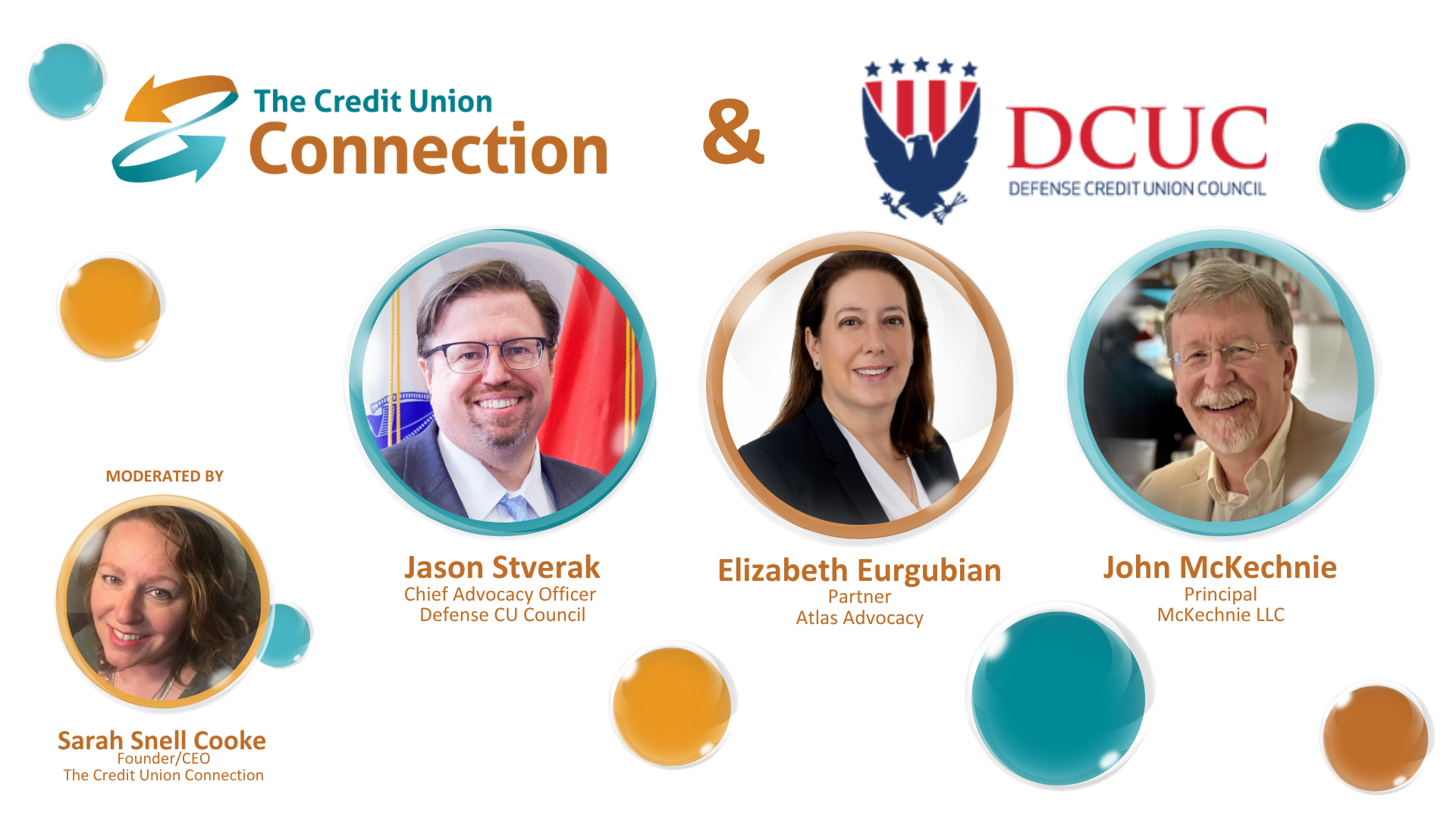
Credit unions won a significant victory in 2025 when they prevented taxation in federal reconciliation bills. But industry leaders gathered for a DCUC advocacy roundtable warned that celebrating is premature.
The fight has moved, and the terrain is getting more complicated, and their message was clear: Advocacy must evolve, or credit unions will lose ground.
Click here to watch the Roundtable discussion in their own words!
From Washington to Main Street
Defense Credit Union Council Chief Advocacy Officer Jason Stverak reframed DCUC’s mission: no longer just defense credit unions, but advocates for all credit unions. “When we protect military financial readiness, we strengthen communities. When we defend the tax status, we protect millions of members.”

DCUC’s push for “democratized advocacy” means grassroots involvement beyond Washington lobbyists. “Advocacy must become part of every credit union’s culture,” Stverak said, “involving executives, volunteers, staff members, and grassroots advocates all working toward a single common goal.”
The traditional model of lobbyists meeting with policymakers and trade associations sending letters no longer works against sophisticated, well-funded opposition.
The 2025 Tax Win: Don’t Get Comfortable

John McKechnie of McKechnie LLC credited credit unions with a decisive victory when House Republicans included credit union taxation in their reconciliation “pay-fors” list in January 2025, but credit unions kept it off the final bill. Success came directly from credit unions advocating back home.
But McKechnie warned against overconfidence. The threat hasn’t disappeared; it’s shifted. Senator Dick Durbin and Senator Roger Marshall will very likely try to push the Credit Card Competition Act language into other bills, like the NDAA, farm bill or spending bills.
Some of the strongest advocates for taxing credit unions have faded. Randy Feenstra, an Iowa legislator and Ways and Means member who pushed taxation, lost his primary race for governor. Others face similar setbacks.
“When 40% of Congress either won’t come back or has been sent home, bills get moved forward,” McKechnie said. “If we haven’t done the work to protect credit union priorities, they get slipped into bills at 2:30 in the morning.”
The NCUA Solo Board Member Issue
Atlas Advocacy Partner Elizabeth Eurgubian addressed regulatory activity. Chair Hauptman has proposed dozens of rulemakings, certainly far more than in recent memory. It’s a flurry of activity that can carry legal risk.

For example, the board has just one member. Hauptman is acting as a quorum of one, an interpretation Elizabeth questions on statutory grounds. The Department of Justice has backed this interpretation, but courts may disagree.
The strategy appears calculated. Hauptman is moving rule after rule through the comment period, aware that once a full board is reconstituted (possibly by the end of the year), all these pending rules can be finalized simultaneously. It’s running the clock on regulatory change.
But here’s the danger Elizabeth points out. “When you only have one person there with one position, it works as long as you agree with their position. But if you don’t agree, advocacy becomes extremely difficult.”
She pointed to CFPB Director Rohit Chopra as a cautionary tale. “He’s not elected. If you don’t care what happens afterward, you have no stake in this. Voting power, money—none of the traditional lobbying tools work.”
A Supreme Court decision expected by end of June could reshape the NCUA board entirely. The court is deciding whether presidents can fire independent board members. If the court upholds that power, Hauptman could add board members. If not, former board members Harper and Otsuka could be reinstated.
“Circle the last week of June on your calendar,” McKechnie advised.
The Interchange Battlefield Moves State-by-State
Federal advocacy on interchange has been successful, but success in Washington has rehomed the issue to the states.
Illinois passed a law applying price controls to interchange. Courts just ruled it applies to federal credit unions but not nationally chartered banks. The Office of the Comptroller of the Currency (OCC) has statutory preemption authority while the NCUA does not have it explicitly, although that’s been assumed in the past.
Colorado has a law on the governor’s desk. Pennsylvania and New York have introduced bills. The goal isn’t to pass these individually, but to create “such a forest fire of problems” that Congress passes national reform on retailers’ terms.
“If your card works in Montana but not Wyoming, and members are confused everywhere they travel, states eventually force Congress to act,” McKechnie said.
Elizabeth remains cautiously nervous about NCUA preemption. “I’m not certain NCUA is going to do what we hope they do. There’s been press statements, but I haven’t seen the actual rule. We just have to wait.”
The Illinois legislature granted a one-year extension, pushing implementation to July 1, 2027. That buys time but also creates uncertainty.
What’s Coming at You This Fall
The group predicted the bills most likely to move before November could include the defense bill (NDAA), digital assets legislation (CLARITY), a modified housing bill, spending bills and possibly the farm bill. As election dynamics shift and Democrats sense an opportunity to take the House, fewer bills will move. Durbin and Marshall will keep pushing interchange language onto anything that moves.
A year-end “Christmas tree” bill will likely attach a range of provisions. Another reconciliation bill is probable.
For credit unions, the message is consistent: advocacy must be fundamental to your business.