

The credit union regulatory and legislative landscape is moving fast, and honestly, the stakes are pretty high. From military pay raises that shift member liquidity to an administrative defense of the credit union tax exemption, leaders are having to skate where the puck is going, not where it’s at.
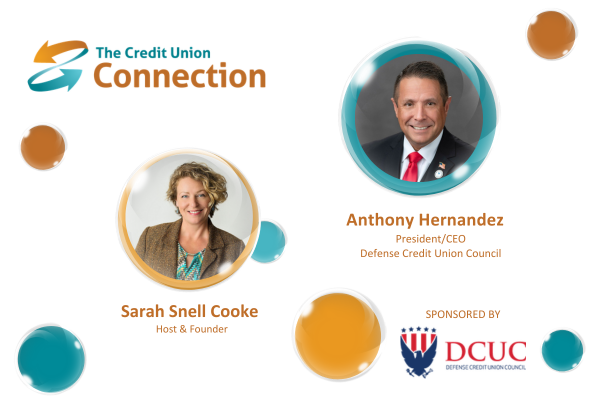
Defense Credit Union Council (DCUC) President/CEO Anthony “Tony” Hernandez joined Sarah Snell Cooke on the latest episode of The Credit Union Connection to unpack the madness in Washington, new NCUA board dynamics, and a massive upcoming collaborative moment for the industry.
Topics included:
- The NDAA & The Liquidity Crunch: Tony breaks down why a proposed 3.6% military pay raise and troop expansion is a major win for defense-focused credit unions. But it’s not all smooth sailing. He explains how extended government shutdowns force credit unions to burn through liquidity to provide zero-interest loans for military families when Congress stalls—making Central Liquidity Facility (CLF) enhancements an absolute necessity.
- Defending the Charter: The conversation gets real about the NCUA’s latest deregulation push. While cutting red tape is great, Tony and Sarah raise some major red flags regarding proposed cuts to member disclosure rules during credit union-to-mutual savings bank conversions, warning that lowering these barriers risks stripping members of built-up institutional capital.
- Major Stage Announcement: Looking ahead to August, Tony dropped some big news for the upcoming DCUC Annual Conference in Miami. In a true display of cooperative collaboration, America’s Credit Unions CEO Scott Simpson will be joining Tony on stage for an exclusive, live one-on-one discussion to tackle advocacy and the future of the movement.
Whether you’re keeping an eye on the upcoming midterm elections, preparing for the U.S. 250th anniversary, or managing shifting NCUA policies, consider this episode your quick strategic briefing.
Catch the full breakdown and find out how your credit union can grab a customized America 250 video!
NOTE: This transcript may contain minor imperfections courtesy of our AI overlords-in-training. We’re not complaining. We’re definitely not complaining.
Sarah Snell Cooke: Hello, welcome. I am Sarah Snell Cooke, your host here at the Credit Union Connection. I was joined recently by DCUC President, CEO Anthony Hernandez. We talked about the NDAA, what’s gonna happen with the budget bill. We talked about other legislation and activities in Washington and at NCUA. We discussed America’s 250th anniversary, as well as DCUC’s annual conference, where there may be a guest speaker from America’s Credit Unions. That’s right, CEO Scott Simpson at America’s Credit Unions may be joining Anthony on the stage. Let’s connect with Anthony.
Sarah Snell Cooke: Hello, welcome everyone. I am Sarah Snell Cooke, your host here at The Credit Union Connection. I’m joined by Anthony Hernandez. Welcome.
Anthony Hernandez: Thanks, Sarah. It’s great to be here again, always a pleasure. I enjoy doing these.
Sarah Snell Cooke: Yeah. I love having you on. So Anthony, as you probably all know, is the head cheese at the Defense Credit Union Council. The grand poohbah.
Anthony Hernandez: Call me Tony. It’s just easier that way.
Sarah Snell Cooke: You Tony. All right, that’s enough. Okay. Tony. and so yeah, we are here to talk a little bit about all the legislation, and the craziness going on in Washington, America’s 250th anniversary, and being a bicentennial baby, you know how old I am now, as well as the DCUC annual conference. They got a big announcement. So let’s get started. Anthony, tell us a little bit about the legislation, and I wanna start with the NDAA, ’cause that’s the huge one, right? What’s the status of that and what are you looking for?
Anthony Hernandez: The House Armed Services Committee passed their version, and it’s a clean NDAA. and we were, keeping our eye on the Senate Armed Services, version, and we haven’t seen the actual bill text. That’ll come out probably over the weekend or something. But we did get some good insight on what’s going out there. The bill authorizes a 3.6, percent pay raise. That impacts credit unions ’cause now there’ll be more disposable income for military families, leading to improved loan performance and reduced delinquencies, potentially, stronger savings and deposit growth and an opportunity for credit unions to reinforce financial readiness messaging, and that’s always important.
It increases the force structure growth, which means, Army’s getting 15,000 more troops, Navy’s getting 12,000, Air Force 8,900, and Space Force, in the Senate version, is getting 2,800. And that just means more people coming on, which means military credit unions are going to expand even more. There’s also that, opportunity to increase your membership. There’s some family readiness provision that deals with finances. There’s expanded military family life counseling authority, and that’s important just with all the stuff that military are dealing with improving the childcare capacity oversight, and that impacts family finances, too. More support for military spouse employment, which again, translates to more income for the family. Education support funding for military kids, and that’s important also. and then tuition assistance for the active duty folks to get their advanced degrees or their associate degrees and bachelor degrees or advanced degrees after that. And so it just improves the overall, readiness.
And then there’s more protections for tenants in privatized military housing who report housing related issues. And that’s important just given the quality of life and people getting housing, taking care of the housing. And that’s another bill in Congress we can talk about a little bit later as well too. Then, all the other stuff, when they increase shipbuilding or they increase industrial capacity, that’s jobs in the district, which leads to better, financial in those defense communities that people operate on. And military healthcare changes and a whole bunch of other good stuff.
What’s not in the bill, although we’re keeping an eye when it goes to the floor, is stuff like veteran member business lending provisions, community development financial institution provisions, the CDFI Fund, central liquidity facility enhancements, the Credit Card Competition Act, making sure that stays out. And so we were very successful last year in getting many of those provisions inserted into the Senate version, and we had three of the four corners, sign off on it except for the chair of the House Financial Service Committee didn’t sign off on it, so they all got dropped in the final conference version. But, looking to make that the leap again and really advocate hard for credit union-specific measures as they relate to, impacting on military and military families. So that’s big legislation that we’re currently watching right now.
Anthony Hernandez: The other thing that we’re watching is the nominations, right? Particularly with John Crews being nominated for the NCUA chairman position. And I think all that’s coming to a head, possibly before the Fourth of July break. That’s real important for the Senate to look like they’re actually doing something and pushing stuff. Especially in a midterm election, you wanna be able to show that you can legislate, right? So we’re watching for all those. That has a lot of impact on the industry, getting a new chairman.
Then what’s also coming to a head is the Supreme Court ruling on whether the president has the authority to fire NCUA officials. It’s a different agency that brought it up, but we’re looking for that ruling to come out before the Supreme Court session ends as well. So everything’s coming to a head. Then you got housing bills and clarity and all these other things that are moving through the Senate and the House as well.
There’s talk of a third reconciliation bill to fund a lot of the defense, the $350 billion in defense plus-up. The danger there is if that makes it through, Congress is gonna want offsets. We’re not raising the red flag on that, but my radar goes off going, credit union tax-exempt status, right? And we’re already mobilizing to start setting our messaging now. ‘Cause you don’t wanna fight this inside of a week. You wanna start the battle now. So those are the things we’re working out on the Hill.
Sarah Snell Cooke: And it’s that consistent storytelling of what credit unions are doing right to continue earning the tax-exempt status. I am certain 99.9% of credit unions are doing the right things, it’s just nobody knows about it.
Anthony Hernandez: Yeah, we do this with Congress all the time, but we had two really good meetings with senior DOD officials. One on May 26th with the office of the Under Secretary of Defense for Personnel and Readiness with his Office of Financial Readiness. We met with their team there, and it was a very good meeting. We’re resetting some of the things that we worked on before. We worked very closely with DOD in the past, but some folks needed to retire, I’ll just leave it at that, and they’re gone. So I think the department’s realizing that they’ve got a good public-private partnership with not just defense credit unions, but our counterparts on the banks as well.
Then yesterday, I had a really good meeting with the department’s deputy chief financial officer, and his office writes policy for financial institutions on military installations. We’re resetting the bridges also. To bring it around to what we were talking about, they were very interested in our letter. Both offices were interested in the letter that we wrote to Congress, to the four corners of the Armed Services Committee, and wanted to know why those things needed to be in the NDAA.
I said, during the extended government shutdown that happened last October for 42 days, I was getting calls from the Army, the Navy, and the Air Force asking, “What are credit unions doing to help members out that aren’t getting paid right now?” I told them, “It’s what we always do.” We extend zero-interest loans to cover their military pay, and then we do skip-pay programs or restructure their stuff. All that comes at the expense of liquidity. So the reason why central liquidity enhancements are in there is because credit unions need to be able to get liquidity so they can make life easier for people the next time Congress can’t decide on an appropriations bill. Same thing happened with the Coast Guard recently, and they finally got that passed a month ago. That’s a practical application.
When I talk about veteran member business lending, that’s to help military transition into a job for what we train them very well to do. So all this started making sense. Then when we got to, “Well, why do you need a federal advisory committee?” I said, “‘Cause you guys have made a lot of mistakes. When you rolled out the overseas military banking contract, you should’ve consulted with us. We could’ve saved you a lot of missteps on that.”
Then I said, even more recently, the new DOD Financial Management Regulation has some inconsistencies in it. I gave them one example. I said, “You know, you said that both federal and state charters by your regulation are able to be fiscal agents of the government and accept public deposits. Not if you’re a state-chartered credit union, ’cause some states don’t allow state-chartered credit unions to hold public funds.” He goes, “Really?” I go, “Yeah, but if you guys had talked to us…”
Sarah Snell Cooke: You’d know that.
Anthony Hernandez: Yeah. I told them the only reason why we went to a federal advisory committee is ’cause we were getting what I like to call the Heisman. In other words, they were keeping us away and they said, “If you want to do that, you gotta go to Congress and ask for that authority,” which implied a federal advisory committee. If we agree to have a twice-a-year or four-times-a-year meeting to go over all these issues, believe me, we can settle all these. And it costs you nothing to do that. We’re already here in town, you know? It makes a whole lot of sense.
So it’s been a great month for DCUC in terms of advocacy and where we see it going, not just on Capitol Hill, but inside the Pentagon, and working with the agency on a lot of their letters. A lot of the deregulation that’s coming up, some that we have some concerns about, but others, we can see the wisdom in doing that and we’re willing to work together.
Sarah Snell Cooke: Yeah, and it’s funny you brought that up, ’cause one of the reasons I wanted to speak with you also, and I think DCUC and myself have aligned opinions, is that most of the dereg is great. I think we have some concerns, knowing the history, about reducing the conversion disclosures to members during a credit union to mutual savings bank conversion. I just wanted to get your thoughts on that as well because I think not many people have spoken up.
Anthony Hernandez: Yeah, no, it’s important. There was a good reason in the past why those disclosures were there and some of the behavior that happened in the past. I’m always worried about what losing the tax-exempt status would mean. So when I see language on that, I’m wondering—I always like to skate where the puck’s gonna be, not where it’s at—and when I see stuff like that being proposed, I gotta ask why, or why now, and what’s going on outside of that would cause it. If we lose taxation and we have to go to a mutual savings bank, what does that imply for members, and how do we protect members’ funds if that situation happens? I don’t wanna get into any conspiracy theories or anything like that; it’d be easy to do. But I think just understanding where NCUA’s coming from and being able to provide comments on those is important. It lets them know that we’re watching.
If we’re the only ones watching, that’s our role. But fortunately, there were a couple others that wrote letters with the same concerns as well. I think it’s good from a public comment period that we’re asking some good questions to let them know that, wait a minute, let’s take a look at this. Let’s not ask just why, but why now and what else is going on, so that we can either put any conspiracy theories to rest or get clarity on why they’re doing it. ‘Cause maybe there’s something to it that we can’t see, and that’s what the dialogue is all about.
Sarah Snell Cooke: And the question of member capital—if you’re converting to a mutual savings bank, the capital the members built over usually decades, if not a century, is held differently. It’s not owned by the members. And then, when inevitably 99% do convert to a stock-held bank, then it just goes out to pay shareholders. You might as well give up the credit union charter at that point, and I certainly don’t want it to go that way, which is why I’m raising the flag about this one in particular. It was so controversial back in the early 2000s when it was actually happening. Now, one of the attorneys told me since 2012 was the last conversion. In 14 years, some people don’t even know about it.
Anthony Hernandez: I’m just wondering, is there anybody out there thinking about it now? Who would most likely be in that position? That’s where you start asking some deeper questions as to why we are doing it now. What’s coming down the pipe? I think we can perceive it, but you gotta ask why and why now. I think those are good, healthy questions to ask.
Something else, I know you and I have talked about this offline, is protecting the independence of the NCUA. If we’re gonna regulate everybody like a mutual savings bank and then go on to commercial banks, then what’s the future of the independence of the agency look like? It has all kinds of branches and sequels to it, which is why we’re asking the questions. Kudos to the DCUC team with Jason Stverak and Elizabeth Eurgubian for highlighting that, but also to all the others that wrote similar letters and voiced some concerns. There was a credit union that wrote, and then of course the endangered small credit union defense guys wrote that letter. It’s good to have people at least asking those types of questions, and maybe others will start to ask the same questions too. Or not, and then you gotta ask, why aren’t they writing letters?
Sarah Snell Cooke: And I got a concerned letter from a board member actually not long ago about the alignment of the NCUA with the administration. For those of us who grew up in the DC area—I was a DC reporter back in the day—and yourself, you look at the alignment of the NCUA with the administration. They are nominated by the president and confirmed by the Senate, and you’re not often gonna have somebody who willingly goes against the administration. In fact, one person did and lost their board seat way back in history over the deposit insurance issue.
So yeah, I think the conversion disclosures are very interesting. You would think in an act of self-preservation the NCUA would want to keep credit unions. At the same time, the administration is streamlining the government. They are questioning what an independent agency really is. Can they fire somebody who’s on the board of an independent agency like the NCUA, like President Trump did several months back now? It brings up a lot of existential questions for credit unions, and we really need to be out there.
Anthony Hernandez: Yeah, and we polished off a lot of talking points on the independence of the NCUA. It’s credit union-funded, it’s not federally funded, so we have a lot of good things going for us on maintaining that independence. But you sparked a thought on it, and it’s an interesting segue. When you have that voice appointed by the other party on the board, and you look at the same issue or problem set from two different sides, you ask difficult questions and hopefully get to a negotiated settlement that’s good for everybody.
That’s the beauty of our Constitution and the way our republic was set up. It wasn’t meant to be efficient; it was meant to be imperfect and deliberate. It would be easier to have a one-party government where everything just happens, and you’re seeing that whether you’re in a blue state or a red state. But it’s good to have other viewpoints on there. It’s messy, but I think it’s necessary ’cause you get to a better outcome.
That’s why we just released an America 250 video. I liked the way the video laid out. We’re doing this for all our members, so if you’re a member of DCUC, you just send us your logo and we will create a copy for you. The one we used is Keys Federal Credit Union, as Maggie Sayer is our current chair. It’ll have the credit union logo, so it’ll say, “Keys Federal Credit Union proudly presents,” and it’s the 250 video. I like the way it ends because it says every generation has asked themselves the same question: not just what America is, but what can America become or be.
That’s the beauty of our republic—we’re not finished yet, we’re always trying to perfect what we have. That gets back to the comment you made. You gotta have that voice of opposition. Hopefully, it’s a loyal opposition, but you gotta have it in order to look out for those pitfalls. If it’s not on the board, that’s where trade associations, credit unions themselves, or interested parties come in by writing those comment letters saying, “Hey, wait a minute, there’s some things here that you need to be paying attention to.” That’s our role within the industry, and we’re happy to have as many partners willing to do it. We’re willing to pile on to somebody else that identified it also. Something I learned a long time ago is you can get a lot done if you don’t care who takes the credit for it. One of our core values is selfless service, and that goes hand-in-hand with doing what makes sense for our members, no matter who gets the credit. I know our advocacy team believes in that, and we’re happy to do that anytime.
Sarah Snell Cooke: No, I totally get it, because we need people, not just DCUC, but the credit unions themselves to send comments in on these issues. Like you mentioned, ORNL in Tennessee has submitted. But we need more credit union voices telling the story on Capitol Hill and at the NCUA so that they understand truly how these things affect your credit union operationally and affect your ability to serve your members. It’s important for credit unions to comment on these things because that is part of what makes America great for its 250th anniversary. We get to speak up against the government and not fear retribution. We get to support our opinions and ideas before the government. That’s why we have a comment process at the NCUA, regardless of what side you wanna come down on. Comment. Same with members of Congress going to the Hill—always keep your voice up there. Individual credit unions are so important to hear from, as well as potentially individual members that you can bring to the Hill as well. That’s the best storytelling.
Anthony Hernandez: I’ve said this many times: Congress will take a letter from DCUC, a league, or America’s Credit Unions, but we’re not the constituent. It’s much more powerful when a credit union like Oak Ridge National Laboratory (ORNL) writes a letter ’cause that’s the constituent, and Senator Hagerty is on the banking committee. You can voice your concerns several ways, either to the agency themselves or in Congress, and we need more credit unions to step up and be that voice. Our role as trade associations, leagues, or system partners is to help write the letter and let the members decide if that’s what they wanna send. That’s where I see us doing more from a grassroots advocacy model and supporting that.
We love it when CEOs write letters that jibe with it ’cause they’re the ones that vote. They’re the ones that represent hundreds of thousands of members within those credit unions themselves, or in some of the larger ones, millions of credit union members. Those numbers mean something, which brings me to the midterms. All I’m gonna say is this is gonna be another consequential election. So here’s a public service announcement: make sure you register to vote, get knowledgeable on the issues, and then vote according to your value system. Your vote matters. The pendulum swings left and it swings right, and things will change as we get new information or solutions work out or they don’t. But that’s the beauty of our system—every citizen gets a vote in the process. Register to vote, get knowledgeable on the issues, and then go vote, for sure.
Sarah Snell Cooke: Yeah, 100% agree, as a political science major back in the day. You mentioned system partners and working together and collaborating. You have your annual conference. What are the dates for that, and where is it again?
Anthony Hernandez: August 3rd through 6th, and it’s at the JW Marriott Turnberry Resort. We just came out with an announcement yesterday that Scott Simpson’s gonna be appearing at the conference. I’ve invited him to make a few remarks from the podium, and then maybe he and I sit down for a one-on-one discussion. It’s important for the audience, which is made up of both ACU and DCUC members, to hear that conversation live. Scott and I agree on more than we would ever disagree on, but I know we’re not 100% in agreement, otherwise, why would you need two trade associations? You have different viewpoints, and that’s okay. I am perfectly comfortable with that setting, and I think it’s a healthy dialogue, so I’m looking forward to it.
If you registered for the conference, you’re in for a treat. We’ve got other great keynote speakers, and you can go to the conference website and check that out. We’ve got some great government officials coming as well, and we’ll be announcing those shortly. If you’re not registered, it’s not too late. If you’re not a member, I encourage you to come check it out. I’m pretty excited about having Scott, and I’m glad he accepted the invitation. It’s a dialogue worth having, and we need to do more of that, not just with leagues and system partners, but anyone that has the cooperative financial model in mind for the future of our industry.
Sarah Snell Cooke: Love it. Yeah, ’cause the credit union community is all about collaboration, and obviously being collaborative makes sense. Even more sense than it should anyway.
Anthony Hernandez: Right.
Sarah Snell Cooke: Tony, I always allow our guest to have the final thought. What would you like to leave our credit union audience with today?
Anthony Hernandez: Again, there are lots of things going on in the next couple of months. We mentioned America 250, and it’s just good to reflect on it. There’s plenty of bad things to reflect on in our country, but there are tons of good things. I’d say focus on the good, be mindful of the past, but focus on what’s good about America, and we talked about a lot of them on this podcast. We also have the 25th anniversary since 9/11 coming up, and that’s an important quarter-century. We still haven’t forgotten. Plus, we have an important midterm coming up, so this is a very consequential time in our nation’s history. For those listening, just pause, reflect on those, and then participate.
You mentioned something when we talked earlier about the bicentennial, right? Remember the bicentennial quarters? We’ve got the Bureau of Engraving director coming to speak, and I think the one thing that’s raised a lot of hackles is the $250 bill, and it’s very political, but it makes me smile too. You remember those bicentennial coins. What do they call it? The semiquincentennial, right? Something like that.
Sarah Snell Cooke: There you go.
Anthony Hernandez: Yeah, quintacentennial. I forget what it is. There’s some Latin name for it, but bicentennial was just so easy ’cause that just rolls off the tongue.
Sarah Snell Cooke: The quarter-millennial.
Anthony Hernandez: Yeah, there you go. But no, there’s just a lot of things going on. So my closing would just be: be mindful of that, be thankful, and let’s have a great and safe summer.
Sarah Snell Cooke: Absolutely. Thank you. I appreciate your time today, Tony.
Anthony Hernandez: You bet. Thanks, Sarah.
Sarah Snell Cooke: All right.