

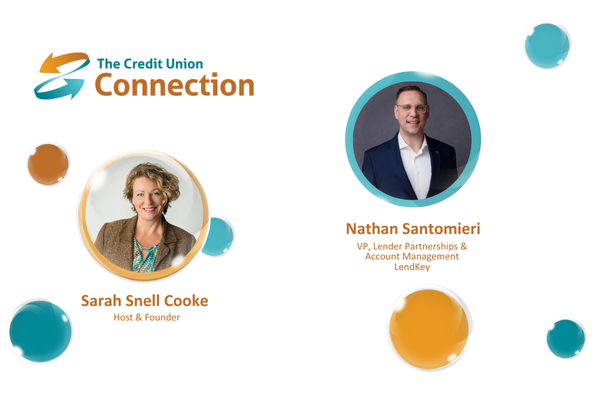
If you think big fintechs and digital-first lenders are eating the credit union movement’s lunch, you aren’t alone. In a recent episode of The Credit Union Connection, host Sarah Snell Cooke tracked down LendKey’s VP of Lender Partnerships (and former big-bank insider) Nathan Santomieri to talk growth, headwinds, and why it’s time to ditch the fear of scaling.
When fintech giants like SoFi are opening more accounts in a single year than the entire credit union system combined—and pulling a staggering 23% of their deposits straight from credit union members—playing safe is a losing game.
So, how do we fix it? Don’t wait until you’re playing catch-up—catch the full conversation on The Credit Union Connection today!
NOTE: This transcript may contain minor imperfections courtesy of our AI overlords-in-training. We’re not complaining. We’re definitely not complaining.
Sarah Snell Cooke: Hello and welcome everybody. I am, of course, Sarah Snell Cooke, your host here at The Credit Union Connection. I am joined today by Nathan Santomieri. Welcome.
Nathan Santomieri: Thank you. It’s great to be with you, Sarah.
Sarah Snell Cooke: Great to meet you. So you’ve recently joined LendKey as the vice president of lender partnerships and account management. Why don’t you tell us a little bit more about yourself and the company?
Nathan Santomieri: Yeah, absolutely. I’ve been with LendKey for a year and a half, but prior to that, was with another CUSO. The majority of my career, as I say, was spent on the dark side, so I worked for some big banks, and I saw the light to come to the credit union space and came over to a CUSO prior to joining LendKey, and then came to LendKey a year and a half ago.
And I will say, at LendKey, one of the greatest things about us is our goal is to make lending simple and to make it easy for credit unions, but ultimately our goal is to serve credit unions and help them serve their members, whether that’s through private student loans, refinances, or the home improvement offerings that we have.
But ultimately, our goal is to serve credit unions and help them grow their member base. And the exciting part about it is being in the credit union space right now in 2026 is interesting, but the word I would use is it’s exhilarating. Because at the same time, there’s a lot of headwinds, but I think that’s the resolve of the credit union space, is pushing through all those headwinds and all the noise and getting to deliver world-class member experience to their members.
Sarah Snell Cooke: Yes, 100% agree with that. And we’re going to go both ways. We’re going to go dystopian and we’re going to go happy-joy-joy.
Nathan Santomieri: Yeah.
Sarah Snell Cooke: No, seriously, so you have worked a little bit with credit unions in the past, obviously as a CUSO, but from the dark side, what’s been most surprising to you about the credit union market?
Nathan Santomieri: I would say the good is really how much they care about their communities, and that echoes in every conversation we have, and every conversation is, how do we impact our communities? How do we develop and grow our member base? And I would say one of the areas that I think for opportunity for the credit union space is to continue to tell the story, and we can’t be afraid of growth because of that story.
And I heard Scott Simpson say it not too long ago that credit unions have a great story to tell, but we can’t be afraid to tell it at the cost of growth. And so growing is essential, it’s important, but how we grow and how we get there is telling the stories of those members that we have and the ones that we’ve impacted.
So I’d say one of the opportunities coming in from the outside, if you will, not spending my entire career in credit unions, is don’t be afraid to tell the story. We’ve got great stories to tell, but we can’t be afraid to tell what that looks like, and the fact that some of these stories are gonna cause growth, let’s do it. Let’s grow. Let’s get there, and let’s take that next step together.
Sarah Snell Cooke: Yeah, absolutely. I’ve been preaching for 20 years probably about having a credit union brand so that people actually know what credit unions are.
Nathan Santomieri: That’s right. Yeah.
Sarah Snell Cooke: And speaking of that, what’s really scary, you guys did some research and, I guess SoFi put out some data that they’ve opened more accounts last year than the entire credit union system put together.
Nathan Santomieri: Yeah.
Sarah Snell Cooke: So that’s scary to me. What is it telling you?
Nathan Santomieri: So I look at it from three different ways, and I’ll start with the first, is like this idea of the front door theory. And I am of the opinion, and even my previous world was everywhere, every step in my career, I look at how I got there, why I got there, and look at it from a career perspective.
When you get out of college, you get this job, right? You hear all these things, and your first job is either gonna be good or bad. There’s no in-between on your first job out of college. It’s the same way in the credit union industry, and the same way with what SoFi did. Their front door theory was they chose student lending, they got into this, and it wasn’t just a product to them or a line on a balance sheet.
It was, “We’re gonna do this, we’re gonna meet these borrowers now,” because then, look back when they started and all of a sudden it’s like there’s a need. SoFi said, “All right, let’s start here. Let’s build this front door.” And maybe the front door was just a front door into a living room at that moment, and there was no other part of the house that was built, but they’ve continued to build the house as they grew.
So they started with student lending. It was the first touch point in a relationship that we know can run 40 years. They built their whole flywheel on this front door, that education lending is here at 22, at 18 to 22 you’re gonna refi, let’s say, at 23, 24. Then we’re gonna get your deposits at 25. We’re gonna get your mortgage at 30.
Oh, and by the way, now we do HELOCs, and by the way, now we do business loans. So the front door theory was, we just need to get somebody in the front door. That cost of acquisition is there. Let’s build the rest of the house as we go. And I think that’s a story that credit unions… We’ve got the legacy.
We’ve been around for how long? Hundreds of years. We’ve got the legacy, and the greatest members and the greatest things that we need are already in our member base. We don’t need to rebuild the front door, we need to improve what’s already in the house. SoFi built this front door and they said, “The front door is student lending. We’re gonna get you in, and in three years we’re gonna refi your loan. In three years we’re gonna make sure that all your direct deposits are coming here, and then we’re gonna get your mortgage.” And it was a front door theory that I look at and I say, the best way to look at this is they priced a 40-year relationship like a 40-year loan.
And you think about that, how do we learn from that in the credit union space? Because when the government exited student loans a long time ago and are now back into it, and now we’re back out of it. This is a critical moment for credit unions to repaint that front door and say, “Let’s get back in the front door here.”
Because if not, SoFi’s gonna do it, other banks are getting back into it. And now you look at some of these other institutions that were just, Give us your paycheck and we’ll just be happy. Now they’re getting into student lending, and it’s because they understand the value of the front door and getting those members in when the cost of acquisition is really low.
Sarah Snell Cooke: Yeah, for sure. What amazes me, I’ll say, is SoFi built a brand on one product. Like you were saying, the small dollar loans, excuse me, and the student loans, and then they build the rest, and that’s a very strategic move that credit unions in generally speaking aren’t making.
Chime built a brand around getting your paycheck a couple days early, but that only happens once. And I think, I just want to go back to we need a brand, and we need to be able to share those stories to have a brand so that people know that credit unions are better, because only 4% of credit union members are Gen Z, or 4% of Gen Z are credit union members.
And in addition to that, SoFi also had 23% of their deposits came from credit unions. So not only are they growing faster than credit unions, they’re stealing from credit unions, and credit unions are letting it happen. Put in the context of that previous data point, I’m concerned about the future of the credit union movement. This is where we get a little dystopian.
Nathan Santomieri: Yeah.
Sarah Snell Cooke: What are your thoughts?
Nathan Santomieri: Yeah. I would say front door theory, that’s important. And the reason that’s important is because 23% of SoFi’s deposits came from the credit union. So if we’re looking at $38 billion in deposits, we can do the math on that, right?
But where that led to was 85% multi-product attach rate. So they get them in the front door, and then where I think the future is that we’ve looked at this and said, the cost of acquisition is your lowest at student lending. Your cost of acquisition is at your lowest. So they paid to acquire these members once.
They don’t have to pay for that for the mortgage now. So as credit unions, what we’re constantly chasing now is that cost of acquisition of a new member. That cost of acquisition for a new member is expensive these days, because we’ve got the overhead, we’ve got the people, we’ve got all these things. So if I’m looking at the future and how we can look at this from a credit union perspective and say dystopian future is, yikes, things may not be looking good, we’ve got to figure out what our one-time cost and what that product is in the credit union space.
Maybe it’s student lending, or maybe it’s a play of, “Hey, we’re gonna compete with Chime on the paycheck piece,” because Chime just bought a bank. They call their people members. They’re coming after credit unions just like SoFi did, and their one-time acquisition fee into this was your direct deposit.
So now I’ve got your direct deposit, I’ve got your paycheck ready for you available. Oh, and by the way, we’re now a bank, so you can come in and make a withdrawal. We’re gonna offer loans at this point now. So the credit union space has this moment that’s in front of us, and we have to figure out what is our one-time cost of acquisition that we’re gonna commit to right now, the story that we’re gonna tell in order to be around in forty years.
And we see this last year, this year, twenty twenty-six, there were more mergers and acquisitions in the credit union space than there’s ever been. And the reason being is we’re trying to stay relevant. We’re trying to compete, but we’ve got to find our cost of acquisition right now of what that moment looks like for us.
And for some credit unions, it may be different. For some, it’s like, “Hey, we’re gonna go all in on the mortgage side.” Maybe that’s it. Maybe we’re gonna go all in on auto lending. Maybe that’s it. But right now, where there’s a vacancy from the federal government and there’s a vacancy from everybody else out there, you look, Citibank got out of it, PNC Bank got out of student lending.
There is a niche right now that the credit union movement can solve by saying, “We’re going to go in, and we’re gonna sink our costs into this.” It may be a loss leader for a year, just like SoFi was. Theirs was a loss leader, but they realized that cost of acquisition was so much greater now because I’m gonna get the mortgage.
Oh, and by the way, they also do now business loans where they got the doctor that’s gonna buy a practice. They’ve got the dentists who are gonna buy a practice. This is where the credit union can step in and avoid a weird future, to your point, where if we could just get in now and realize that there is a need now, we’re getting in and sinking our cost on something that’s gonna pay off over the lifetime.
And I think that’s one thing to help solve the dystopian future is credit unions have to learn the lifetime value in that member journey. That’s one thing I think is an opportunity for us in the credit union space. We do not value the lifetime journey or journey map for members like the big banks do.
And that’s how I think we survive. That’s how I think we thrive in a weird marketplace right now, where we look at it and say, “This member may not be worth a lot right now, but I need to get younger in the member base. How do I do that?” And also, by the way, I have an opportunity to get younger in the member base right now with the largest government pullout in student lending since the last time it happened, and we’re in the midst of the largest wealth transfer in history.
The only way to do that is to look at it and to say, “How do we meet the need that’s already there and be willing to commit to it right now and tell that story now, so that way I don’t have to go out and buy a mortgage? Because that’s expensive. I don’t have to go out and get the SBA or the business loan just as a standalone product.
I’ve seen credit unions standing up CRE teams, which is great, and I love the fact that the credit union is getting into the commercial real estate industry. I love that. But the cost of acquisition is so significant when if we hired the right people and did the student lending now, who knows, we may have the CEO of a commercial real estate company here in five years.
So again, I think the way we avoid that dystopian future is we’ve gotta plant our foot in the ground, plant our flag, and say, “This is our moment. This is what we’re gonna do, and this is how we survive and keep growing, by telling our story.”
Sarah Snell Cooke: Yeah, I agree. Credit unions have a huge opportunity right now.
Nathan Santomieri: Yeah.
Sarah Snell Cooke: And while others are scaling, credit unions have been successful niching down, and given the younger generation’s propensity for mom-and-pop shopping, social causes, things like that, that credit unions have always supported, but nobody knows it, again, getting back to telling that story.
And so leveraging technology regardless of the size of the credit union, it’s never as much of a field leveler as it is now, particularly with AI. And so how, one, how can credit unions speed up their scale without losing their niche? And two, will technology make them more or less wary of taking on more risk like you were talking about, more calculated risk?
Nathan Santomieri: I would say it this way: We can’t look at the member base as a line item and what the margin looks like as an excuse to not grow. So for example, if I need a new core system, right? I’m gonna go out, I’m gonna buy a core system. Those are expensive. So that takes time, effort, and energy from a credit union.
We need project managers, we need people that are subject matter experts, and what we do is we sink all this cost into the back part of this to get a new core system, and they’re great and they’re needed. But at the end of the day, just because it’s new technology and it’s great and it’s needed, we gotta start reframing our thinking in the credit union space.
So if I get a new core, what does this unlock for me? Am I getting the new core just so that I can say I have a new core, it’s better, it’s more easy, or is this unlocking additional things that I can integrate and tie into? And I think that’s one of the conversations that I’ve been having with credit unions is, “Hey, I hear that you want a new core. That’s fantastic, but how does that tie into what your growth goals are?”
So if you’re not getting a core or leveraging technology, and I use a core because that’s the number one thing we hear all the time at credit unions, right? But whatever new technology it is, so if you’re a credit union deciding, hey, I wanna use AI and Claude and ChatGPT and all these things and Granola and all these things that are out there, those are all great.
But if it’s not helping you fuel growth or tell your story, that’s the conversation we should be having, and that’s the way I look at it with technology for the credit union space is when I wanna grow, what technology vertical is gonna help me with my growth goals? Secondly, how does it fit within my margin and in my budget?
And thirdly, how does this help me tell my story? Because if any of those three are out of line, you gotta start over. And that’s where I think we need board members, we need C-level executives at the credit union who are thinking about it as, this has to be a growth strategy. Getting a new core is great.
How is that my growth strategy? Getting a new mortgage LOS, how does this impact my growth strategy? Getting a new auto loan and direct provider, that’s great, but how does it impact my growth strategy? And I think that’s one of the things at LendKey that we’re constantly trying to talk through, and really trying to tell these credit unions and help.
It may not be us. You may not be able to come to us for what you’re looking for, but what is gonna be your growth lever that you’re trying to pull, but we can help you get there in another way. And I think that’s where the credit union industry as a whole needs to take a look at and say, “I don’t wanna sacrifice margin, but I’ve also got a member base that trusts me.”
Sarah Snell Cooke: They asked us to start a credit union for a reason. So whether they’re closed seg or open seg, your members are choosing you for a reason. Let’s give them… Let’s be out in front of the curve on all of this stuff. Let’s show them and walk them through, my decision to choose a new core system unlocks this for the members, unlocks this for growth, and oh, by the way, it fits into the budget.
Nathan Santomieri: So that way, when your board of directors is out there having dinner with someone, they could say, “Hey, did you know that XYZ Credit Union just got a new core system, and here’s what that unlocks for you.” Because if you’re just changing core systems to fill a job for somebody, you’re not telling your story, you’re not growing your member base, and ultimately, at the end of the day, you’re not doing what your credit union members asked you to do.
And that was to be somebody that’s in your community, developing relationships, and helping grow your community. And like I said, I think that the technology piece is so important, but it can’t come at the cost of your membership. You can’t just be so committed to just getting the new thing because it looks cool, but it’s gotta be like, how does this unlock growth levers for us?
How does this unlock more community development for us? How does this unlock board of directors to be out there talking about it? And I think that’s what we’ve gotta look at from a credit union space in the technology game.
Sarah Snell Cooke: 100%. We need to be looking at, what I’m hearing you say is outcomes versus just the shiny toys, but your strategy should be focused on the outcomes of those shiny toys. Eventually, obviously the money needs to be spent. That, of course, with a core and the time and the headaches to switch cores, from what I understand, can be huge. And how do we get that…
I’m gonna ask you my favorite question. How do we get that brand out there? I know we have to lay the foundation with all this stuff, with the strategy that we’re gonna set. Once we have that foundation in place, how do credit unions go to market with that?
Nathan Santomieri: I would say it this way, Sarah, is I look at what successful companies do with branding, like Coca-Cola, like their branding is superior, right?
Like we just know Coca-Cola, you know what it brings to the table. I don’t think that is impossible in the credit union space, and I think that’s a lie that the credit union space has bought into, that just because we don’t have thousands of branches or a branch on every street corner like some of the big banks, that we can’t tell a story that would give us that.
So for example, I think of, I live in Kansas City, and there’s a large credit union here, Community America, and they do such a great job of branding. They’re everywhere with their branding. But the story they tell isn’t that we’re everywhere. The story that they tell isn’t that, hey, we’re just doing this.
The story that they tell is, we’re here for you when you need it. And I think that’s how credit unions get into the space of, find what your segment, your member base looks at. So if your member base is heavy in the auto industry, or you are a builder’s trade association, whatever it is, tell that story and go to market with that.
And I think that one of the greatest opportunities as it relates to what we’ve learned from the SoFi white paper is, yeah, they went out and paid for all these influencers to do it, and that is certainly a go-to-market. Every city has influencers now. I live in Kansas City, and I come across a new one every time I’m on Instagram, and I’m like, “Goodness, like, how many more influencers can we possibly have in Kansas City?”
Do that. I mean, it’s fairly inexpensive, but the most impactful thing that you’re gonna do to go to market to tell your story is by just getting real testimonials from your members, and don’t hide behind what that means. We get so afraid like, “Oh, if I tell this, and we grew and everything looks good and we grew members, like we’re gonna be… banks are gonna come for us.”
No. That’s not why the banks are gonna come for us. The banks are gonna come for us for other reasons. But when you look at it and you say, “We’ve impacted the community by this much, we’ve grown by that much,” that is exciting. And as a member, as somebody that falls into that millennial generation, I don’t wanna join a credit union that’s stagnant.
I wanna join a credit union that’s telling me why they’re growing and how they’re growing, and the members that are impacted from it. That’s the success behind this, and I think that’s how we tell that story of, “Hey, we grew. Here’s how we grew.” But ultimately, the question is, here’s why we grew. It’s so that we could help more members like Bob, who was down on his luck.
We were able to get him an auto loan. We were able to get him a job and help him get a job because he got a new car, and because now Bob could go to work six or five days a week, whatever that looks like. Tell me why you grew. I don’t care, yeah, I wanna know that you grew, but tell me why you grew. And I think that’s the story that credit unions really need to start to tell.
And if we don’t know our why, that’s what stops us.
Sarah Snell Cooke: It’s a huge thing.
Nathan Santomieri: Yeah. If we don’t know our why, you could go to any credit union’s website, go to their Google and look, and almost every one of them was, “My credit union helped me get my first auto loan.” Great. Why didn’t your credit union help you get your first student loan?
I don’t know, that’s a conversation for you and your credit union. But I think ultimately, that why and why we do things, we all know every credit union CEO can tell you their mission statement, but if they don’t really know the why of why that mission statement exists, we will never tell the story successfully, and we’ll never be able to go to market successfully and compete and be there when our members need it.
And I think that is one of the biggest misses in the credit union space, is that just because we don’t have 1,000 branches, just ’cause we don’t have as many as the big banks that are out there, we don’t need that. We’ve got a better story to tell, and it’s all about can we tell our why as to why we grew, how we grew, and ultimately that this is who we’re serving.
Sarah Snell Cooke: And 90% of those taglines are about member service, yet they don’t have the technology in place to actually have modern, more modern member service. And I can go on and on because, as you said, you don’t win playing defense. Nope.
Nathan Santomieri: That’s right.
Sarah Snell Cooke: So anyway, I always allow my guests to have final thoughts. What would you like to leave our credit union audience with today?
Nathan Santomieri: I would say this, Sarah, that the thing I would like to leave the credit unions with is three things. Don’t be afraid to tell your story. Tell your why. But ultimately this, the greatest leverage that you can pull from member growth and to serve your members are the stories that are sitting in your member base that you don’t know.
And I am a firm believer that if you just activate your member base, those costs and those margins that we talked about earlier, they’ll take care of themselves. It’s when you start losing stuff out the back door that you didn’t even realize was a problem, that’s where we get into trouble, ’cause then it’s like a catch-up game of, we lost this, how do we get back that?
Or how do we get those members through the front door? But if you just look at your member base and hear the stories and hear what’s happening in there, you don’t have to worry about the back door. You can grow the front door, you can grow the member base, you can tell the story, and you don’t have to be afraid of exponential growth by just knowing your why and realizing what’s in your member base today.
Sarah Snell Cooke: Awesome. Thank you so much for your time, Nathan. Appreciate it.
Nathan Santomieri: Absolutely. Thank you, Sarah. I really appreciate it.