

If you think a basic chatbot from the 1980s counts as cutting-edge AI, it’s time to wake up.
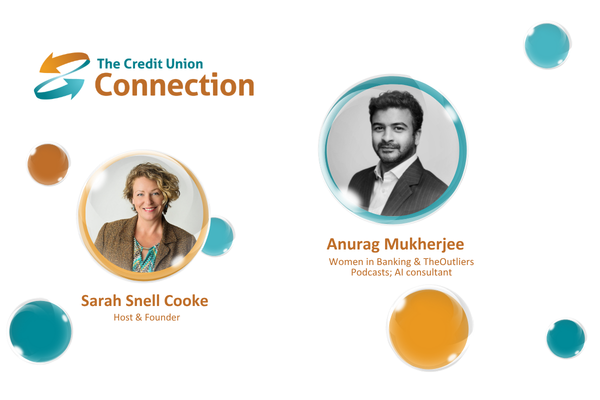
In a recent episode of The Credit Union Connection podcast, host Sarah Snell Cooke caught up with tech consultant, AI strategist, and double-podcast host Anurag Mukherjee to talk tech, talent and why credit unions need to hustle if they want to survive.
Mukherjee—who spent over a decade in traditional consulting for Fortune 500s before officially “drinking the credit union Kool-Aid”—broke down the good, the bad, and the painfully slow in the financial sector.
Want to catch the full conversation on member acquisition, generational wealth transfer and why the US payments system is lagging behind the rest of the world? Tune in to the latest episode of The Credit Union Connection podcast today!
NOTE: This transcript may contain minor imperfections courtesy of our AI overlords-in-training. We’re not complaining. We’re definitely not complaining.
Sarah Snell Cooke: Hello, and welcome everyone. I am, of course, Sarah Snell Cooke, your host here at The Credit Union Connection. I am joined today by Anurag Mukherjee. Welcome.
Anurag Mukherjee: Thank you, Sarah. Appreciate it.
Sarah Snell Cooke: Happy to have you here. You work, I mean you are the host of two of your own podcasts, Women of Banking and The Outlier. You work in AI, so you’ve got a very interesting and diverse background. Why don’t you do a little more, and maybe a better introduction of yourself and what you do?
Anurag Mukherjee: So this is what I exactly get. I ask the same thing to my guests. The first question is talk about your journey, right? So yeah, I’m Anurag. I’m 32. Actually, I’m 33, but I still tend to slash my age by a year, so I’m 32.
Sarah Snell Cooke: You’re a baby. Shut up. Go on.
Anurag Mukherjee: Right? Based in New York. So my career has been through and through consulting, almost 11 years in consulting. Started my career back with Accenture doing strategy consulting back in India. Moved to Dubai for a while, then moved to US five years back, close to.
So I was nowhere close to credit unions, right? I was always working for the Fortune 500s. Started working for oil and gas, retail, telecom, media, even aviation, right? And then finally moved on to banking. I worked with street banks and with tier one banks, but it is just around three years back I fell in love with credit union, or I call myself I drank the credit union Kool-Aid, and possibly I don’t think I’ll be able to go out of this ecosystem.
So pretty much my day starts with credit unions and ends with credit union, if that’s what you want to hear about. Apart from that, my day job is I work with credit unions, from all sizes, 4 to 5 billion assets, to one of the largest credit unions, top 10 credit unions, helping them with their data AI analytics maturity strategy.
Apart from that, I have two podcasts. As you mentioned, Women of Banking, we’ve done 180 episodes, released 130, 32 actually as of today. And the other one is The Outlier Podcast. We’ve done 120 plus episodes, released 100 of them. So long story short, recorded 300 plus episodes of podcast in the last two years.
I hope that was quick introduction. I don’t want to just blabber about my introduction. Let’s keep it short.
Sarah Snell Cooke: Blabber, blabber, blabber. So what do you think is the most fascinating thing, generally speaking, not necessarily credit unions, but what is the most fascinating thing about AI right now?
Anurag Mukherjee: That’s a very broad-based question, right? Now, the way how human interaction has changed. Now, what do I mean by that? With LLMs coming in, it has touched across all facets of my life, right? Starting with developing a product. I can do it myself. Do I really need a big group of engineers do it? Not really. I can do it myself. That’s one. Time to market for any idea, from idea till deployment, that has slashed very less. So ideation to creation, that’s one. I’m fascinated. I could never think that I can build, develop whatever, in a week’s time. That’s really fascinating to me.
That’s one. Second, with that coming in, obviously there are multiple other nuances to it, right? Now the other side of the house, the fraudsters or the people who do crime, right? That’s also increasing, and it’s very difficult to go and put a tab on them. So every coin has both the side. It helps you do bunch of things that you could not do, but now because of that, there are other after effects.
So long story short, for me, the most fascinating thing is that finally I can find a smarter Anurag who can give me better answers, for the lack of better words, and consistently. It’s not, I don’t have to wait for a human emotion, for emotion to go up and down. I always have Claude who gives me consistent answers. Consistency is a really important key that I found out. I don’t know if that answers the question because it’s a very broad-based question, how, what fascinates me the most. I would think time to market for anything that you want to develop.
Sarah Snell Cooke: No, I think too, the back office work of any organization, and we’ll start leading toward credit unions, is the ability of AI to make it easier for an organization to be more member-focused, customer-focused, human, more human, because they’re not doing the boring paperwork stuff anymore. Which not only, I imagine, puts people in a better mood, but also it saves time for the more what needs human touch. And okay, I’m gonna switch gears then and narrow it down. How about as it pertains to credit unions?
Anurag Mukherjee: It’s fascinating, right? I strongly feel there are two or three layers where AI will really change the way how we are perceiving things.
One is across acquisition. Credit unions still struggle to acquire members in a cost-effective way. So gone are the days of just running a email campaign or a digital campaign without measuring ROIs and successes.
With AI coming in, I think firstly, the reach-out strategy to acquire new members, that’ll get much sharper. So in that way, you’re getting, it’s a very wrong way to look at it, better quality member. Better quality member by spending less amount of money. So your cost of acquisition will slash a lot. Because earlier, I’ll give an example. Earlier, when we were building machine learning models from scratch, for example, for targeting of new prospects, it would take months to go and build it.
Now, with AI coming in, you can just fast-track and make it in a couple of days, right? So one, that will get improved a lot in terms of acquisition. Cost of acquisitions will go down, route one. Second, another unsexy part that we don’t talk about is operations, right? Since it doesn’t touch and feel members, so operations becomes always a backseat for investments, right? Be it reconciliation, be it even fraud. Fraud is increasing. We’re spending money on fraud a lot. But on back-office operations, we don’t spend money a lot. But now, with AI coming in, a lot of it can be automated to a huge extent, right?
So in that way, the unsexy part of the business, I think, will go away. It’s not we’ll have everyone in those departments go. Not really. But we can have those employees do some other things where they’ll get more value out of it, right? So in credit unions, I think, yes, growth will really happen if you use AI the right way.
And second, that’s more of top line, right? And for the bottom line, essentially if you can automate bunch of operational, mundane activity, starting with reconciliation to disputes to fraud, that can add a lot to your bottom line by reducing your operating expenses.
Sarah Snell Cooke: Yeah, for sure. I think fraud is a very interesting topic in this area. I was talking to somebody this morning about, he actually does some AI work for us, and he was talking about how the Mythos version of Claude, excuse me, is it basically was able to outsmart itself as far as cybersecurity. And it, so it knows the flaws that are built in. At the same time, it’s also building and responding to new… It’s just a big circle, and I’m sure, like I said, you can explain it better than me. But it was really scary. It’s like Skynet is here, honestly.
Anurag Mukherjee: I think, to your point, I would differ in something. So is Skynet here? Maybe not, because I’m a strong proponent of human in the loop. I mean you still need a human in the loop for doing any single thing. Your members can interact with a chatbot. The sad part of trade unions is you talk about AI, half of trade union executives talk about, “We have a copilot, right?” I’m like, “Seriously? Is that AI for you?”
Sarah Snell Cooke: Yeah. We have a chatbot. Yep.
Anurag Mukherjee: Yeah. I’m very sorry to say, guys, that’s not even AI. That’s not even use of AI. That’s 1980s, right? Now it’s 2026. So anything you do, I think there has to a maker-checker still there. A human in loop still has to be there. Elon Musk talks about might be, yes, there’s a probability that machines might turn against humans, like Terminator. Yeah. It might happen, but if we let it happen, that’s the basic thing, right? There has to be enough guardrails. There has to be enough, I would say maker-checker approaches, to let not that happen, right? So I would, again, I’m a proponent of, yeah, everything AI, but you still need a human in loop in whatever you’re doing.
Sarah Snell Cooke: Yep, for sure. And the other thing you talked about is back office. I had a consulting client maybe five-plus years ago who was doing robotic process automation, and it was such a difficult sell because it was not sexy. It was not one of those sexy member-facing things. And we really need to think about how much better can you serve the member because your people are freed up to have time to do that, because the AI or the RPA is doing a small part of that. Again, making credit unions more human, I think. So what… I’m gonna go to the flip side. What scares you most about banking in the current tech revolution?
Anurag Mukherjee: Ability to move fast. Now, why do I say that? When you go to an average credit union or a community banking website, it sucks. Let’s put it right? No, no argument here. Yeah, no argument. I’m very vocal about it. I love credit unions, but I call speed as speed. As simple as that. It sucks. Now, my question is, I don’t have time to figure out where do I go and apply for a credit card. It has to just come out right now to me. Just an example. Or I don’t have time to spend two hours to complete a mortgage application, right? It has to happen quicker, right? So inability to move fast and improve experience is my biggest concern, right? Because of that, will I park my money in a credit union if the experience is not sexy? Hell, no. I’ll go to Chime.
Sarah Snell Cooke: Yeah.
Anurag Mukherjee: I’ll go to SoFi.
Sarah Snell Cooke: My daughter-in-law did the exact same thing when I introduced her to our credit union.
Anurag Mukherjee: Yeah. It’s “Why?” I don’t owe anything to anyone. I’ll park my money where I’ll find it quicker to move money from point A to point B, right?
So that’s my biggest concern. If we do not seriously still think about improving experiences, it’s a nightmare, right? And we can talk about how good we are, but believe me, all of us are same. We have the exact same products with the exact same thing, that we are for members, we think about members.
And what is the difference that 4,500 credit unions are? All are same. Unless we differentiate that this is what we stand for, it’s very difficult to, not even win the race, run the race. The number of credit unions that were there have reduced to half. And with M&As happening, this will even continue.
I think the large players should really think about upping their game and at least reaching to the level of a regional or super regional bank. Otherwise, it’s very difficult. I mean, I’m just being as candid as possible.
Sarah Snell Cooke: Yeah, no, love that because yes. I feel like, and to get to your, I guess dig a little more into your point about the credit unions now offering exactly the same things, and what I see and speak on a lot is branding. And so it’s if you’re not leaning into that branding right now, look at companies like, I think it was Chime, that was first offering the get your paycheck two days early. That only happens once, and they built a brand around that that Gen Z and millennials love. And leaning into your brand with something a little more meaningful would be very helpful for credit unions. And I don’t know, I’m just speaking now, but any thoughts on that too?
Anurag Mukherjee: I would say yes. Branding is very important. I’ll give you an example. A friend of mine who got his mortgage from a Bay Area-based credit union, none, I’m naming the credit union, a credit union in the Bay Area. He didn’t even know that these guys have a credit card. I asked him, now, if you got a mortgage from this, these guys pay you so much of money, helped you, why do you use a credit card? Why do you still use a Chase Sapphire? Why do you use a top 10 bank where your APR is skyrocketing? Why can’t you use a credit union?
He didn’t even know that, and he earns half a million. Of my same age.
Sarah Snell Cooke: The business services are not any better either.
Anurag Mukherjee: Exactly, right? Now, it, firstly, even before branding, the biggest problem is awareness. No one knows what a credit union is. Yeah, if, no disrespect, yeah, if you’re in a small town in Alabama, then yeah, then probably you will know. But I’m based in New York. I don’t even know a credit union that’s nearby me. I can only see a Chase or a B of A. I’m not bashing, but I’m frustrated. I want to take the movement ahead. Help me do it. If we are not doing it, then someone else will eat our lunch, right? What do we do about that?
Sarah Snell Cooke: I’ve been saying that for 27 years. So I wanna go back a little bit to AI, since I went off on my tangent, my usual tangent. But, so what is the final outcome for AI? Seriously, it could maybe not be great, but it could do pretty much anybody’s job one way or another eventually. And so what is the ultimate future of AI in general?
And I think it’s important for credit unions to think about, too, because these are their members. It’s not just them and how they use it. Their members’ jobs could be going away, all that sort of thing. And so how, what is the ultimate outcome? Is it dystopia?
Anurag Mukherjee: Let me quote IBM, right? Since I come from consulting. So CEO of IBM talked about, I think, 30% of people of IBM will be let go because of AI. I might…
Sarah Snell Cooke: Saw that, yeah.
Anurag Mukherjee: I might grossly overstate or understate the number, but I think it was close to that. IBM, no offense, guys. My numbers can be wrong, but your CEO talked about this, and that’s reality.
So if you ask me what is my POV, yes, we have to be ready towards this change, right? If you still think that, “No, what was happening five years ago will still continue happening,” then you’re either under the cave or under the rock, because things are changing so fast, right? If you do not embrace yourself to change, you’re still falling behind. But for me, since I focus on delivering business impact, I come from the for-profit area and came to credit unions two years back. For me, still, EBIT makes sense.
I know for credit unions it doesn’t really matter, but still, you need to run a shop to deliver value to your members. If you’re not profitable, then what are you even doing? How are you running the shop, right? For me, AI can do anything, but at the end of the day, this needs to be tied to P&L. You should be able to justify whatever AI investments you are doing. Either it grows your top line or it improves your bottom line. Unless it’s directly impacting both, either top or bottom line, you’re just wasting your money. You can still experiment on 10 use cases, but those use cases still need to be very focused towards improving something, either top or bottom line. Otherwise, it’s an experiment. Now, people can talk about if the entire world thinks like me, then an Anthropic or OpenAI would have never been created, because they are experiments. Guys, yeah, they are experiments. They’ve got billion dollars, trillion dollars based in Bay Area. They’re funded by VCs, right? We are not. We need to spend every single dollar very carefully in AI that delivers impact and not with just another shiny vendor coming in and talking about, “Yeah, we’ll change the entire ecosystem because we are AI.”
Sarah Snell Cooke: And that is what credit unions are supposed to be doing, returning the most value to the member. So it makes perfect sense. Credit unions and AI make perfect sense together. So now I’m gonna totally shift gears on you.
Anurag Mukherjee: Sure.
Sarah Snell Cooke: You have these two podcasts, which I’ve been on at least one of them, anyway. And why podcasting?
Anurag Mukherjee: Interesting. So couple of reasons. One is I was that introvert, geeky, nerdy kid in school who used to get straight A’s in mathematics and computer science. So that’s my background, and then suddenly one day I wanted to become a journalist. I wanted to go to NYU, I wanted to work for BBC, Al Jazeera, I wanted to become a journalist traveling the world. But obviously in India what happens, Sarah, you either become a doctor or you become an engineer, or you don’t become anything else.
So my parents were kind enough not to listen to me and send me to engineering school, so I become a computer science engineer, to realize that I want to do something else in life. So that urge of becoming a journalist always stayed back with me. So that thirst never quenched. Then I started working in Wall Street.
I started working for larger banks to realize that representation of women leaders, women in leadership is very less in large banks. Then I came to credit unions to realize that for smaller credit unions, yes, you’ll find a lot of women leaders in C-levels, but for midsize to large ones, still not.
So the genesis of the idea of Women of Banking came from that, that how about creating a platform for women leaders to come and share their journey, the successes, their wins, their failures? And it was an experiment, right? And it just worked out without any expectation. So because of that reason we want to do Women of Banking as a tribute to my mother. Back in India, she started STEM 35 years back in India, when studying was not, when STEM was very difficult back in India. So that’s Women of Banking.
And the other podcast, the Outlier Podcast, the backstory of that is I’m a brand guy. I’m a huge brand marketing guy who never went to a business school. I always believed I don’t need to go to business school to learn brand because it comes naturally to me. I love Apple. I love simplicity. I love how simple products are. So Apple had an ad called Think Different that talked about honoring outliers, honoring people like Mahatma Gandhi, Martin Luther King, Richard Branson.
So I got inspired by that ad of Apple. And I wanted to do something with that ad. This was literally a Saturday evening in downtown, getting drunk, idea of Outlier Podcast. Started the Outlier Podcast, texted a couple of friends, started the podcast called Outlier where I want to honor people who are outliers, right? Who do not fit the mold, because I’m a rebel, I don’t really care. So I want to get people like me who are rebels, who do not care about societal norms, to come and talk to me. So that’s the reason for the Outlier Podcast. It was a long-winded answer, but why podcast is that.
Sarah Snell Cooke: Yeah. No, that’s awesome. And so you also alluded to, you travel a lot, you’ve lived in different places. What still surprises you about US banking?
Anurag Mukherjee: Payments. Very slow payments. It sucks. I’m sorry to say, but it’s reality, right? Real-time payment is still in progress, whereas the entire world has moved to a different level altogether. So what I’m sad about is real-time payments. We should do a better job in that, when the rest of the world is moving leaps and bounds. So that’s one thing that sucks about US banking.
But rather, on the flip side, the good thing is about access to credit. Not a lot of country has this amount of access to credit, right?
Sarah Snell Cooke: Too much sometimes, I feel like.
Anurag Mukherjee: That’s good, right? At times I feel it’s good, right? In such a huge democracy, in such a democracy, we enable Americans to go and live the American dream. And there always will be some financial institution or the other who’ll support you with your first car, with your first mortgage. That’s very important. The way how this country has shaped up the middle class by giving them, handing over actual money to build something for themselves, that is, I think, incomparable. No country on the earth has been able to do it, and I’m so proud to call this country my home. That’s the reason.
Sarah Snell Cooke: That’s awesome. That’s awesome. We’re both running out of time here. How about a quick final thoughts as we leave? What would you like to tell our Credit Union audience today?
Anurag Mukherjee: Be flexible, be agile, and keep your eyes and ears open, otherwise your lunches will be eaten by the top 10 banks and the fintechs and you won’t even realize that, right? Be flexible, be agile, and don’t think whatever worked 20 years back will work now. Things are changing. Focus on strategy of acquisition for Gen Z because if you’re not attracting them, it’s difficult. Focus on generational wealth transfer. If you’re not able to capture that, God help you.
Sarah Snell Cooke: All right. Thanks so much. Appreciate it.
Anurag Mukherjee: Absolutely, Sarah. Thank you. Thank you for having me.