

In early 2020, a small credit union in Beaver, Pa., collapsed. Insider theft. Federal liquidation. A town of 4,400 people lost an institution that had been woven into its fabric for five decades.
The trade media covered it briefly. Then everyone moved on – except Andy Janning.
The result is Overdrawn, a serialized investigative documentary podcast and Andy’s most extensive project yet. Season one features a Pennsylvania credit union’s collapse as an entry point into something much bigger: crime, cost and consequence.
Join the Overdrawn podcast waitlist today! Click here.
Two things stood out as Andy’s boots hit the ground in Beaver.
First, six years later, people are still angry. Not distant, historical anger, but raw, lingering anger. This wasn’t just numbers on a spreadsheet. It happened to real people, and they haven’t moved on.
Second, a striking number of people don’t want to talk about it at all. Doors closed. Messages ignored. Not hostile, just unwilling. That reluctance became its own storyline; one Andy is determined to understand rather than dismiss.
“I don’t want to re-litigate the case,” Andy said. “This isn’t gotcha journalism.” Instead, he wants listeners to sit with the complexity of the human toll and the ripple effects that outlast headlines. Andy wants us to look closer.
This isn’t Andy’s first documentary project. He previously created Side Effects, a seven-part National Credit Union Foundation documentary on the financial toxicity of cancer and has worked with the TriUnity Foundation to support members facing terminal illness. Overdrawn represents a natural next chapter in that storytelling career—one focused on what happens when trust is broken.
Listen to the Season 1 trailer at overdrawnpodcast.com.
And be sure to watch Andy’s full conversation with Sarah Snell Cooke to hear why this story found him, what makes it the hardest project he’s ever worked on and why he still believes credit unions’ best days are ahead.
NOTE: This transcript may contain minor imperfections courtesy of our AI overlords-in-training. We’re not complaining. We’re definitely not complaining.
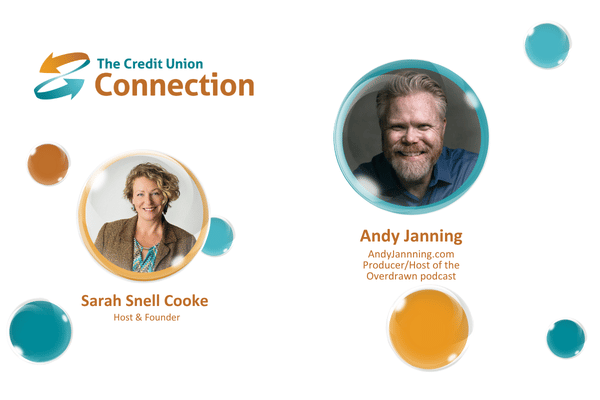
Sarah Snell Cooke: Hello, and welcome everyone. I am Sarah Snell Cooke, your host here at The Credit Union Connection. I am joined by the famous Andy Janning. Welcome.
Andy Janning: Good to see you, Sarah. How are you?
Sarah Snell Cooke: I’m great. I’m great, and we see each other all the time now. We’ve been working together on this podcast, Overdrawn, which is very different from anything that’s ever been in credit unions. So Andy, I don’t know if you want to give a little background on yourself, and maybe just a blurb about the podcast so we don’t ruin the rest of the show.
Andy Janning: First of all, I appreciate it. Thank you so much for calling me the famous guy and letting me blush and turn the shade of the chair that’s behind me. That’s going to be great tape. I’ve been in credit unions for almost three decades now, and love this industry, love what it’s about. If we’re talking about people helping people, we’re talking about being cooperative, I love all elements of it.
With this particular show, I want to be able to tell stories about what happens when we don’t always live up to our principles. I think that’s a story that we have to talk about as well. What fills in that breach? What fills in that gap? Before I get into the premise of the show, I want to be really clear that this first season is about a really tragic situation that happened to a small credit union in Western Pennsylvania, but it also showed me some of the best elements of our industry as well. That’s been a really powerful thing to experience.
Overdrawn, like you mentioned, is a serialized investigative documentary podcast. That’s a lot of words to say that this isn’t just two people sitting in a studio talking about stuff. This is long-form documentary work to talk about a situation that at the time didn’t really get a lot of attention. It’s about the liquidation of a credit union in Western Pennsylvania that went under in early 2020 at the height of the pandemic. A couple years later, more came out about what happened at that credit union, which was basically a case of insider theft. The trades ran with it, it made a few headlines here and there, but then everybody moved on.
My interest in this is going back to find out what happened afterwards. How did it affect the people of the town? The town that this happened in is called Beaver, Pennsylvania. It’s only about 4,400 people. It is the quintessential American small town, and this particular credit union was tightly woven into the fabric of this town for over five decades. When something like that goes away, there’s a cost. What rushes in to fill that up, and what does it leave behind for everybody else? This show is about crime, cost, and consequence, and that’s what this first season is going to be all about, using this case of a small credit union in Western Pennsylvania as the entry point.
Sarah Snell Cooke: Now, you don’t have to give any details, but I would like to know how you’re defining cost and consequence.
Andy Janning: I’m putting it first and foremost in human terms. Yes, we can look at the spreadsheets and we can see from a dollar standpoint what happened and what caused the collapse, and those were the numbers that really got people’s eyebrows shooting to hairlines. But for me, first and foremost, it’s about the human toll that this took. What happened to the credit union that had to pick up the pieces from this? What happened to people in the town that were affected by the collapse of this credit union? What happened to the people at the center of it?
Those stories really haven’t been told. So I want to find a way to bring those narratives out to show that when something like this happens, there’s a ripple effect that lasts far longer than the headlines do. I think that’s instructive for us certainly as an industry, but I think it’s also useful for us as human beings to realize that there’s far more going on underneath the surface than any of us know.
Sarah Snell Cooke: And I know from some of the little tidbits you’ve told me, it’s a lot. It’s like that image of the iceberg where only the top little peak is showing through.
Andy Janning: Well, if you go to the podcast website, overdrawnpodcast.com, the very top image is what looks like a ball of yarn with a little string pulling out of it. When you pull on it, you uncover a whole bunch of other stuff. That’s what has really been compelling about this for me: I went into this thinking it was going to be a pretty straight line story, and it’s not.
You pull on one thread, and four other things come out. When you pull on that and other things come out, there are real people at the end of that. There are real human lives at stake here. Balancing all of those perspectives is something that I want to do with this season. I don’t want to re-litigate the case. This isn’t gotcha journalism. But there’s far more complexity to it than people have seen, and it’s a far more compelling story than I thought. I’m hoping that listeners will agree.
Sarah Snell Cooke: Absolutely. Just so everybody knows, the season one trailer is out and up on the site that Andy just mentioned, overdrawnpodcast.com. Just another little plug there for you.
Andy Janning: Appreciate it.
Sarah Snell Cooke: One of the things you talked about in this last reporter’s notebook—which people should also be signing up for, I’ll include the link in this article—we have a wait list where you can get first little tidbits from Andy as well as get notified when every episode drops. Andy, can you give us something you haven’t shared yet in the reporter’s notebook?
Andy Janning: Two things have stood out to me. Again, I’m keeping a lot of stuff close to the vest because I do want to reveal it on the show, and there are still some facts I’m chasing down. But two things have really stood out.
One is that it’s been six years since this credit union collapsed, and people are still mad about it. I talked to some of the folks that have been associated with it, that were directly affected by it, and those emotions are still raw. The emotions are very much there. This wasn’t just something that happened on paper. This happened to people. That was the first surprising element to me.
The second was how many people still don’t want to talk about it. How many people basically have shut the door in my face, left me on read, or just ghosted me completely. They’ve all been very respectful about it, for the most part. I really haven’t had anybody saying anything really bad.
Sarah Snell Cooke: GTFO out.
Andy Janning: Yeah. But there is still, from the feedback that I’ve received from different sources, a pretty significant unwillingness to talk about this particular case. I think that is what has drawn me, no pun intended, to find out what that is, and challenge my own assumptions about why people may not want to talk about it.
Those two surprises are, in some ways, the narrative force behind what this season is going to look like. It’s a journey that has been the hardest story I’ve ever reported. It’s been the hardest documentary project I’ve ever worked on. It’s also been, arguably, one of the most fulfilling. Like I said, I can’t wait for listeners to come along with me.
Sarah Snell Cooke: So this isn’t your first rodeo either. You’ve done documentaries before. Why don’t you talk a little bit about your previous experience?
Andy Janning: I love telling stories. I love focusing on real people and talking about where they go, the point A to point B, and the messy middle. That has been infused in my career, first in talent development, and now in documentary storytelling and all this other stuff.
Back in 2019, my wife was diagnosed with cancer, and a few months afterwards, the National Credit Union Foundation gave me the opportunity. Gigi Hyland, who was the executive director at the time, said, “Hey, we want you to do a documentary about the financial toxicity of cancer.” One of the very first lessons I learned in documentary filmmaking is that when Gigi Hyland asks you something, you say yes, and you don’t question it.
That really gave me an opportunity to use my storytelling and documentary heart on a national stage and create a seven-part documentary called Side Effects, which I think remains one of the largest documentary projects ever done in financial services, to try and educate people about this problem that hides in plain sight.
From there, I’ve been able to work with and tell stories about the individual costs of cancer, and help work with the great folks at St. Cloud Financial Credit Union up in St. Cloud, Minnesota, to start a foundation called the TriUnity Foundation. It gives cash grants up to $10,000 to credit union members across the country who are in financial distress because of terminal cancer and other life-threatening illnesses.
I got to serve as their storyteller for a little while and document the impact of their work as well. Definitely link that in the show notes, triunityfoundation.org. They’re doing amazing work.
All of that to say, this particular project has always been on my bucket list—to be able to talk about crime, cause, and consequence. Those three Cs have been a bit of the green light out in the distance for me. So when I had the opportunity to put this together and then speak to you about it and say, “Hey, I’ve got this relatively nutty idea, do you want to maybe put it out there?” And when you said yes, I thought, “Okay.” For me, this is a natural progression in my storytelling career, and I can’t wait to see where it goes next.
Sarah Snell Cooke: Yeah, when you brought it to me, I was so excited. As you’ve gone along, I’m even more excited to be a distribution partner through The Credit Union Connection because it is nutty. It got nuttier, I think, than you expected even.
Andy Janning: It did. I also want to not get ahead of my skis here and make wild, outlandish claims to get a whole bunch of clickbaity stuff. That’s not what this is about. Again, this isn’t gotcha journalism. I’m not trying to say, “Well, I looked at this and I know better.” No, this is where the paper leads. This is where the people lead. This is where the stories lead. This is where the truth leads. What you do with that as a listener is completely up to you.
Why this happened in this particular town, there is definitely a through line. You can see the connections there, and I think it’s a journey that will definitely be worth people’s listens.
Sarah Snell Cooke: Yeah, for sure. Now, I think I’m going to step way back in history. I’ll bet you and I and only a few others are old enough to remember. So you started out as an HR person in credit unions. Forum Credit Union—a very progressive, larger credit union in Indiana. How did you get into doing storytelling, journalism, and documentary-kind of work? Because as a former recovering reporter, the ethics that were trained into me, you’re following all the rules, but maybe you came to it another way.
Andy Janning: FORUM Credit Union was better to me than I ever deserved. I got to work with literally an Indiana Credit Union League Hall of Famer, Jenny Budroe. She was my supervisor for my entire time there. Their CEO now, Doug True, is one of the best that our industry has ever seen. That entire culture and credit union gave me the opportunity to try new things, to rapidly prototype, break stuff, fail, and learn from it.
When they hired me in 1998, going way back when my hair was red at the time, they hired me to create their training department from the ground up. They had no formal training and were about $300 million in assets at that time. Collaborating with internal subject matter experts and building a team, we built a lot of programs that helped support their growth to $700 million in assets.
During that time, I got to scratch a lot of itches when it came to storytelling, using video and audio, and trying to tell what was really going on, not just talking about butts in seats or how happy people were with the programs. I got to really talk about, “Hey, this is where this person was. Here’s where they are now. Here was the effect of that.” We were really grateful to win eight state and national awards for excellence in talent development, which was nice validation.
I would not be speaking to you here today if I did not have that framework and foundation to be able to try a lot of things that I’m trying today at scale. They took a chance on me. Let’s be honest: I was working for a bank for 10 years before then, and I went to the interview with FORUM on a lark. There was an ad for a corporate trainer. I went to that interview thinking, “I’m not going to get it. This little rinky-dink credit union, I’m going to go in there and they’re not going to know what to do with me because I’m a big, bad banker.” Within one interview with Jenny Budroe, who served up the credit union Kool-Aid, I drank it and have not looked back since. A chance situation that I didn’t take seriously took me seriously, and I’m glad that it did.
Sarah Snell Cooke: For sure. Everybody who gets into credit unions, the credit unions get into them, I feel like.
Andy Janning: Right. Absolutely.
Sarah Snell Cooke: Yep. So how did that drive you to where you are now? Draw the straight lines for people.
Andy Janning: In 2012, I thought, “Hey, I’ve got a job that I could probably stay in until I retire. I’ve got a wife and two small kids. What would be the smartest thing for me to do? I know, I’ll start my own company.” Because, of course.
Since 2012, I’ve had my own business doing speaking, consulting, and leadership development—a natural continuation of all the things I did at FORUM. Then when my wife got sick in 2019, everything shifted for me. Not to say that anything I was doing before then didn’t have value, but it set me up for and crystallized what was important to me.
Going through that experience with my wife—who is the absolute single strongest and best human being I have ever met in my life—seeing what she went through and realizing that we weren’t the only ones, I wanted to document what she was going through while also connecting with other people and hearing their stories as well.
When she got sick, I did something called the Breast Cancer Portrait Project, taking portraits of people with breast cancer. Creative title, because I’m creative like that. I just did a photo shoot saying, “Hey, if you’re in the Indianapolis area and you have breast cancer and you want to have your portrait taken and share your insights, wisdoms, and journey, I’d love to hear it.”
That was an amazing time to photograph these amazing women and hear their perspectives. To see them come around my wife in between shots, listen to her, and become literally her pink sisters—that’s community. That’s people helping people. I thought, “I want to learn more about this. I want to honor what’s going on here.”
I documented my wife’s journey first and foremost as a way to heal and remember what was going on. Humans have an unparalleled capacity for forgetting. We are wired to forget our accomplishments and all the good things that happen. That’s why we say the days are long, but the years are short. I want to flip that. If I can do that with stories of real-life heroes who are laying out the best of themselves to make humanity better, while at the same time telling stories about when that breaks, why it does, and the very human reasons why, then that’s what pulls me forward.
I have no designs of being the next Ken Burns or any desire for fame and fortune. I just want to be able to tell good stories about great people.
Sarah Snell Cooke: And that’s exactly the line that brings you to today and into the Overdrawn podcast.
Andy Janning: Yeah.
Sarah Snell Cooke: But why financial crime?
Andy Janning: It’s one of the crimes that invites a lot of scorn and judgment. One of the big questions I get when I talk to people about this case or interview them is, “How’d you learn about this? Why are you talking to me?” They think, “We didn’t really want to talk about it.”
The more compelling reaction I get from people is, “Well, I can’t believe that person did that.” The other half of that sentence that they don’t typically say is, “Because I would never do that.”
When financial crimes hit, there is this sense of, “Well, I’m immune to it. Those people that did that, clearly something was wrong with them, but I’m better than that.” I’m not trying to shatter that preconception, but I am trying to say, “Let me look under the hood.” Because you’re going to find that there’s a lot more going on here than what you realized.
I’m not trying to prosecute or defend anyone. I just want people to have the full picture of what happens when something like this happens, because it’s not an easy answer. There are people directly associated with this case who to this day cannot give me easy answers, and it confounds them. That complexity and ambiguity is something to be examined carefully and humanely, so we can ask ourselves the question, “What would I do?”
Sarah Snell Cooke: Absolutely. Love that. As somebody who tries to tell stories, I love hearing yours. It’s so compelling when you go out and speak. And the voice! This is an audio podcast. That voice! If only you could get the hair in, too.
Andy Janning: It’s all Photoshop! That’s very kind of you to say. Thank you.
Sarah Snell Cooke: I remember when it was red, too.
Andy Janning: Redheads don’t go gray; we just go from red to white. When people ask what my hair color is and I say red, they look at me like, “Really? Are you really a redhead?” So I’m still holding onto a little bit there.
Sarah Snell Cooke: Yep, for sure. So Andy, I always allow my guests to have final thoughts, and you’re a recurring guest here. What would you like to leave our credit union audience with?
Andy Janning: This is still one of the best jobs in the world—to be able to work in and for credit unions. There is still so much promise and so much opportunity ahead of us. Yes, this particular show is talking about what happens when things break, but dark times are always followed by people’s brightest moments. Our industry was created to help people in the worst seasons of their lives, when financial hardship, sickness, and life are raining down on them.
I still believe in our movement. I still believe in our industry. I still believe that our best days are ahead of us. If the stories that I’m telling set in our little corner of the financial services pond can help us do that better, more responsibly, more transparently, more accurately, and more humanely, then that’s a pretty good day at the office.
Sarah Snell Cooke: Amen. Well, thank you so much for your time today, Andy. Appreciate it.
Andy Janning: Thanks, Sarah.
Other Andy Janning articles:
89% of Credit Union Stories are not actually stories
Life Over Debt Wins Gold At The Anthem Awards