

When it comes to digital transformation, today’s credit union members don’t compare their digital banking app to the local bank down the street.
They compare it to DoorDash, Amazon, and whatever app just delivered dinner to their doorstep in three clicks. In short: they want seamless, frictionless experiences, and they want them now.
So how do you roll out shiny new tech without accidentally replacing the “people helping people” secret sauce with a cold, unfeeling robot?
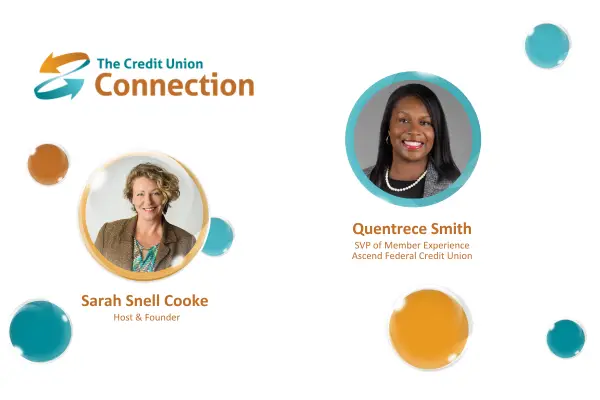
In this episode of The Credit Union Connection podcast, host Sarah Snell Cooke sat down with Quentrece Smith, Senior Vice President of Member Experience at Ascend Federal Credit Union, to discuss how the 75-year-old institution is navigating the digital age.
Check out how Ascend FCU tracks Member Effort Scores, aligns channels to eliminate friction and keeps employees around for 25+ years.
NOTE: This transcript may contain minor imperfections courtesy of our AI overlords-in-training. We’re not complaining. We’re definitely not complaining.
Sarah Snell Cooke: Hello, and welcome everyone. I am Sarah Snell Cooke, your host here at the Credit Union Connection.
I’m joined today by Quentrece Smith. Welcome.
Quentrece Smith: Thank you for having me. Glad to be here.
Sarah Snell Cooke: Absolutely. Totally awesome to have credit union lovers on the show. She is the senior vice president of member experience at Ascend Federal Credit Union. Why don’t you give us a little more introduction to yourself and the credit union?
Quentrece Smith: Sure. I have been with Ascend for 25 years. We were started in 1951 on Arnold Engineering Air Force Base in Tullahoma, Tennessee. We are actually celebrating our 75th year in July, so next month. So super excited that we’ve been able to serve the members in our community for 75 years, and I’m excited for the career that I’ve been able to build here over the last 25 years.
Sarah Snell Cooke: Yeah, that’s awesome. People tend to come to credit unions and get sucked in.
Quentrece Smith: Absolutely. Absolutely. It’s just a phenomenal place to work and a phenomenal industry to be within, and the ability that we have to be able to serve our members is just something that is near and dear to my heart.
Sarah Snell Cooke: Absolutely. We’re here today, we’re gonna talk digital transformation, which has been evolving over the last several years, but faster than ever because of the advent of AI and people starting to get comfortable with it within the credit union market. It’s being accepted as part of the business now.
So how is your credit union evolving with the digital transformation without harming a member-centric approach?
Quentrece Smith: Everything that we do, we look through the lens of what does it mean for the members. We try really hard to take their feedback, and implement that into whatever it is that we decide to roll out.
So we understand that they want technology to be able to make the everyday routine tasks easier and more convenient, but we also understand that they want that personal human touch as well. Finances are so complex, and we wanna be able to be there with them and partner with them in the ways that matter to them, and in the channels that matter to them as well.
Sarah Snell Cooke: Mm-hmm. And so in the first part of that question, how is your credit union evolving in the digital space?
Quentrece Smith: Any time that we can implement a process or a policy or a product that’s going to allow our members to be able to have their needs met in a way that is meaningful to them, we try to do that.
So for example, we have interactive teller machines. They’re our teller line, basically. And that allows us to be able to serve our members from 7:00 AM in the morning to 7:00 PM at night, Monday through Saturday. So that technology allows us to have a centralized place with local people to serve our members across our 28 locations that are not all in the same place.
So we’re able to use that technology and leverage that convenience and that seamless experience to them, no matter where they may be throughout our branch network.
Sarah Snell Cooke: Yeah. Yeah. Those things are awesome. I like playing with them at my credit union. Members, and particularly young adults, all talk about wanting seamless experiences, and so how do you make that happen?
How do you test and evaluate?
Quentrece Smith: So we try to be sure that we are not only looking at what’s important to the members in the financial space, but they are going to expect that experience to mirror what they may see with other industries. To them, they’re not thinking about, “Oh, I expect my financial institution to behave in this way, but I expect to be able to order food from a platform another way.”
They want that seamless, easy, frictionless experience. And so whenever we’re looking at delivering solutions, we’re looking at it also through that lens as well to make sure that we’re meeting what their expectations are, because most consumers are not thinking about it in different buckets of industries.
They just want that to be seamless and frictionless, no matter who they’re doing business with. And so we try to keep that in mind as well.
Sarah Snell Cooke: Yeah. We’re no longer competing with the credit union or the bank up the street. It’s everybody everywhere all the time.
Quentrece Smith: Absolutely. Yeah.
Sarah Snell Cooke: So how do you prioritize your tech investments?
Say you have these five things you wanna do, how do you decide where to start?
Quentrece Smith: We really, like I said, listen to the members. Every credit union is going to be different, and so it can be easy to see different things that are coming down the pike and think, “Oh, we should invest in this,” or, “We should invest in that.”
But will it resonate with our members? Will it move the needle for them? And if it doesn’t move the needle for them or doesn’t resonate with them, that’s how we prioritize what we decide to invest in, just to make sure that it’s meaningful to the members that we serve, because that’s what we’re here for every day.
Sarah Snell Cooke: And part of that, too, as you evolve through your digital transformation, is ensuring proper employee training as well to make sure you get the best ROI out of the tech investments that you’re making. How does the credit union coordinate that type of work?
Quentrece Smith: We absolutely wanna be sure that if we have the opportunity to utilize any automation that can help make those routine tasks easier, that then allows us to upskill our employees.
That allows them to be able to provide that personal, knowledgeable, more in-depth service that the members expect. So really it becomes a return on investment because as those employees get career opportunities and career growth, they want to stay with the credit union. And so then that allows the members, when they come in or call in, to see and hear the same voices and faces.
And so that’s a return on investment because that allows us to be able to have individuals that love what the credit union stands for, and they wanna be here alongside us to serve our members.
Sarah Snell Cooke: Yes, that’s always… The people are so important in any kind of a tech evolution or revolution—ensuring that we can all use the technology and get the best out of it that we can.
So how do you align, then, member experience across all your various member-facing channels, and has that improved member engagement?
Quentrece Smith: Absolutely. So one of the things that we try to do is break down silos between different departments. We communicate. And so whenever we’re rolling out a process or a procedure or technology, we think about how will this resonate for the members between the different channels?
Can we move them consistently between channels, and that process be seamless? So for example, we have employees who chat with our members, and so we upskill them with the same level of knowledge that our branch employees have, our contact center employees have, so that if a member wants to engage in chat, we don’t have to move them to a different channel.
So we really try to communicate among departments and make sure that as we invest in technology, it’s going to be a consistent, seamless experience, no matter the channel that the member decides to interact with us within.
Sarah Snell Cooke: Yeah, that’s so important to building trust is that consistency everywhere. Have you looked at the member engagement numbers? Have they improved?
Quentrece Smith: They absolutely have. We look at NPS, we look at member effort score, we look at overall satisfaction. And so just having a dedicated focus to making sure that, again, we’re communicating and we don’t have these disjointed experiences, we can definitely tell that the members are experiencing the effort that we’re putting in to try to make that a seamless experience, no matter the channel.
Sarah Snell Cooke: And what are some of the critical KPIs that you have to track in doing the whole process, basically?
Quentrece Smith: So we look at net promoter score. So would a member be willing to promote us? And we look at that in all the channels. So we look at that in our branch channels, our phone channels, as well as in our digital channels if they’re interacting with us through our online banking.
We also, again, look at member effort score. So that’s them telling us how hard was it to do business with you. Was I able to do what I needed to do pretty easily? And those scores, for us, typically are above where we would want them to be. And so again, we keep a very close eye.
When I said earlier, we try to prioritize based on feedback, we really delve into those comments to try to see what are the members saying they like, and what are the things that they’re saying we can improve on. And that’s very important to us, to make sure we take that to heart.
Sarah Snell Cooke: Right. Right.
And I assume you’re also looking at the number of members who get through the call center, for example.
Quentrece Smith: Absolutely.
Sarah Snell Cooke: The line, and get their issue resolved, and then, but more quickly maybe than they would have in the past.
Quentrece Smith: Correct. So we do look at first call resolution. We look at the number of calls that are coming in.
We look at how often we have to transfer them or not. Because again, obviously, if we can help them in one channel, we want to do that. But there are gonna be times where it may require a little bit more specialized response, and so we’ll look at how often do we have to transfer, and is that an opportunity for us to then maybe upskill or add some additional knowledge sets to those individuals that are on that first line so that we don’t have to transfer members around.
Sarah Snell Cooke: Mm-hmm. And I assume this has deepened member relationships as well.
Quentrece Smith: Absolutely. Yeah.
Sarah Snell Cooke: Yeah.
Quentrece Smith: Absolutely. Because obviously we wanna be able to resolve whatever problem they’ve called in for or come into the branch for or chatted in for, and then that allows us an opportunity, if there’s a way, to put a product or service in front of them that can maybe keep them from having that issue again in the future.
We obviously want to be able to do that. But you can’t get to that conversation if you haven’t resolved the issue at hand first. They’re not gonna be receptive to hearing about a way to prevent it from occurring in the future if we haven’t fixed it for them the first time.
Sarah Snell Cooke: Absolutely. Yeah, that makes perfect sense. And I imagine too, it could increase your loan production, just being able to go through those faster.
Quentrece Smith: Absolutely. And so we have individuals in those channels as well that can assist members with loans. So really for us, again, it’s about trying to meet the members where they’re at, using technology where we can, so we can meet with members virtually, where they don’t have to come into a location if they don’t want to.
They can chat, they can call, they can come into a branch. And again, we wanna keep those processes as seamless as possible. So even if they do start on the phone and then they have to finish it in the branch, we want that branch employee to be able to use technology to pick up that application and finish it without having to do a lot of back and forth or without the member feeling like they have to repeat everything over again in order to be able to get their loan closed or their account opened. So again, we try to work very closely among departments to make sure those processes are seamless and we can move members as easily as possible within any channel.
Sarah Snell Cooke: Yeah. Nothing’s more annoying to me than when I have to write the address over and over again, that kind of stuff.
Quentrece Smith: Absolutely.
Sarah Snell Cooke: That goes on sometimes with mortgages and stuff like that. So we allow our guests to have the final thoughts here. What would you like to leave your credit union colleagues with today?
Quentrece Smith: I would say, again, as you invest in technology, think about what it means to your membership, how will it move the needle for them, but don’t ever sacrifice that personal member experience with technology.
As I stated earlier, finances are so very personal, and I like to call us the social workers of finance. When individuals are struggling with finances, it can impact so many different facets of their life. And so we don’t ever want technology to get in the way of us being able to be that partner with our members, be that trusted advisor, and we want them to always know that no matter how technology evolves, there will always be a personal touch to the way in which credit unions continue to serve their members.
Sarah Snell Cooke: That’s awesome. Thank you so much for your time today. Appreciate it, Quentrece.
Quentrece Smith: Thank you. I appreciate being here.