

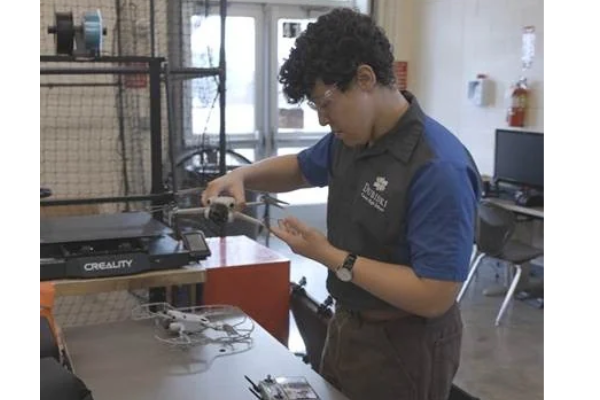
Custom stickers don’t usually make the headlines, but these do tell the story.
The drones and 3D printers at Dubiski Career High School now carry the logos of the Vought Heritage Foundation and a small thank-you for a big gift: a $20,000 grant from the Texas Trust Gives Foundation.
The money is going to the school’s newly renamed Pilot and Aviation Operations program of study in the Grand Prairie Independent School District (GPISD).
Two Local Names, One Matched Gift
The Vought Heritage Foundation put up $10,000. Texas Trust matched it dollar for dollar, which brought the total to $20,000. The two organizations share deep historical roots in the area, so the partnership has a hometown feel.
The grant supports the school’s Aviation and Engineering department, a competitive four-year STEM (science, technology, engineering and math) pathway. About 100 students from freshman to senior year move through it each year, training for college, a career or military service right after graduation.
Think of It as Stocking a Real Workshop
A school budget is a bit like a home kitchen: it covers the pots and pans, but nobody expects it to include a commercial-grade range. This grant bought that range. Here’s what landed in the classroom:
- A drone class set with a STEM project-based learning course, including an e-learning curriculum and a physical drone arena
- A Bambu Lab H2D 3D printer and premium filaments, adding 3D printing and laser engraving to engineering classes
- Windows-based Dell laptops with Intel Core 7 processors, powerful enough to run CAD and REVIT simulation software that standard school iPads can’t handle
- DJI Mini 4 Pro drones for professional-grade aerial photography, surveying and mapping
- 27 soldering kits and 25 Arduino microcontroller kits for learning circuit boards, robotics and coding
Students started using the gear this semester, beginning with building out drone components.
Why It Matters Here
School officials say the program is unique in the Dallas-Fort Worth Metroplex. It offers a full four-year path that mixes manned pilot concepts with unmanned drone technology. Roughly 40 percent of enrolled students are classified as at-risk, so hands-on, applied learning is a critical piece of keeping them on track to graduate and land careers.
“This grant has helped advance our Pilot and Aviation Operations program to a place we simply wouldn’t have been able to reach on our own,” said Dr. Larry Jones, GPISD’s Executive Director of Career and Technical Education. “It is providing critical, industry-standard resources that aren’t typically covered in a high school budget. As our students work on professional CAD software, program microcontrollers, and pilot advanced drones, it prepares them for high-demand careers upon graduation. We are deeply grateful to Texas Trust and Vought for investing in our students’ futures.”
Washima Huq of the Texas Trust Gives Foundation pointed to the shared history. “Texas Trust and Vought share a legacy built on local innovation and community strength,” she said. “By coming together to double this investment, we are equipping the next generation of aviation pioneers with real-world technical skills and tools that will give them a competitive edge in college, the military, and the modern workforce.”
Larry Skinner, director of the Vought Heritage Foundation, said experiences like these let students “discover their interests, develop problem-solving skills and see how classroom learning translates into real-world applications in the aviation field.”
What to Watch Next
The first test is what students build with the new equipment as the school year goes on, from finished drones to 3D-printed designs and CAD projects. Keep an eye on graduation and career-placement results in the program too, since those numbers will show how far a $20,000 toolkit can carry a classroom.