

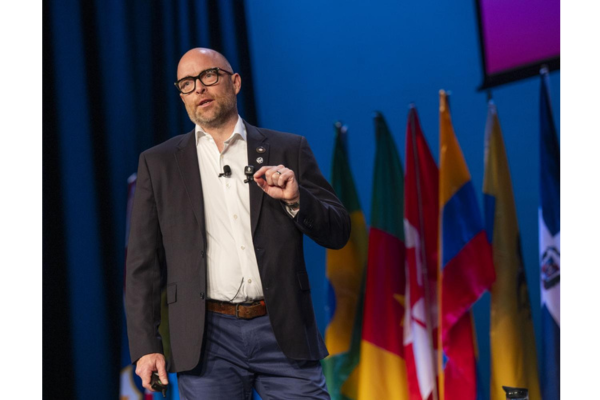
At this year’s World Credit Union Conference, Mike Reuter distilled an entire financial movement down to three words: Belonging. Possibility. Legacy.
As President of the Worldwide Foundation for Credit Unions, Reuter took the stage Tuesday with a message that hit different than your typical conference keynote. Instead of rattling off statistics or corporate platitudes, he asked the room full of global credit union leaders a simple question: Why did you choose this movement in the first place?
The answer to that question, he argued, should drive everything that comes next.
More Than Money: What Makes Cooperative Finance Matter
Here’s the thing about credit unions that often gets lost in the financial services shuffle—they’re not just another way to park your money. They’re a fundamentally different approach to finance, one built on the radical idea that people should invest in each other.
Reuter’s keynote, built around the Foundation’s 2026 theme “Tune In to Global Cooperative Finance,” hammered this home. He framed the entire cooperative finance movement as a chord held together by those three notes: belonging, possibility, and legacy. Remove any one of them, and the whole thing falls apart.
“Movement ownership fuels philanthropy, philanthropy fuels impact, impact deepens ownership,” Reuter explained. It’s a virtuous cycle, the kind that actually works when people commit to it.
Celebrating the People Who Are Building the Future
The best part of the keynote? Reuter didn’t just talk about abstract concepts. He put names and faces to the movement by recognizing the 2026 Global Women’s Leadership Network Scholars, the 2026 World Young Credit Union Professionals Scholars, and the newest International Credit Union Development Educator designates.
These aren’t just nice titles to put on LinkedIn. These are the people doing the actual work of expanding financial inclusion and cooperative leadership around the world.
And in a move that shows the Foundation is thinking beyond just one annual conference, Reuter announced plans for a new global community platform. Thanks to a generous donation from Sicredi, GWLN and WYCUP participants will be able to connect, collaborate, and mentor each other year-round.
“When a young professional in Indonesia can work through challenges with peers in Ecuador, Ukraine, Brazil or the United States, something shifts,” Reuter said. “New harmonies emerge.” (See what he did there with the “Tune In” theme? Pretty slick.)
From Spectator to Owner: The Challenge
Reuter wrapped up with a challenge that should make anyone in the credit union space sit up a little straighter. He didn’t ask attendees to simply support the Foundation or spread awareness about it. He asked them to own it.
“Don’t leave the Worldwide Foundation as something you know about,” he said. “Leave as an owner of it.”
That’s not just motivational speaker talk. It’s a direct call to action: invest in the leadership development programs, support global financial inclusion initiatives, and embrace philanthropy as the catalyst that turns good intentions into lasting impact.
The After-Party With Purpose
The focus on leadership didn’t end when Reuter left the stage. Later that day, the Worldwide Foundation hosted the Global DE Social, supported by Velera and TruStage. This wasn’t your average networking event with sad conference center appetizers.
Development Education graduates from around the globe came together to reconnect, swap ideas, and officially welcome the newest 2026 International Credit Union Development Education designees into the fold. It’s the kind of community-building that turns a professional development program into an actual movement.
Because here’s the real takeaway from all of this: cooperative finance only works when people choose to actively participate in it. You can’t just show up, take notes, and go home unchanged. The movement requires owners, not spectators.
And if Reuter’s keynote accomplished anything, it was reminding a room full of global leaders why they signed up for this work in the first place—and giving them a roadmap for what comes next.
Related:
Credit Unions Need to Get Ready for Tomorrow—Here’s How the Global Movement is Stepping Up
How to Keep Your Credit Union Sharp in a World That Won’t Stop Changing