

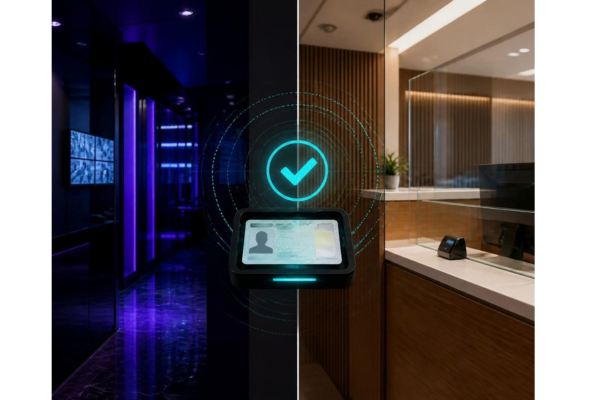
Veridocs, the physical ID verification company used across 95% of the Las Vegas casino industry, is now pointing its forensic-grade authentication tech at banks and credit unions.
The company has spent two decades checking IDs in places where a bad call gets expensive fast. Casinos handle huge crowds, big money and zero patience for fakes. That’s a useful résumé for banking, which is dealing with its own flood of counterfeit, altered, borrowed and stolen IDs. Think of it as the pit boss’s eye for a dodgy driver’s license, now stationed at the teller line.
The problem keeps growing
The numbers explain the timing. FinCEN’s latest analysis of identity-related activity found that it accounted for 42 percent of Bank Secrecy Act (BSA) filings. Meanwhile, Datos Insights estimates synthetic identity fraud (where criminals stitch together real and fake details to invent a person) caused nearly $3 billion in unsecured credit losses in 2025. That’s close to double the $1.8 billion recorded in 2020.
Banks and credit unions haven’t been sitting still. They’ve poured money into fraud detection. But most of those tools kick in only after identity information is already inside the workflow, which means a bad actor may have cleared the front door before anyone starts looking.
Checking at the first moment of trust
Veridocs targets that gap at the branch, during what it calls the “first moment of trust.” That’s the interaction that feeds a bank’s know your customer (KYC) and anti-money laundering (AML) processes. For customers who enrolled digitally, it also lets the institution close the ID verification loop whenever they next walk into a branch.
Here’s what the platform does, in seconds:
- Examines the physical ID under ultraviolet, infrared and white light, looking for security features counterfeits can’t replicate
- Compares the document against 4,500 government-issued ID templates
- Screens the individual against fraud databases and more than 1,000 global watchlists
Front-line staff get a clear pass or alert, so they can stop a false identity before it opens an account, cashes a check, buys a money order or completes another high-risk transaction. The system can also flag when the same person recently visited another location, which gives institutions cross-branch visibility into organized fraud.
“Every downstream decision at a bank or credit union depends on the identity first accepted,” said Joe Lynam, CEO of Veridocs. “Community banks and credit unions lose millions annually to synthetic fraud, but existing tools only catch it after account opening. We stop it at enrollment, before fraud has a chance to contaminate the system.”
From post-9/11 casinos to the bank branch
Veridocs launched in 2006, amid sweeping post-Sept. 11 changes to identity security and verification rules. It started by working with security teams at the largest Las Vegas casinos, automating ID checks and screening, then expanded to casinos worldwide. It later built its own authentication engine to catch counterfeit, altered and stolen IDs and to screen patrons against applicable watchlists. Today it authenticates more than 65 million IDs a year.
Verification without a data hoard
Veridocs logs who was authenticated, when and with what result, creating an evidence trail for compliance reviews and regulatory exams. It does not collect or centrally store consumer ID scans in bulk, and it does not record personally identifiable information (PII). The limited scans it does receive are heavily encrypted, individual samples used to train its models to spot new, altered or fraudulent IDs. Clients can opt out of sharing entirely. Deployments are tailored to each institution’s environment, and Veridocs advises clients to keep only the scans and data they need, and to encrypt what they keep.
“Our work in the demanding Las Vegas environment taught us that identity decisions must be accurate, fast and operationally practical,” Lynam said. “But trust also depends on what happens to the data after the scan. We designed Veridocs to minimize unnecessary data collection, help clients reduce exposure within their own environments and adapt as new threats emerge.”
Next up: watch which community banks and credit unions sign on first, and whether branch-level ID checks become a standard piece of KYC as synthetic fraud numbers keep climbing.