

James Chemplavil, Founder/CEO, Salus
Competition exists in every corner of the economy – from restaurants to manufacturing to hospitality, and especially financial services. While the products and services can differ, the strategies and lessons are often similar. Credit unions are making the same mistake that the 2nd most valuable company in the world made.
Google’s Trillion-Dollar Mistake
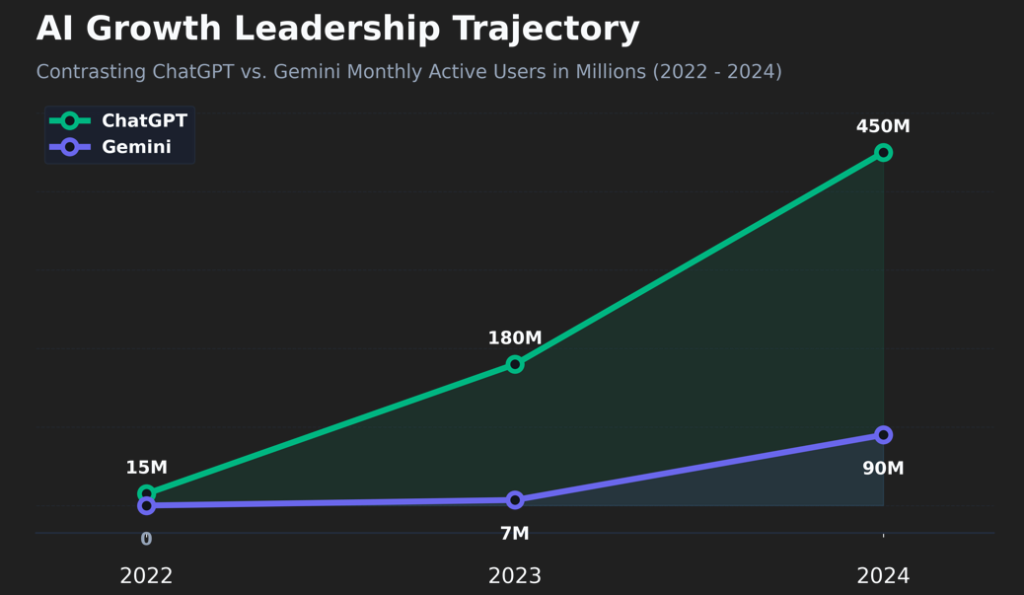
In 2022, Google was arguably the world’s most dominant company. Over 90% of all internet search volume worldwide was theirs. 71% of all phones operated on Android. Over 2 billion people worldwide watched YouTube, 10x the nearest competitor. And they had been developing something new for years – a chatbot. As opposed to the old way of search, this was a way for people to converse with their technology to get the answers they wanted. But Google decided not to launch it. And then, in November 2022, a company no one considered a rival to Google, OpenAI, launched a chatbot called ChatGPT. OpenAI grew from a $30 billion company to worth nearly a trillion dollars. Google’s 90% global search dominance? Eroded. And now, in 2026, Google has introduced AI overviews to catch up.
What happened? How did an incumbent like Google choose to cede this ground to an upstart? The answer sits in, of all places, a book: Clayton Christensen’s “The Innovator’s Dilemma.” In it, he explains the main reasons why established market players often miss out on new technologies.
“First, disruptive products are simpler and cheaper; they generally promise lower margins, not greater profits. Second, disruptive technologies typically are first commercialized in emerging or insignificant markets. And third, leading firms’ most profitable customers generally don’t want, and indeed initially can’t use, products based on disruptive technologies.”
On those three points, Google fell victim to the incumbent’s challenge with new products.
- The new product had lower margins than the current products. AI chatbot answers were generated using new technology. The cost structure was wildly different and less efficient than the costs of traditional search.
- The new product was first commercialized in insignificant markets. Early chatbot users were generally tech enthusiasts and younger consumers. They didn’t look enough like the current customer Google served.
- Today’s most profitable customers can’t use it. AI chatbot answers didn’t look like search results. They couldn’t be used to sell ads like traditional search. And Google Search was the company’s most profitable product.
Google focused on how a new product compared to what they already had, instead of thinking about how it would help them compete in the future. They chose to focus on the existing business model. They ceded new customers to the competitor, and now they’re fighting to keep existing customers.
And credit unions are repeating the same mistake.
Microloans and Credit Unions’ Dilemma
As credit unions think about strategies to engage new members, they naturally compare them to the existing set of products and services. And credit unions often think about new products like microloans the same way that Google thought about ChatGPT.
- The new product is lower margin than the current products. Microloans are smaller and shorter-term than personal, auto, and mortgage loans. Net interest income dollars are smaller than credit unions’ traditional loan offerings.
- The new product is first commercialized in insignificant markets. 88% of microloan borrowers are Gen Z and millennials (median age of 29), and most credit union members are older.
- Today’s most profitable [members] won’t use it. The average credit union member is in their 50s. They are half as likely to struggle with small-dollar financial emergencies than Gen Zs and Millennials, so it feels like most of the membership isn’t clamoring for the product.
Credit unions are falling victim to the same dilemma that froze Google, with similar consequences. New member growth in three digital neobanks over the last two years has nearly doubled the growth of all credit unions combined.
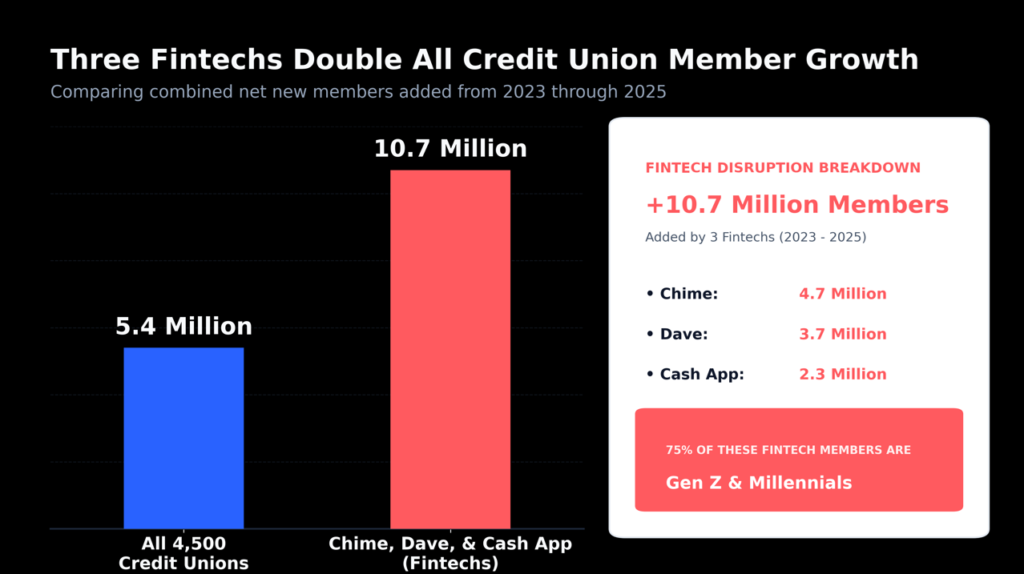
And similar to other examples of disruptive technology, these new kinds of services attract more than just the early adopters. In Chime’s most recent earnings, they noted that their fastest-growing segment is now consumers making $75,000 or more; meaning the market for their services is far from “insignificant.”
What Can Credit Unions Do
There’s a silver lining in the story. Google missed the early opportunity, but it still had several advantages in its core assets and capabilities (infrastructure, other products that users can leverage, etc.). Total Gemini users in 2026 are now catching up to ChatGPT, boosted by these advantages.
Credit unions have similar advantages: trust in security, a community-focused ethos that resonates with consumers, and the slate of products that young members will eventually grow into. And credit unions that have embraced products focused on today’s member needs are seeing real growth. A path forward exists that ends in success for credit unions. But it requires looking past the formula that has “always” worked and seeing what will work in the future.
Partner With Fintechs To Disrupt the Disruptors
Credit unions don’t have to build solutions from scratch to compete with fintechs and neobanks. Collaborative fintechs can help credit unions offer tested, cutting-edge solutions that level the playing field. The Salus platform delivers solutions like earned waged access and more, so credit unions can meet younger members where they are. When you’re ready to make Gen Z members for life, check us out to learn more.